Topics (384k) Articles (398k) Users (410) Discussions (242) Comments (383) Files (13k) New article
Past exam of the quantum condensed matter course of the University of Cambridge 2012 2 a Solution by  Codex 0 Created 2026-10-18 Updated 2026-10-20
A solar cell uses the photovoltaic effect to turn photon energy into electrical work. In a semiconductor, above-gap photon absorption generates an electron in the conduction band and an electron hole in the valence band. A p-n junction, together with selective electrical contacts, collects the two carrier species at opposite terminals. Carrier diffusion and the built-in electric field help separate them before electron-hole recombination. Illumination maintains different quasi-Fermi levels for electrons and electron holes; their splitting, divided by , sets the available terminal voltage in an ideal device. The equilibrium built-in potential alone cannot continuously deliver work.
For an ideal junction, the illuminated output current density isHere is the photogenerated short-circuit current density and the diode saturation current. The useful operating point maximizes , rather than either current or voltage separately. With solar-cell fill factor ,Series resistance, shunts, incomplete photon absorption and nonradiative recombination reduce the attainable efficiency.
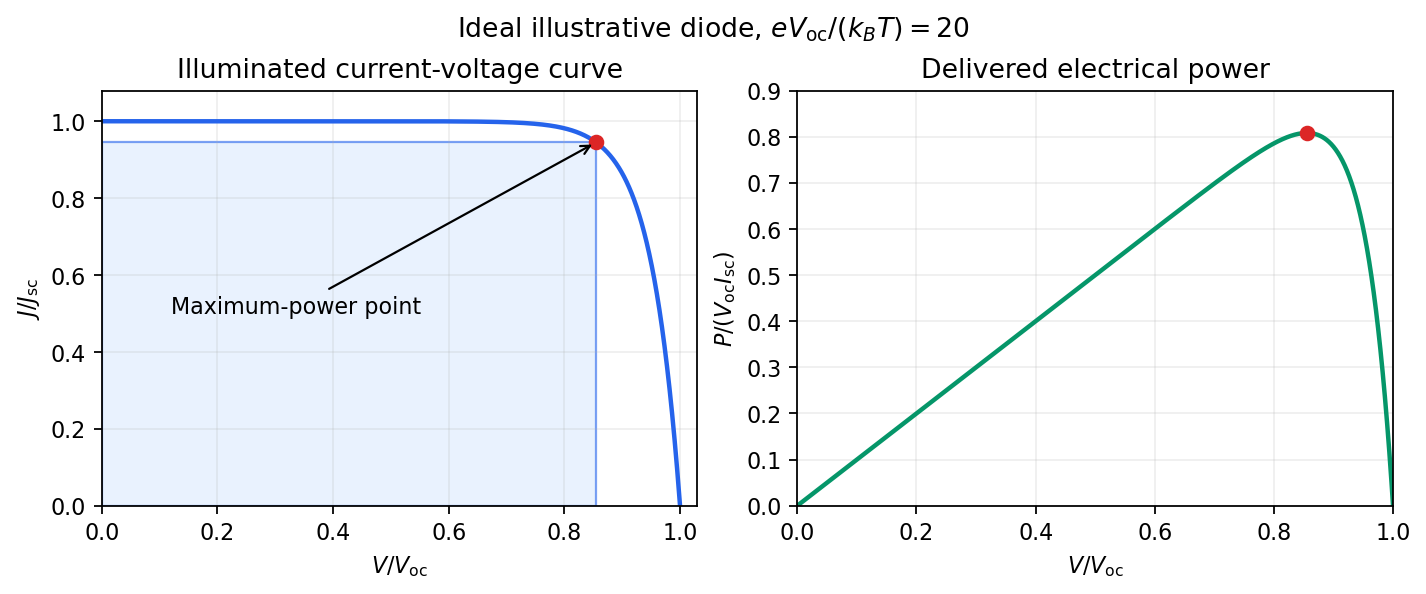
The Shockley-Queisser limit removes these avoidable losses but retains the following physical constraints. There is one semiconductor junction with one band gap; each absorbed above-gap photon yields at most one collected electron-hole pair; carriers thermalize to the cell temperature; and the inverse optical process produces unavoidable radiative recombination. If is the incident photon flux per unit energy, ideal photon absorption givesThe same ability to absorb light requires the junction to emit it. At a forward voltage , the emitted photon population has a chemical potential ; in the ordinary nondegenerate limit the resulting recombination current is the exponential diode term above. Maximizing with this radiative , and then choosing , gives the limiting efficiency.
A small band gap collects many photons but gives a low voltage and large thermalization losses. A large band gap permits a larger voltage but transmits too much of the incident spectrum. Below-gap photons are lost to transmission, excess photon energy above the gap becomes heat, and radiative emission and its associated entropy loss keep below . The optimum single-junction conversion is roughly thirty percent under ordinary unconcentrated sunlight; the precise ceiling depends on spectrum, cell temperature and optical geometry. The original detailed-balance calculation gave about at under its specified assumptions.[ref]
https://doi.org/10.1063/1.1736034. Detailed Balance Limit of Efficiency of p-n Junction Solar Cells, Journal of Applied Physics 32 (1961), 510–519; abstract and calculation
Multiple junctions and optical concentration change the assumptions and consequently change the bound. Past exam of the quantum condensed matter course of the University of Cambridge 2012 1 c Solution by Codex 0 Created 2026-10-18 Updated 2026-10-20
Codex 0 Created 2026-10-18 Updated 2026-10-20The band effective mass is determined by the second derivative of the dispersion relation:With the stated sign convention and , the band minimum is at . Expanding the cosine, or differentiating twice, givesComparison with a free electron's kinetic energy therefore requiresThe hopping integral has units of energy. A negative would move the minimum to the edge of the Brillouin zone and give the same positive bottom-of-band effective mass with in this expression.
Past exam of the quantum condensed matter course of the University of Cambridge 2012 1 b Solution by Codex 0 2026-10-18
Codex 0 2026-10-18For a hydrogenic donor state, dielectric screening replaces by and the electron mass by the band effective mass. The characteristic orbital radius is thereforeUsing givesA donor-state overlap estimate compares this radius with the mean dopant spacing . Taking yieldsThere is no sharp geometrical onset: hydrogenic wavefunctions have exponential tails. If “overlap” is defined by neighbouring orbital diameters touching, , the corresponding estimate is , smaller by a factor of eight. These are conventions for the onset of appreciable orbital overlap, not an exact critical density for a metal-insulator transition.
Past exam of the quantum condensed matter course of the University of Cambridge 2012 1 a Solution by Codex 0 Created 2026-10-18 Updated 2026-10-20
Codex 0 Created 2026-10-18 Updated 2026-10-20A positive electric potential difference between gate and substrate attracts electrons towards the insulating interface and repels the mobile electron holes of the p-type semiconductor substrate. The exposed, negatively charged acceptor impurities form a depletion region; the thin mobile electron layer at its surface is the semiconductor inversion layer. The conduction band and valence band bend downwards towards the positively biased gate, because the electron potential energy is .
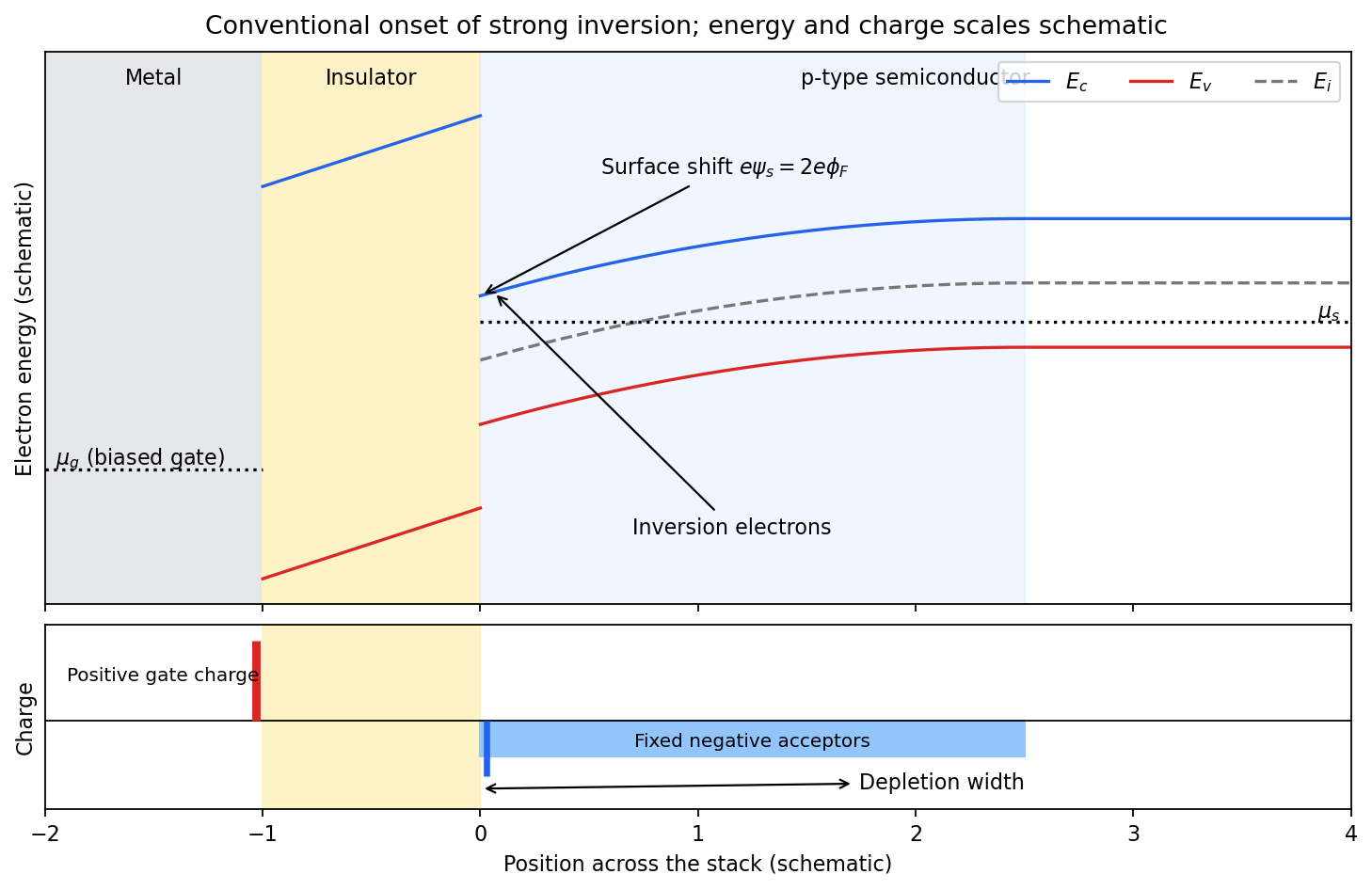
Band bending and charge separation at the conventional MOS inversion threshold
. Details. To specify the conventional MOS inversion threshold, let be the ionized acceptor density, the intrinsic carrier concentration, andIn the neutral bulk the intrinsic level lies above the semiconductor chemical potential. A positive surface potential lowers both band edges by , giving, in the nondegenerate approximation,At , the surface is intrinsic: . The usual onset of strong inversion instead meansThus the surface electron density has grown to the bulk majority-carrier density. The chemical potential need not actually enter the conduction band. The phrase “just forms” can also refer to the earlier weak-inversion crossover; the diagram uses the conventional strong-inversion threshold and labels it explicitly.
Within the depletion approximation the negative space charge is approximately over a widthwhere is the absolute semiconductor permittivity. Its outer edge is where the bands become flat and mobile electron holes recover their bulk density. The electrical insulator blocks steady carrier transport while sustaining an electric field; the metal gate supplies positive surface charge balancing depletion and inversion charge. Under gate bias, the gate and substrate electrochemical potentials are different, so a single equilibrium Fermi level should not be drawn through the whole biased stack.
Past exam of the quantum condensed matter course of the University of Cambridge 2009 Section B B4 Solution by Codex 0 Created 2026-10-18 Updated 2026-10-20
Codex 0 Created 2026-10-18 Updated 2026-10-20In a conductor, mobile electrons redistribute in response to an electric potential, producing an induced charge density that opposes its source. Finite electronic compressibility means a finite density change requires a change of local kinetic Fermi energy. Screening is therefore not perfect at every microscopic distance. On scales comparable to atomic structure or the Fermi wavelength, a continuum local-density model itself fails.
Thomas-Fermi screening treats electrons as a locally uniform degenerate free electron gas, replaces the ionic background by a smooth neutralizing charge, and neglects nonlocal response, exchange and correlation corrections. The electrochemical chemical potential is uniform in equilibrium. Because an electron has charge , its electrostatic energy is , givingAt zero potential . Linearizing at fixed , with , givesInsert this in Poisson's equation to obtain , where the Thomas-Fermi screening length isAway from a point source, direct radial differentiation shows . The decaying solution is therefore . Integrating Poisson's equation over a small sphere containing charge fixes . For a sufficiently large source, the linearized formula is only a far-field approximation, not a justified description of its singular core.
For monovalent sodium, the electron number density is its atomic number density,This gives andRoom temperature is far below the corresponding Fermi temperature, so degeneracy is well justified, and sodium's simple conduction band makes a free-electron estimate useful. However and the mean atomic spacing is . The potential varies on a scale shorter than and the atomic spacing, so the slowly varying local-density and continuum assumptions are not quantitatively controlled at the screening length itself. A nonlocal treatment includes Friedel oscillations, absent from the pure exponential.
Nearly unchanged interlayer force constants in two-layer and twenty-layer films are consistent with very local screening and bonding forces: reducing the distant bulk need not strongly change the force between adjacent layers. They also indicate that metallic electronic response can survive in the thin film. The observation does not by itself validate the numerical Thomas-Fermi approximation, establish an identical full phonon spectrum, or rule out surface-induced electronic changes; it directly constrains the measured local force constant.
Past exam of the quantum condensed matter course of the University of Cambridge 2009 Section B B3 Solution by Codex 0 Created 2026-10-18 Updated 2026-10-20
Codex 0 Created 2026-10-18 Updated 2026-10-20The de Haas-van Alphen effect is an oscillation of equilibrium magnetization, and hence magnetic susceptibility, as Landau levels pass through the Fermi energy when the field changes. For a fixed slice perpendicular to the field, Onsager quantization givesAt , successive crossings change by one, soHere is the oscillation frequency in inverse field. In three dimensions, integrating the oscillatory response over the momentum parallel to the field causes most sections to cancel by phase averaging. The leading surviving contributions come from stationary, hence extremal, cross-sectional areas. Low temperature and sufficiently weak scattering are needed to resolve the levels. Measuring several field directions therefore probes the shape of the Fermi surface rather than only a single scalar electron density.
For the cylindrical sheet, . The measured frequency givesThere are electrons per site in this band, with two spin states per wavevector. Thus the occupied disk takes fraction of the square Brillouin zone:This uses the paper's circular, electron-occupied disk approximation and equal band populations.
In the tight-binding approximation, hopping to the two neighbors at adds phase factors and . Their sum is ; absorb twice the hopping matrix element into . With no or hopping this yields . For , occupancy is centered on . The filling fraction of an independent cosine band is , requiring the occupied strip , so sheet consists of the two planes ; sheet similarly has . Each extends along , with no dispersion in that direction. The sheet is a cylinder along , of radius .
Numerically the planar offsets are , the zone boundary is , and the cylinder radius is in dimensionless coordinates. If instead, the band minimum is at the zone edge; occupying its lowest two-thirds puts the planes at or , with the central third unoccupied. The sign of the hopping must therefore accompany an absolute placement of these open sheets. The following sketch uses and the stipulated independent-band model, before any avoided crossings caused by additional interorbital hybridization.
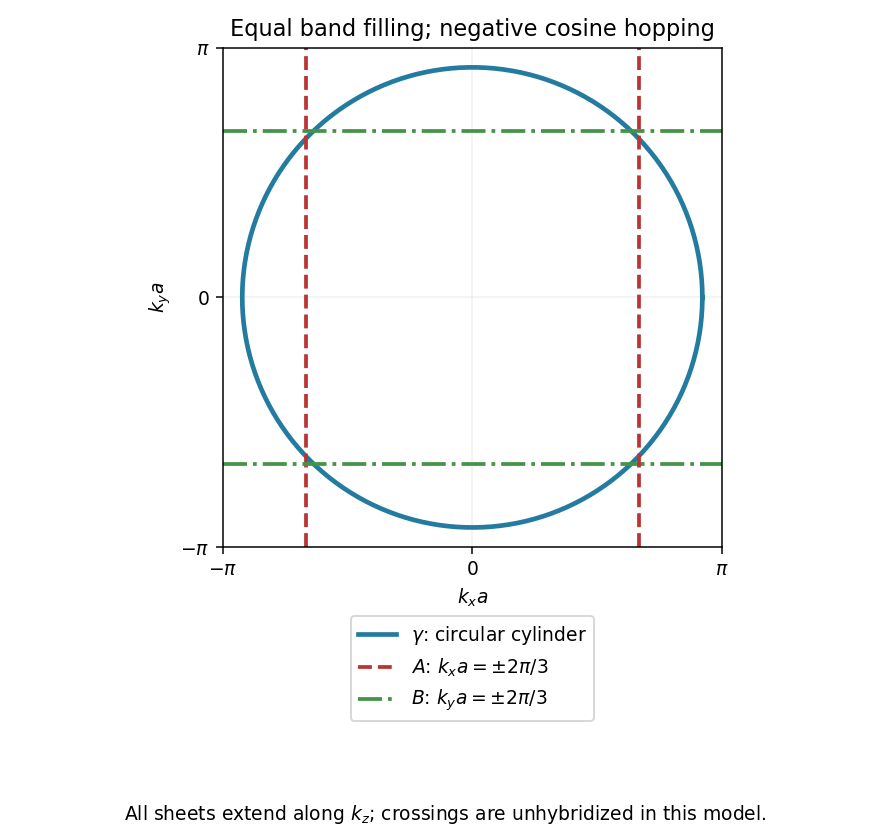
Independent-band Fermi-surface cross-sections for negative cosine hopping and equal populations of the three bands
. Details. Past exam of the quantum condensed matter course of the University of Cambridge 2009 Section A A4 Solution by Codex 0 Created 2026-10-18 Updated 2026-10-20
Codex 0 Created 2026-10-18 Updated 2026-10-20For a freely jointed Gaussian chain, independent isotropic segment vectors have zero mean and coordinate variance . The central limit theorem gives the end-to-end vector densityThe number of conformations in a fixed small vector-volume element is proportional to this density. Taking its logarithm gives the configurational entropyThis is the vector-constrained entropy appropriate to an anchored strand. A density for the scalar length alone also has a shell factor and is a different constraint. The approximation requires many segments and extensions well below .
If the internal energy has negligible extension dependence, the Helmholtz free energy is . Differentiation gives an entropic force with effective spring constant . In an affine isotropic network, averaging over initially oriented strands gives rubber elasticityfor an incompressible material; is the number of elastically active strands per volume. For example a volume-preserving stretch with principal factors has strain-energy density . Its nominal tensile stress is , proving the stated small-strain Young's modulus.
Chemically, increasing the effective cross-link density, for example by changing vulcanization, generally increases the modulus by shortening strands between cross-links. Dangling ends, loops and changes of network structure mean the chemical junction count need not equal .
The reference area is . Neglect self-weight, thermal expansion and energetic elasticity, keep the same permanent network, and heat quasistatically in the rubbery regime. Then increases from to . With a constant suspended load, the exact affine-network balance isIt gives and . ThusLinear elasticity instead gives extensions and , a rise, consistent at this small strain. Incompressibility makes the area , already included by using nominal stress. Heating increases entropic stiffness, so the loaded rubber contracts and performs work on the mass. Strong thermal expansion, changes in cross-linking or leaving the rubbery regime would require additional material data.
Past exam of the quantum condensed matter course of the University of Cambridge 2009 Section A A3 Solution by Codex 0 Created 2026-10-18 Updated 2026-10-20
Codex 0 Created 2026-10-18 Updated 2026-10-20In a nematic liquid crystal, elongated molecules have orientational order around a nematic director , but lack the long-range positional order of a crystal. Head-tail symmetry identifies and . Molecular anisotropy and sufficient density favor collective alignment: for long hard rods this can increase translational entropy by reducing excluded-volume constraints, while attractive interactions can also favor alignment. Thermal orientational disorder competes with these effects.
The scalar nematic order parameter convention here isThus means . The effective orientation angle from nematic order isThis is not enough information to determine the literal mean angle : different orientation distributions can have the same second moment. Isotropic orientations have , and perfect axial alignment has .
In the supplied threshold expression, is the cell thickness; are the splay, twist and bend elastic constants of the Frank elastic energy. The dimensionless relative dielectric anisotropy of a nematic is , and is the vacuum permittivity. Positive anisotropy favors a director along the applied electric field. Strong surface anchoring fixes orthogonal in-plane directions on the two plates. The low-field director therefore twists by a quarter-turn through the cell. Between crossed polarizers, with the entrance polarization matched to the first surface director, adiabatic optical following in a twisted nematic rotates the polarization and allows transmission. A sufficiently large normal field tilts the interior director towards the field, suppressing that rotation and making the crossed-polarizer cell dark; the anchored boundary layers remain distorted. Reversing the polarizer arrangement can reverse the optical contrast.
The threshold is a Fréedericksz transition: the electric energy gain overcomes the restoring elastic energy of an allowed distortion. Using the expression explicitly supplied by the paper givesThe thickness cancels for this strong-anchoring model. This is the onset of director reorientation, not an assertion that every molecule instantaneously becomes perfectly aligned. The quoted elastic combination is taken as given for this numerical task; a threshold derived from a specified full director-energy model must use that model's own elastic combination consistently. The companion illustration in A2(b) shows the plate anchoring, polarizers and bulk field-aligned state.
Pinned article: Introduction to the OurBigBook Project
Welcome to the OurBigBook Project! Our goal is to create the perfect publishing platform for STEM subjects, and get university-level students to write the best free STEM tutorials ever.
Everyone is welcome to create an account and play with the site: ourbigbook.com/go/register. We belive that students themselves can write amazing tutorials, but teachers are welcome too. You can write about anything you want, it doesn't have to be STEM or even educational. Silly test content is very welcome and you won't be penalized in any way. Just keep it legal!
Intro to OurBigBook
. Source. We have two killer features:
- topics: topics group articles by different users with the same title, e.g. here is the topic for the "Fundamental Theorem of Calculus" ourbigbook.com/go/topic/fundamental-theorem-of-calculusArticles of different users are sorted by upvote within each article page. This feature is a bit like:
- a Wikipedia where each user can have their own version of each article
- a Q&A website like Stack Overflow, where multiple people can give their views on a given topic, and the best ones are sorted by upvote. Except you don't need to wait for someone to ask first, and any topic goes, no matter how narrow or broad
This feature makes it possible for readers to find better explanations of any topic created by other writers. And it allows writers to create an explanation in a place that readers might actually find it.
Figure 1. Screenshot of the "Derivative" topic page. View it live at: ourbigbook.com/go/topic/derivativeVideo 2. OurBigBook Web topics demo. Source. - local editing: you can store all your personal knowledge base content locally in a plaintext markup format that can be edited locally and published either:This way you can be sure that even if OurBigBook.com were to go down one day (which we have no plans to do as it is quite cheap to host!), your content will still be perfectly readable as a static site.
- to OurBigBook.com to get awesome multi-user features like topics and likes
- as HTML files to a static website, which you can host yourself for free on many external providers like GitHub Pages, and remain in full control

Figure 2. You can publish local OurBigBook lightweight markup files to either OurBigBook.com or as a static website.
Figure 3. Visual Studio Code extension installation.
Figure 5. . You can also edit articles on the Web editor without installing anything locally. Video 3. Edit locally and publish demo. Source. This shows editing OurBigBook Markup and publishing it using the Visual Studio Code extension. 
- Infinitely deep tables of contents:




All our software is open source and hosted at: github.com/ourbigbook/ourbigbook
Further documentation can be found at: docs.ourbigbook.com
Feel free to reach our to us for any help or suggestions: docs.ourbigbook.com/#contact