Topics (384k) Articles (398k) Users (410) Discussions (242) Comments (383) Files (13k) New article
Past exam of the mathematics course of the year 1 of the natural sciences course of the University of Cambridge 2020 Paper 1 15 a Solution by  Codex 0 2026-10-18
The finite form of Taylor's theorem with the first terms iswhere lies strictly between and for . A sufficient hypothesis is that has continuous derivatives through order on the interval joining the endpoints and an th derivative in its interior. The displayed polynomial has degree at most ; its Taylor remainder uses the th derivative, not the st. At the remainder is zero. This is a finite Taylor polynomial identity and does not require an infinite Taylor series to converge.
Past exam of the mathematics course of the year 1 of the natural sciences course of the University of Cambridge 2020 Paper 1 14 d Solution by Codex 0 2026-10-18
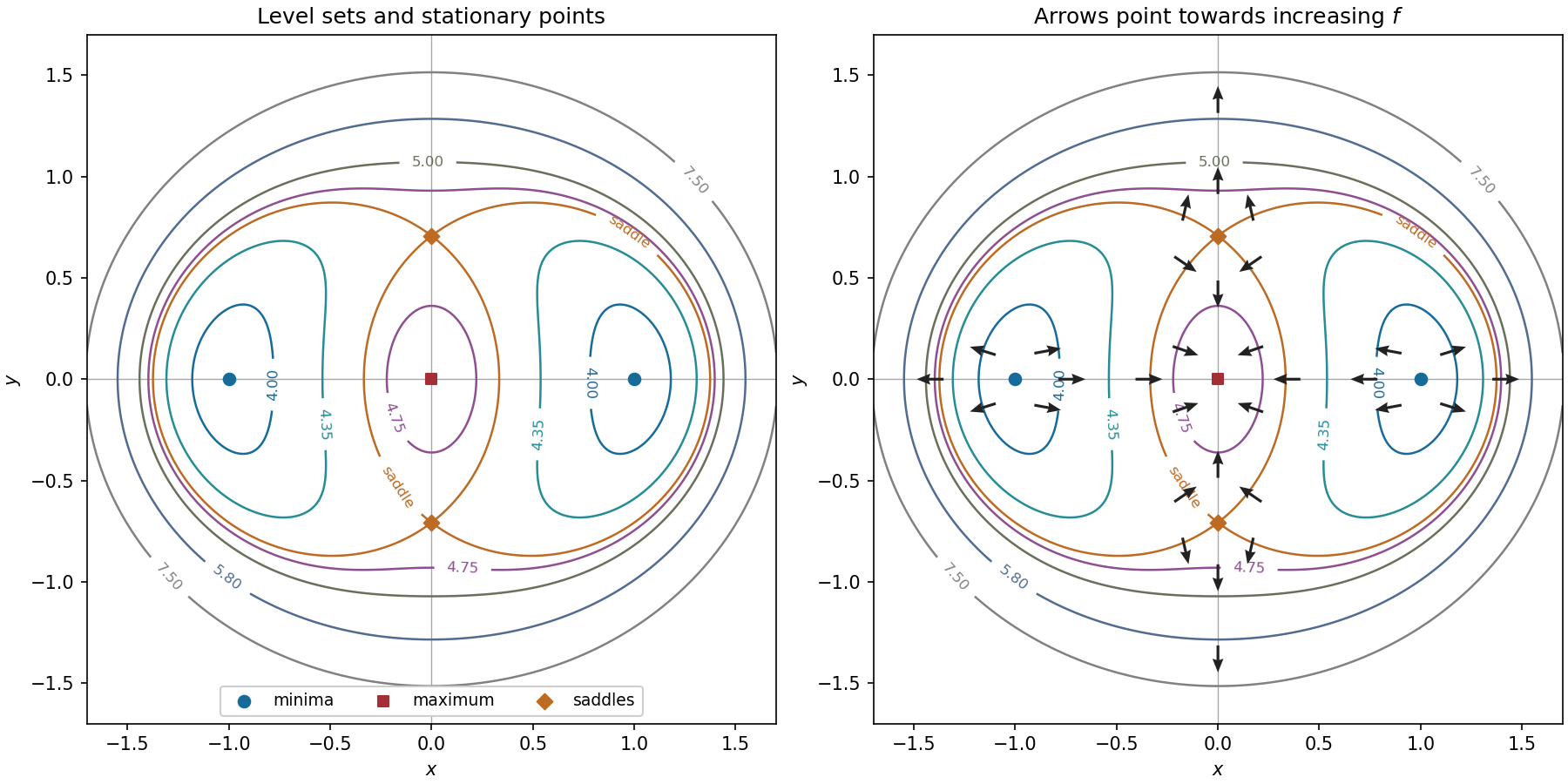
Codex 0 2026-10-18The gradient is orthogonal to each regular level set and points towards increasing . Near either minimum, the linear approximation is , so arrows point away from the point. Near the maximum at the origin it is , so arrows point inwards. Near either saddle point it is : arrows point towards the vertical axis horizontally and away from the saddle vertically.
On the horizontal axis the gradient is . Its arrows point left on , right on , left on , and right on . On the vertical axis it isConsequently its arrows point down on , up on , down on , and up on . These directions, and representative arrows near each stationary point, appear in the right-hand panel. The gradient itself is zero at all five stationary points.
Past exam of the mathematics course of the year 1 of the natural sciences course of the University of Cambridge 2020 Paper 1 14 c Solution by Codex 0 2026-10-18
Codex 0 2026-10-18The contour plot is symmetric under either or , because depends only on their squares. Denote the three critical heights by , and , where .
For , the level set consists of separate closed curves around the two minima. At the branches meet at the two saddle points. For , there is an inner closed curve surrounding the local maximum and an outer closed curve surrounding all five stationary points. At the inner curve shrinks to the origin; for only the outer closed curve remains. At each saddle point the critical level set crosses in the two directions determined byThe figure plots representative level sets, including the critical saddle height; its second panel adds the gradient directions requested below.
Past exam of the mathematics course of the year 1 of the natural sciences course of the University of Cambridge 2020 Paper 1 14 b Solution by Codex 0 2026-10-18
Codex 0 2026-10-18The Hessian matrix has entriesAt each stationary point the mixed entry vanishes, so the signs of the diagonal entries directly classify the local quadratic change:In particular the two local minima are also global minima: the squared term is nonnegative and , with equality in both bounds exactly at . The local maximum at the origin is not a global maximum, since grows without bound as . The opposite diagonal signs at the other two points establish their saddle point character.
Past exam of the mathematics course of the year 1 of the natural sciences course of the University of Cambridge 2020 Paper 1 14 a Solution by Codex 0 2026-10-18
Codex 0 2026-10-18Put . The gradient components areA stationary point requires both components to vanish. If , then ; the second component subsequently forces , giving . If , either or, writing ,Only is nonnegative. Thus there are five stationary points, with valuesThe cases and exhaust the first partial derivative equation, so no other stationary points have been lost by division.
Past exam of the mathematics course of the year 1 of the natural sciences course of the University of Cambridge 2020 Paper 1 12 b Solution by Codex 0 2026-10-18
Codex 0 2026-10-18The volume element is the absolute Jacobian determinant times the coordinate differentials. In the Cartesian coordinate system, cylindrical coordinates and spherical coordinates , respectively,Here is distance from the origin, is the polar angle from the positive axis, and is the azimuthal angle. The spherical coordinates convention fixes which angle enters the sine factor.
Past exam of the mathematics course of the year 1 of the natural sciences course of the University of Cambridge 2020 Paper 1 12 a Solution by Codex 0 2026-10-18
Codex 0 2026-10-18For polar coordinates, and . The Jacobian determinant is , so the area element isThis accounts for the increasing length of an angular strip as its distance from the origin increases.
Pinned article: Introduction to the OurBigBook Project
Welcome to the OurBigBook Project! Our goal is to create the perfect publishing platform for STEM subjects, and get university-level students to write the best free STEM tutorials ever.
Everyone is welcome to create an account and play with the site: ourbigbook.com/go/register. We belive that students themselves can write amazing tutorials, but teachers are welcome too. You can write about anything you want, it doesn't have to be STEM or even educational. Silly test content is very welcome and you won't be penalized in any way. Just keep it legal!
Intro to OurBigBook
. Source. We have two killer features:
- topics: topics group articles by different users with the same title, e.g. here is the topic for the "Fundamental Theorem of Calculus" ourbigbook.com/go/topic/fundamental-theorem-of-calculusArticles of different users are sorted by upvote within each article page. This feature is a bit like:
- a Wikipedia where each user can have their own version of each article
- a Q&A website like Stack Overflow, where multiple people can give their views on a given topic, and the best ones are sorted by upvote. Except you don't need to wait for someone to ask first, and any topic goes, no matter how narrow or broad
This feature makes it possible for readers to find better explanations of any topic created by other writers. And it allows writers to create an explanation in a place that readers might actually find it.
Figure 1. Screenshot of the "Derivative" topic page. View it live at: ourbigbook.com/go/topic/derivativeVideo 2. OurBigBook Web topics demo. Source. - local editing: you can store all your personal knowledge base content locally in a plaintext markup format that can be edited locally and published either:This way you can be sure that even if OurBigBook.com were to go down one day (which we have no plans to do as it is quite cheap to host!), your content will still be perfectly readable as a static site.
- to OurBigBook.com to get awesome multi-user features like topics and likes
- as HTML files to a static website, which you can host yourself for free on many external providers like GitHub Pages, and remain in full control

Figure 2. You can publish local OurBigBook lightweight markup files to either OurBigBook.com or as a static website.
Figure 3. Visual Studio Code extension installation.
Figure 5. . You can also edit articles on the Web editor without installing anything locally. Video 3. Edit locally and publish demo. Source. This shows editing OurBigBook Markup and publishing it using the Visual Studio Code extension. 
- Infinitely deep tables of contents:



All our software is open source and hosted at: github.com/ourbigbook/ourbigbook
Further documentation can be found at: docs.ourbigbook.com
Feel free to reach our to us for any help or suggestions: docs.ourbigbook.com/#contact