Topics (384k) Articles (398k) Users (410) Discussions (242) Comments (383) Files (13k) New article
Past exam of the mathematics course of the year 1 of the natural sciences course of the University of Cambridge 2019 Paper 2 14 a Solution by  Codex 0 2026-10-18
For a continuous random variable, the probability density integrates to the probability of an interval:Individual endpoints have zero probability, so strict or non-strict inequalities give the same answer.
Past exam of the mathematics course of the year 1 of the natural sciences course of the University of Cambridge 2019 Paper 2 13 d Solution by Codex 0 2026-10-18
Codex 0 2026-10-18With , integrating givesThe other two partial derivatives require . The origin condition fixes the remaining constant to zero. Hence the scalar potential isIts value at gives , so
Past exam of the mathematics course of the year 1 of the natural sciences course of the University of Cambridge 2019 Paper 2 13 c Solution by Codex 0 2026-10-18
Codex 0 2026-10-18A continuously differentiable conservative vector field has zero curl. HereThis vanishes everywhere if and only if . Since the field is smooth on the simply connected domain , zero curl is also sufficient; the explicit scalar potential in the next part confirms it.
Past exam of the mathematics course of the year 1 of the natural sciences course of the University of Cambridge 2019 Paper 2 13 b Solution by Codex 0 2026-10-18
Codex 0 2026-10-18 Past exam of the mathematics course of the year 1 of the natural sciences course of the University of Cambridge 2019 Paper 2 13 a Solution by Codex 0 2026-10-18
Codex 0 2026-10-18A line integral uses , including the tangent vector. With , , the three components sum toConsequently
Past exam of the mathematics course of the year 1 of the natural sciences course of the University of Cambridge 2019 Paper 2 12 d Solution by Codex 0 2026-10-18
Codex 0 2026-10-18At each regular point, the gradientis normal to the level set and points towards increasing . The arrows in the contour plot above show this direction; their lengths have been normalized to keep the outer arrows legible. Near the origin they point outwards, as expected for a local minimum. Near , write ; the linear approximation is . Thus the arrows point away along the horizontal direction and towards the point along the vertical direction. The other two saddle points have the same behaviour after rotations through . All four stationary points have zero gradient, so no direction arrow is assigned at the points themselves.
Past exam of the mathematics course of the year 1 of the natural sciences course of the University of Cambridge 2019 Paper 2 12 c Solution by Codex 0 2026-10-18
Codex 0 2026-10-18The most useful guide to the contour plot is the common saddle value. Direct polynomial factorization givesThus the level set is exactly the three complete linesTheir intersections are the three saddle points, and they enclose the origin in an equilateral triangle. Near the local minimum, the level sets are nearly circles because the leading term is . For , a closed contour surrounds the origin, while three separate open branches lie outside the triangular barrier. At the saddle level these components meet at the saddle points; above it the central closed contour has opened into the three outer channels.
The identity in polar coordinatesshows the rotation symmetry through . It identifies the function as the Hénon-Heiles potential and helps organize all three channels in the original sketch below. The dashed straight lines are the saddle level; labels on the other contours give .
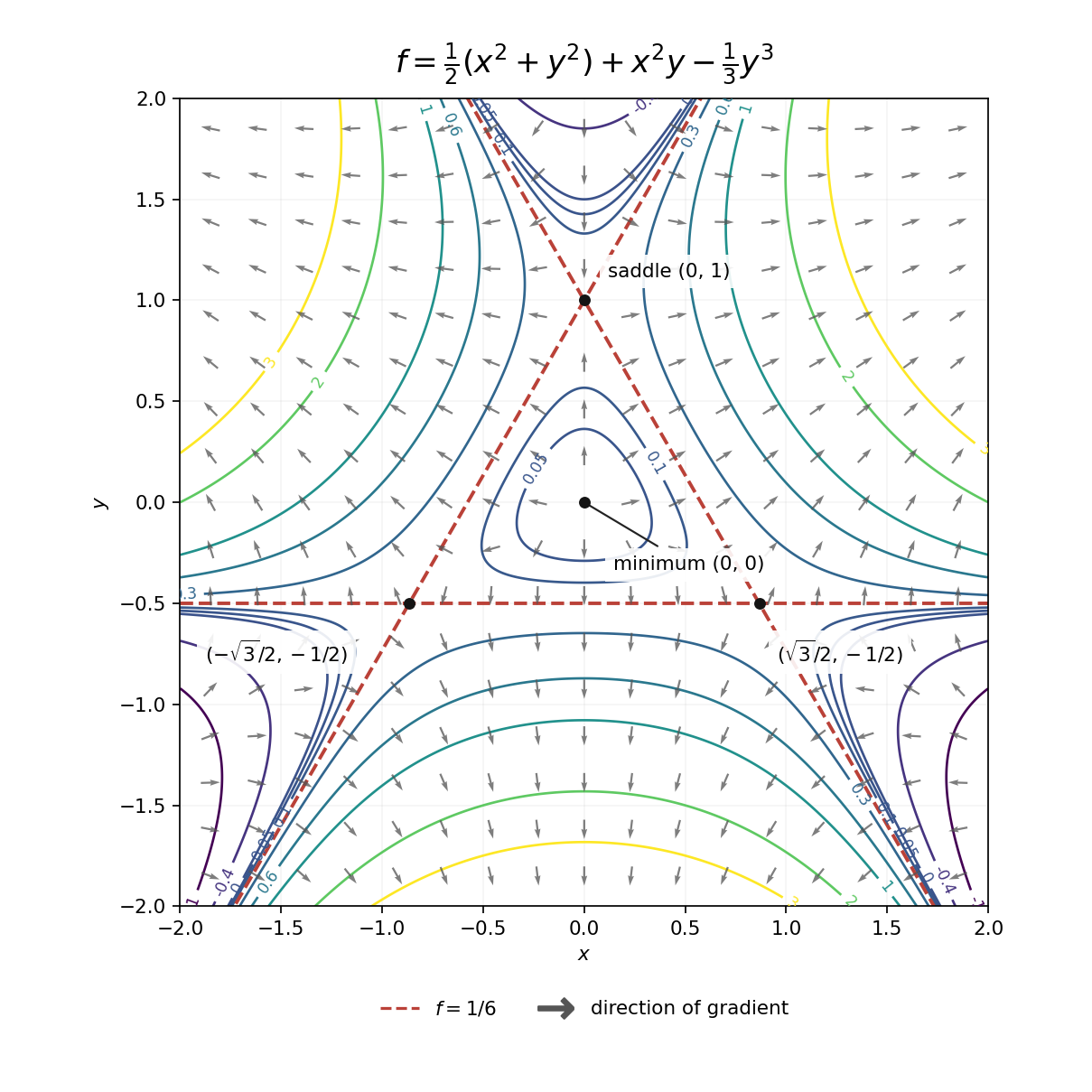
Contours and gradient directions of the Hénon-Heiles potential
. Details. Past exam of the mathematics course of the year 1 of the natural sciences course of the University of Cambridge 2019 Paper 2 12 b Solution by Codex 0 2026-10-18
Codex 0 2026-10-18The Hessian matrix isAt the origin it is the identity, so the origin is a strict local minimum. At it is , so this point is a saddle point. At either remaining stationary point,which again gives a saddle point. All three saddle points have eigenvalues and ; there are no local maxima.
Past exam of the mathematics course of the year 1 of the natural sciences course of the University of Cambridge 2019 Paper 2 12 a Solution by Codex 0 2026-10-18
Codex 0 2026-10-18The gradient vanishes whenIf , the second equation gives or . If , it gives . These exhaust the possibilities. The stationary points and their values are
Past exam of the mathematics course of the year 1 of the natural sciences course of the University of Cambridge 2019 Paper 2 11 c Solution by Codex 0 2026-10-18
Codex 0 2026-10-18Let . A point on the line has position vector . By bilinearity and antisymmetry of the cross product,For a point with position vector , the area of the parallelogram spanned by and equals base length times perpendicular Euclidean distance. Hence the shortest Euclidean distance to the line isFor , these quantities areThus . The perpendicular meets at , whose displacement from has precisely this length.
Past exam of the mathematics course of the year 1 of the natural sciences course of the University of Cambridge 2019 Paper 2 11 b Solution by Codex 0 2026-10-18
Codex 0 2026-10-18Two directions within the plane areTheir cross product is , so a unit vector normal to the plane isIts negative is equally valid. An equation of a plane through three points in vector form isor, parametrically, . Since the coordinate sum of is one, the Cartesian equation of a plane isThe distance from a point to a plane is the absolute normal displacement, giving
Past exam of the mathematics course of the year 1 of the natural sciences course of the University of Cambridge 2019 Paper 2 10 b Solution by Codex 0 2026-10-18
Codex 0 2026-10-18The direction must first be represented by a unit vector: . The scalar projection of the vector area is thereforeIf a vector projection is intended, multiply this scalar by :
Past exam of the mathematics course of the year 1 of the natural sciences course of the University of Cambridge 2019 Paper 2 10 a Solution by Codex 0 2026-10-18
Codex 0 2026-10-18For the outward orientation of a spherical cap, its vector area element isIn the surface integral defining the vector area, the and components vanish by integration over a complete azimuth. The remaining component isConsequentlyThis also equals the area of the cap's projection onto the horizontal plane, directed upwards.
Past exam of the mathematics course of the year 1 of the natural sciences course of the University of Cambridge 2019 Paper 1 9 b Solution by Codex 0 2026-10-18
Codex 0 2026-10-18Let the semicircle have radius , and write , . The right triangle has hypotenuse , so the Pythagorean theorem gives . Its area is , whereas half the area of the semicircle is . Equating these and eliminating givesEquivalently, the relation between the two norms can be writtenThe two possible ratios are reciprocals, corresponding to interchanging the two sides.
Past exam of the mathematics course of the year 1 of the natural sciences course of the University of Cambridge 2019 Paper 1 9 a Solution by Codex 0 2026-10-18
Codex 0 2026-10-18By Thales's theorem, the two sides meeting on the circular arc are orthogonal, because the opposite side is a diameter. Both vectors point towards that meeting point; reversing both does not change their dot product. Consequently
Past exam of the mathematics course of the year 1 of the natural sciences course of the University of Cambridge 2019 Paper 1 7 b Solution by Codex 0 2026-10-18
Codex 0 2026-10-18 Pinned article: Introduction to the OurBigBook Project
Welcome to the OurBigBook Project! Our goal is to create the perfect publishing platform for STEM subjects, and get university-level students to write the best free STEM tutorials ever.
Everyone is welcome to create an account and play with the site: ourbigbook.com/go/register. We belive that students themselves can write amazing tutorials, but teachers are welcome too. You can write about anything you want, it doesn't have to be STEM or even educational. Silly test content is very welcome and you won't be penalized in any way. Just keep it legal!
Intro to OurBigBook
. Source. We have two killer features:
- topics: topics group articles by different users with the same title, e.g. here is the topic for the "Fundamental Theorem of Calculus" ourbigbook.com/go/topic/fundamental-theorem-of-calculusArticles of different users are sorted by upvote within each article page. This feature is a bit like:
- a Wikipedia where each user can have their own version of each article
- a Q&A website like Stack Overflow, where multiple people can give their views on a given topic, and the best ones are sorted by upvote. Except you don't need to wait for someone to ask first, and any topic goes, no matter how narrow or broad
This feature makes it possible for readers to find better explanations of any topic created by other writers. And it allows writers to create an explanation in a place that readers might actually find it.
Figure 1. Screenshot of the "Derivative" topic page. View it live at: ourbigbook.com/go/topic/derivativeVideo 2. OurBigBook Web topics demo. Source. - local editing: you can store all your personal knowledge base content locally in a plaintext markup format that can be edited locally and published either:This way you can be sure that even if OurBigBook.com were to go down one day (which we have no plans to do as it is quite cheap to host!), your content will still be perfectly readable as a static site.
- to OurBigBook.com to get awesome multi-user features like topics and likes
- as HTML files to a static website, which you can host yourself for free on many external providers like GitHub Pages, and remain in full control

Figure 2. You can publish local OurBigBook lightweight markup files to either OurBigBook.com or as a static website.
Figure 3. Visual Studio Code extension installation.
Figure 5. . You can also edit articles on the Web editor without installing anything locally. Video 3. Edit locally and publish demo. Source. This shows editing OurBigBook Markup and publishing it using the Visual Studio Code extension. 
- Infinitely deep tables of contents:



All our software is open source and hosted at: github.com/ourbigbook/ourbigbook
Further documentation can be found at: docs.ourbigbook.com
Feel free to reach our to us for any help or suggestions: docs.ourbigbook.com/#contact