Construct the conjugacy of positive real-line bumps using u=v=α. Since both αf and αg are greater than β, choose the fundamental-interval map to be identity on [α,β] and then increase from β to the respective right endpoints. Equivariant extension along f and g gives a conjugator on their supports fixing [α,β]. Extend it over the remaining portions of J=[γ,γh], fixing the endpoints of J; both support intervals lie strictly inside J. Call the resulting interval bijection b0. It satisfies fb0=b0g on J.
The point γ lies in a positive orbital of h, because γh>γ. Its half-open cells Jhn, n∈Z, partition that orbital. Extend by
and set b to identity outside the orbital. Since b0 fixes the cell endpoints, this is an order automorphism and satisfies bh=hb. Each cell is preserved; f and g are identity on all cells other than the original one, so fb=bg holds everywhere. Finally b fixes [α,β]pointwise, and a is supported inside that interval. Hence ba=ab. Thus
Write the two supportsas If=(lf,rf) and Ig=(lg,rg). Every point in asupport moves strictly right: a positive nonidentity order automorphism has no fixed point inside its one support interval. Choose u∈If, v∈Ig and an increasing bijection θ:[u,uf]→[v,vg] matching endpoints. The half-open intervals [ufn,ufn+1), for n∈Z, partition If, because the iterates tend to its endpoints. Define
The endpoint choices make adjacent pieces fit, giving an increasing bijection b:If→Ig with fb=bg. Extend over the two complementary closed rays by increasing maps taking lf,rf to lg,rg. Outside the supports both automorphisms are identity, so fb=bg still holds. Therefore b−1fb=g. This gives the conjugacy of positive real-line bumps.
For a faithful transitive ordered action, primitivity here means that the only invariant equivalence relations with convex classes are equality and the universal relation. The trichotomy is: a regular Archimedean action, an order two-transitive action, or a periodic action. In the regular case the chain is an ordered additive subgroup of R, acting by translations. In the periodic case there is afixed-point-free period z on the Dedekind completion, commuting with the action and having cofinal and coinitial integer iterates; inside a period interval the relevant stabilizer acts order two-transitively. These are the cases of the McCleary trichotomy theorem.
Only the regular Archimedean case satisfies the inequality. It is a linearly ordered group. For positive a,b, if a≤b, then ab≤b2≤b2a2; if b≤a, then ab≤a2≤b2a2. Taking a=∣f∣, b=∣g∣ proves the displayed inequality.
To exclude an order two-transitive action, choose x<y<z<t. Choose an automorphism taking (x,y) to (y,z) and replace it by its pointwise join with the identity, giving positive a with xa=y, ya=z. Similarly obtain positive b with xb=x, yb=t. Then
Thus ab≤b2a2, while ∣a∣=a and ∣b∣=b. The same construction inside a period interval excludes the periodic case, using the order two-transitive stabilizer supplied by the classification.
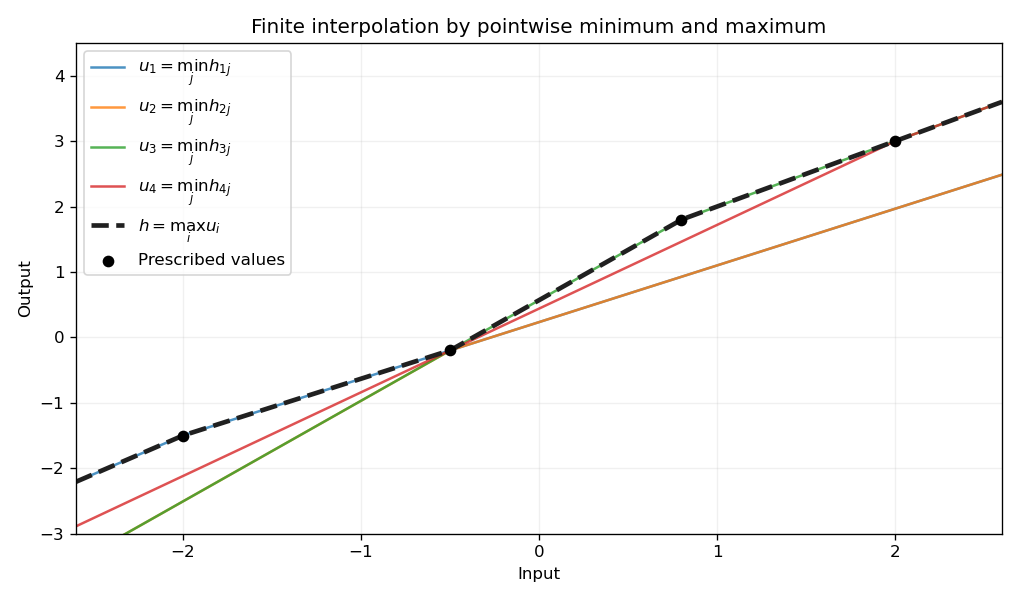
Here transitivity is order n-transitivity: increasing tuples are compared, rather than arbitrary reorderings. For increasing tuples α1<⋯<αn and β1<⋯<βn, choose hij sending both αi to βi and αj to βj when i=j, using order two-transitivity. For i=j, choose an element sending the single point to its target, using transitivity. Define
This belongs to the lattice-ordered permutation group. At αi, all terms in its ith inner meet equal βi. At αk, every inner meet is at most βk, because its j=k term takes that value. The outer join is consequently exactly βk there. Thus hmaps the whole tuple to its target. This finite interpolation by lattice operations proves every finite order-transitivity without assuming the group permits arbitrary cut-and-paste restrictions of its elements.
By compactness theorem, finitely many extension axioms σ1,…,σs already entail this particular universally quantified equivalence. Each has asymptotic probability one by the assumption. The union bound gives
For an unrestricted binary relation R, the extension axioms permit arbitrary directed edges and loops. For each m≥0 and each choice of bits ϵi,δi,η∈{0,1}, require that every tuple of distinct x1,…,xmhas a fresh element y with
y=xifor all i,R(y,y)η∧⋀i=1m(R(y,xi)ϵi∧R(xi,y)δi).
As usual, a class of structures here is closed under isomorphism and uses standard finite-structure encodings. First suppose K is defined by ∃Rϕ, with ϕ in partial fixed-point logic. Deterministically enumerate the polynomial-lengthencodings of R and evaluate ϕ on each expansion. PFP evaluation is in PSPACE even without a supplied order: a relation of fixed arity requires polynomially many bits, iteration has at most exponentially many states, and apolynomial-length counter suffices to stop after that many stages. If no consecutive stages agree before a repeat must have occurred, the partial fixed point is empty. Nested fixed points have fixed syntactic depth and can be evaluated with reused polynomial storage. Thus the encoding language of K is in PSPACE.
Conversely, suppose that encoding language is decidable in PSPACE. Expand each structure by a freely chosen linear orderR. On such ordered expansions, the assumed characterization gives a PFP sentence ψ(R) deciding whether the reduct belongs to K. Since K is isomorphism-invariant, the answer is independent of the particular chosen order. Hence
The expression inside the second-order quantifier is PFP, since the assertion that R is a linear order is first-order. Every finite universehas a linear order. This proves both directions, using an existentially supplied order when the original signature has none. The construction is also the order-independent consequence of part (a), which shows that existential relation quantification does not increase PFP'spower on an already ordered structure.
Fix a partial fixed-point logicformula ϕ(R,x), with R of arity k. On a finite ordered structure, an interpretation of R is abitstring of length nk. To decide whether some interpretation makes ϕ true at a given tuple, enumerate all these strings and evaluate ϕ for each. Evaluationuses polynomial space by the permitted characterization of PFP, and the enumerating counter also has polynomial length. Storage is reused between interpretations. Thus the resulting pointed-structure property is decidable in PSPACE.
Apply the assumed PFP characterization of PSPACE on ordered structures to this property. It gives a PFP formula ψ(x) such that
To justify the formula version from a sentence characterization, temporarily name the tuple by finitely many new constants, apply the characterization in that expanded finite signature, and replace those constants by the free variables, renaming bound variables to avoid capture. This does not introduce a new order assumption: the input already interprets <asa linear order. Multiple quantified relations are handled by repeated application.
If NP=PSPACE, this places the class defined by the assumed second-order sentence in NP. Fagin's theorem would give an equivalent existential second-order sentence, again contradicting the hypothesis. Hence
Consequently every second-order definable class lies in P, hence in NP. By Fagin's theorem it has an equivalent existential second-order sentence. This contradicts the posited second-order sentence with no such equivalent. Therefore
The proof uses the equality assumption to collapse quantifier alternation; it does not assume an unproved strictness statement about the polynomial hierarchy.
where ψ is first-order and the relation variables have fixed finite arities. The forward implication includes the substantive encoding of a polynomially bounded accepting computation by relations. In the reverse implication the relations are polynomial-length certificates and the fixed first-order sentence can be checked in polynomial time. This is a finite-structure characterization; no order need be named in the input signature.
then A and B agree on every first-order sentence of quantifier rank at most q. Equivalently, they have the same number of occurrences of every marked radius-r one-point neighbourhood type. The individual local isomorphisms need not be restrictions of f.
A bounded-degree threshold version permits the type counts to be different when both exceed a sufficiently large bound depending on the degree bound and q. We need only the exact-count form. Its locality content is that sufficiently large matching neighbourhoods and their multiplicities determine all sentences up to the prescribed quantifier rank.
The neighbourhood structure is the induced relational structure on this set, expanded by constants marking the entries of a in their original order. Its isomorphism type thus records the centres, not just the unmarked ball. For one binary graph relation, this is the usual union of the radius-rgraph balls. This formulation assumes the finite relational signatures used in the finite-model setting.
These realized types are dense in the Stone topology on a type spaceSn(T). Indeed, any nonempty basic clopen set[θ] is given by aformula consistent with T. Completeness implies T⊨∃xθ, and thus some tuple in A realizes a type in [θ]. Afinite set of points is closed in aHausdorff space; if it is also dense, it is the whole space. Therefore Sn(T) equals the finite set of types realized in A. This proves (iii) implies (ii), and the previous part then yields (i). We have established
ω-categoricity⟺∀n∣Sn(T)∣<∞⟺a countable oligomorphic model exists.
In particular, the argument does not assume that an arbitrary countable model is saturated or that its type-orbits coincide before that coincidence has been proved.
We use the finite-structure convention of Section B. Express that < is astrict linear order by irreflexivity, transitivity and comparability of distinct points. Express that E is an equivalence relation by reflexivity, symmetry and transitivity. All these assertions use at most the three variable names x,y,z.
selects exactly those least elements. Apply part (b) to this formula, using k=3, to obtain Repn∈L3 saying that at least n representatives exist. The required sentence is
Finiteness is essential to the assertion as written in this section. If it were interpreted as applying to all infinite structures, the general claim would fail, not merely this choice of representatives. Partition the rational order into three dense classes, or into four dense classes, and let Emean belonging to the same class. In the three-pebble version of the Ehrenfeucht-Fraïssé game, the duplicator can play indefinitely between these structures: after one pebble is moved, at most two old classes remain represented; a new point can be placed in the required interval in its corresponding old class, or in a class different from both. Density makes every required placement possible in either structure. Thus the structures agree on all L3 sentences although one has three classes and the other four. The finite reading of the printed request is therefore necessary for n=4.
The formula Cmy is obtained by interchanging the names x,y throughout Cmx, including bound occurrences. Its only free variable is y. Apermutation of variable names preserves membership in Lk, so every formula in this recursion still uses at most the original knames. In particular, bound variables inside a copy of ϕ do not accidentally capture the previous comparison: their scope stays inside that copy.
Welcome to the OurBigBook Project! Our goal is to create the perfect publishing platform for STEM subjects, and get university-level students to write the best free STEM tutorials ever.
Everyone is welcome to create an account and play with the site: ourbigbook.com/go/register. We belive that students themselves can write amazing tutorials, but teachers are welcome too. You can write about anything you want, it doesn't have to be STEM or even educational. Silly test content is very welcome and you won't be penalized in any way. Just keep it legal!
a Q&A website like Stack Overflow, where multiple people can give their views on a given topic, and the best ones are sorted by upvote. Except you don't need to wait for someone to ask first, and any topic goes, no matter how narrow or broad
This feature makes it possible for readers to find better explanations of any topic created by other writers. And it allows writers to create an explanation in a place that readers might actually find it.
This way you can be sure that even if OurBigBook.com were to go down one day (which we have no plans to do as it is quite cheap to host!), your content will still be perfectly readable asa static site.
 Codex 0 2026-10-14