Topics (384k) Articles (398k) Users (410) Discussions (242) Comments (383) Files (13k) New article

A boiling chip is a small solid piece with cavities or a porous surface that supplies sites for heterogeneous nucleation of vapor bubbles in a heated liquid. Gas trapped in a cavity can help an incipient bubble survive the capillary pressure that would collapse a sufficiently small isolated bubble.
Many active sites encourage repeated bubble release, reducing the large, irregular boiling events associated with delayed nucleation and superheating. The chip changes the route by which boiling begins; it does not materially redefine the liquid's equilibrium boiling point. Its action is therefore understood through interface formation and bubble growth, rather than through a chemical conversion of the solvent.
Isamu Akasaki chose metalorganic vapour-phase epitaxy and sapphire, which tolerated hot Ammonia. Large lattice mismatch hindered film growth. In 1985, Hiroshi Amano and Isamu Akasaki's group developed an aluminium nitride epitaxial buffer layer deposited before hotter gallium nitride growth. The buffer supplies initial growth sites; growing islands join into a continuous film. It improves growth without making the lattices identical. Isamu Akasaki separately credits Shuji Nakamura's 1991 gallium nitride buffer.[ref]
https://www.kapitza.ras.ru/~glazkov/students/Nobel-akasaki-lecture.pdf. §§3.2–4.2, pp. 13–20, Figs. 7–11: growth sequence and microscopy
The 1986 growth paper reports a vertical metalorganic vapour-phase epitaxy reactor, source gases mixed just before delivery to slanted sapphire, and subsequent gallium nitride growth over aluminium nitride. Surface microscopy, X-ray diffraction and photoluminescence tested different aspects of the result. Buffered and unbuffered growth supplied the comparison. Its reported preparation conditions should not be replaced by one universal buffer temperature: the later lecture's account of the first low-temperature trial and the paper's parameter study describe different stages of development.[ref]
Metalorganic vapor phase epitaxial growth of a high quality GaN film using an AlN buffer layer by Hiroshi Amano and others. p. 353, Fig. 1 and Table I; p. 354, surface and diffraction comparisons
A magnesium acceptor impurity in gallium nitride accepts a valence band electron, leaving a mobile electron hole. Hydrogen passivation of magnesium acceptors in gallium nitride suppresses this activity. Post-growth activation restores existing impurities' electrical activity; ionization of active acceptor impurities supplies mobile electron holes. Adding magnesium alone is insufficient.[ref]
In 1989, Hiroshi Amano, Masahiro Kito, Kazumasa Hiramatsu and Isamu Akasaki obtained p-type semiconductor conduction in magnesium-doped gallium nitride using low-energy electron beam irradiation. Hiroshi Amano recalls initially resistive samples, an unreliable hot-probe test, then Masahiro Kito's Hall effect confirmation. A junction irradiated in an M-shaped region emitted in that pattern. Treatment, carrier-sign measurement and spatial emission supplied different evidence. Earlier zinc-doped samples brightened under irradiation without becoming p-type semiconductors: brightness alone did not prove the carrier sign.[ref]
https://journals.aps.org/rmp/pdf/10.1103/RevModPhys.87.1133. §V, pp. 1135–1136, Figs. 3–4; authors of 1989 paper in references, p. 1137
Shuji Nakamura, Takashi Mukai, Masayuki Senoh and Naruhito Iwasa's 1992 thermal-activation paper established another route using annealing in nitrogen. Their companion study compared already conducting films heated in nitrogen with films heated in Ammonia: the latter became highly resistive again. Its hydrogen-complex explanation connected this atmosphere dependence to acceptor impurity passivation. These are thermal treatment and atmosphere comparisons, distinct from the earlier electron beam intervention; neither observation alone images an individual hydrogen complex.[ref]
Thermal Annealing Effects on P-Type Mg-Doped GaN Films by Shuji Nakamura and others. abstract: nitrogen annealing above 700 degrees Celsius and electrical changes
[ref]Hole Compensation Mechanism of P-Type GaN Films by Shuji Nakamura and others. p. 1258, abstract and §§1–2: activation history, nitrogen/ammonia comparison and hydrogenation hypothesis
Shuji Nakamura's two-flow metalorganic chemical vapor deposition reactor, gallium nitride buffer, thermal activation and improved indium gallium nitride growth enabled bright double heterostructure devices, followed by thinner quantum well devices.[ref]
The original 1994 paper by Shuji Nakamura, Takashi Mukai and Masayuki Senoh describes a sapphire/gallium nitride-buffer device with zinc-doped indium gallium nitride emission and aluminium gallium nitride confinement. After nitrogen annealing, etching exposed the n-side for a separate contact. At room temperature, varied forward electric currents gave emission spectra and optical-output curves alongside a current-voltage characteristic. At : output, peak wavelength, terminal electric potential difference. The peak stayed nearly fixed across the current series. The paper omits a complete calibrated collection apparatus; comparisons with earlier devices change several preparation details.[ref]
Candela-class high-brightness InGaN⁄AlGaN double-heterostructure blue-light-emitting diodes by Shuji Nakamura and others. pp. 1687–1688, fabrication and Figs. 1–4
TXS 0506+056 is a blazar studied through a gamma-ray flare associated in direction and time with the high-energy neutrino alert IceCube-170922A. The event motivated coordinated observations across the electromagnetic spectrum, connecting a variable relativistic source with a possible source of energetic neutrinos.[ref]
Multi-messenger observations of a flaring blazar coincident with high-energy neutrino IceCube-170922A by IceCube Collaboration and others. Abstract: alert, directional/temporal association and follow-up observations
An association is a statistical inference involving localization, timing and backgrounds. It does not directly image the neutrino-production site or uniquely determine the jet's particle composition. The physical interpretation must account for the measured photons and neutrino evidence together.
Circular birefringence means different refractive indices for opposite circular polarizations. In a transparent isotropic medium, their relative wave phase changes rotate the direction of transmitted linear polarization; optical activity gives the solution measurement and convention.
Linear birefringence means that two orthogonal linear polarizations have different refractive indices. Their different propagation phases produce phase retardation. In a lossless waveplate, with fast-axis angle and slow-minus-fast retardation , the Jones matrix, up to a common phase, isusing time dependence . Circular birefringence instead has circular eigenpolarizations.
Write , . The binomial series for has positive numbers as the magnitudes of its nonconstant coefficients. The product tends to zero, since . Thus by telescoping. The Weierstrass M-test gives uniform convergence and absolute convergence on . Continuity extends the interior identity to both endpoints. Its radius of convergence is one; outside this interval its terms do not tend to zero.
Let and be independent random variables with binomial distributions and . Conditional on having positive probability, the possible values of satisfy . Their probabilities arewhere the denominator sums over that feasible integer range. The formula follows by multiplying independent binomial probabilities and dividing by the probability of the disjoint union of all feasible count pairs.
For , common factors cancel and the weights are proportional to , where . If , this reduces to the hypergeometric distribution, with probabilities . At parameter endpoints, use the original probability weights and check that the conditioning event has positive probability before dividing.
The binomial distribution with parameters and assigns the displayed probability to successes, for integers . Each specified sequence of independent trials has probability , and the binomial coefficient counts the sequences with exactly successes. Outside this range the probability is zero.
An explicit constructed model separates slow magnetization drift from discrete collective jumps:Here is the Heaviside step function, the Dirac delta function, a smooth drift rate, and the jump times. The ideal discontinuities stand for events shorter than the resolved timescale; actual magnetic domain walls move over finite times. This equation stipulates jump sizes rather than deriving them from atomic spin. With in the preceding geometry, subtracting the smooth background leaves .
Let a stable linear filter have causal impulse response , normalized by , and let be a constant dimensionless voltage gain. The output is a convolution:A simple low-pass filter has , with time constant . Its output pulse has peak proportional to and signed area . Integrating the convolution proves area preservation because ; a wider filter response lowers peaks and lengthens tails. This ideal filter models resolution, rather than claiming the cited instrument had exactly this response.

The nearby positive jumps in the figure have additive negative pulse areas even when their tails overlap. For the first of the pair still has of its initial height when the second arrives. Thresholding can merge those responses into one detected event; limited signal bandwidth also obscures their separation. The total signed area still records the sum if the complete response is integrated, but cannot identify how that sum was partitioned into events. Equal simultaneous jumps are exactly indistinguishable from a single jump of their summed size in this linear measurement. Oppositely signed simultaneous changes can cancel.
Area preservation requires the stated electronics. A zero-DC stage after the low-pass filter has responseConsequently over the complete response: a main pulse is followed by a compensating tail. Integrating only a threshold-selected lobe, clipping the record, or saturating the amplifier breaks the simple pulse-area inference. Recovering a magnetization change from such a readout needs the calibrated frequency response and an appropriate reconstruction. Neither the audible crackle nor the displayed voltage is a direct staircase of magnetization.
Write the magnetic flux linkage of the stationary pickup coil as , in SI units of weber. If every turn links the same magnetic flux , then ; the turn count is dimensionless. With a fixed winding and terminal convention, Faraday's law of induction gives the induced electromotive forceThis is the fundamental theorem of calculus applied to magnetic flux linkage. Its units are , not volts alone. Reversing the leads reverses the sign. In a high-input-electrical resistance voltage measurement the input approximately follows this electromotive force; coil loading and the frequency response of the electronics require separate calibration.
Separate direct drive linkage from material linkage: . Even an empty pickup coil has . In an ideal long, uniformly coupled specimen with negligible demagnetizing field correction and eddy current shielding, a useful material approximation isHere is specimen cross-sectional area, not the larger coil aperture; is vacuum permeability and the axial magnetization sampled by the coil. The units check directly: . Finite geometry and nonuniform magnetization generally require a calibrated coupling in place of . The exact linkage identity survives that failure of the uniform approximation.
As an original illustrative calculation, stipulate , , and rounded . ThenA uniform change over would give a rectangular pulse of ; over it gives with the same area. Thus pulse height mixes change size with change speed. These numbers describe an ideal model, not observed pulses or material constants.
Heinrich Barkhausen's 1919 report used iron, a 300-turn pickup coil, moving magnet, amplified telephone readout and galvanometer. Removing iron corrected drive pickup. [ref]
The Barkhausen effect by Gianfranco Durin and Stefano Zapperi. Appendix A, p. 46: later translation of the 1919 apparatus and blank control
A modern primary experiment by Gianfranco Durin and Stefano Zapperi used annealed iron–silicon strips and amorphous alloys. A 60 cm solenoid swept a triangular magnetic field intensity; a 50-turn pickup coil, wound within 1 mm, sensed the specimen. A preamplifier with a 3–20 kHz low-pass filter preceded sampling. Measurements selected the central hysteresis region dominated by magnetic domain wall motion. Above-background threshold crossings defined event durations; integrating between crossings defined event sizes. These are reported procedures, rather than data generated for the diagrams.[ref]
Scaling exponents for Barkhausen avalanches in polycrystals and amorphous ferromagnets by Gianfranco Durin and Stefano Zapperi. pp. 1–2: apparatus, specimens and threshold integration
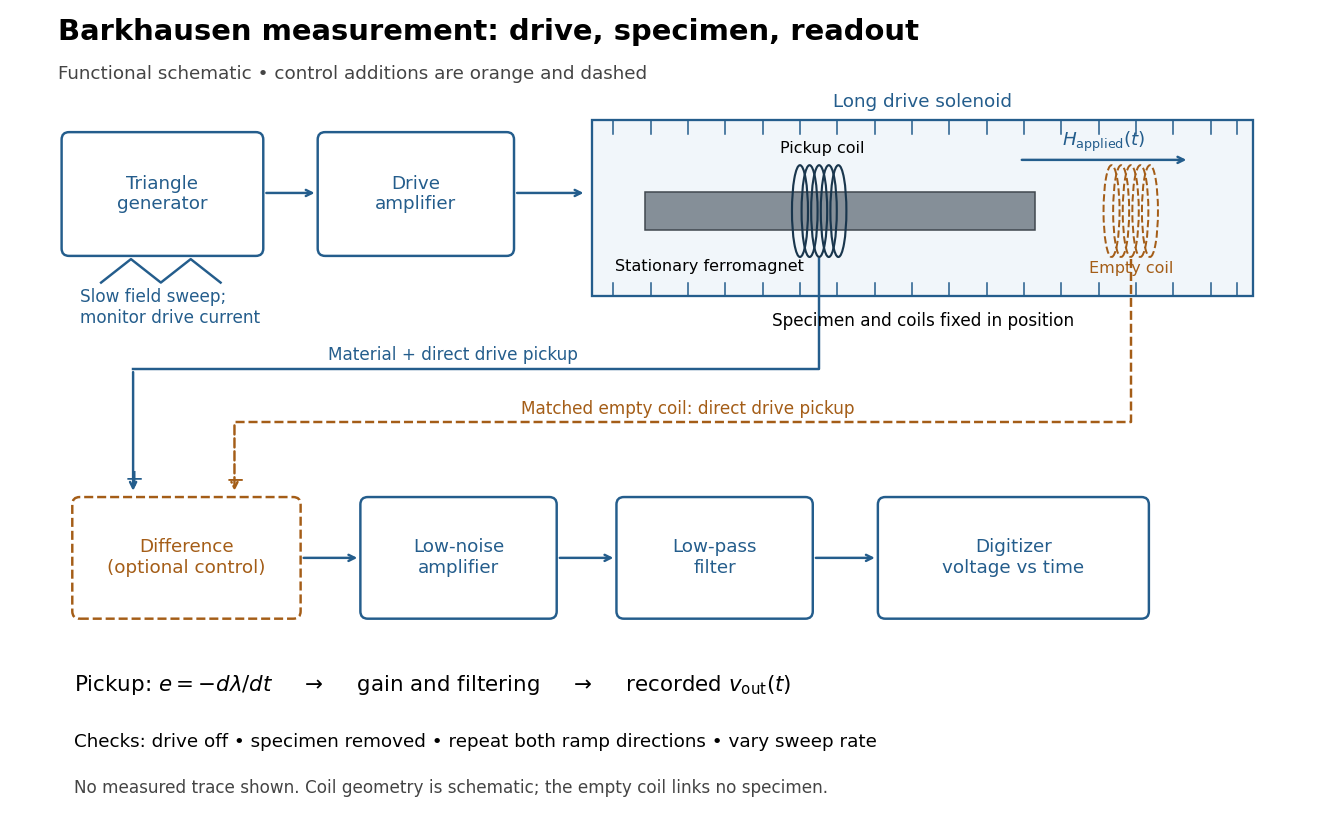
Barkhausen effect: swept magnetic field, stationary specimen and inductive readout
. Original functional schematic of the modern measurement principle. The specimen and pickup coil remain stationary; no torsional suspension or mechanical rotation is needed. The empty matching coil, difference stage and drive monitor show proposed controls, not an assertion that every component was present in the cited 2000 apparatus. The triangle indicates a drive waveform, not measured Barkhausen noise. Details.For this stationary implementation, secure a thin ferromagnet and its pickup coil inside a longer drive solenoid, keeping their relative positions fixed. Drive the solenoid with a slow triangular electric current, monitor that electric current, and record the amplified, filtered induced electromotive force with a digitizer. A speaker may make suitable frequencies audible, but the voltage record is needed for quantitative analysis. Slow variation of the drive does not require smooth magnetization. A triangular drive supplies an approximately constant applied-field sweep rate along each ramp; it does not guarantee constant instantaneous .
A proposed control sequence makes the inference testable. First record the electronics background with no drive. Repeat the same sweep with the specimen removed, retaining coil geometry: mutual induction from the drive can itself induce a voltage. A matching empty pickup coil wired in opposition can suppress common drive pickup, after checking its matching. Compensation of air flux by an opposed coil is an established method.[ref]
The Barkhausen effect by Gianfranco Durin and Stefano Zapperi. §II.A.1, p. 4: opposed-coil compensation
Then restore the specimen, repeat both sweep directions, reduce sweep rate, and compare the same hysteresis region with fixed amplifier gain, filter and threshold. Monitor drive irregularities and mechanical vibration; either can generate spurious pulses. These controls are recommendations for the schematic, rather than undocumented controls attributed to the modern paper.A genuine material contribution should differ from the blank-coil record and change reproducibly with the magnetic preparation and sweep region. Quieting the drive tests drive-correlated pickup, but a held field need not eliminate all delayed material motion. Reversing the sweep is a consistency check on signed changes, not a demand that individual events retrace. A changing pulse count under a different filter or threshold cannot by itself establish changed microscopic dynamics. The useful inference is intermittent collective magnetization change within the instrument's signal bandwidth, with spatial detail left unresolved.
A band gap whose conduction band minimum and valence band maximum occur at the same crystal momentum, allowing an optical transition without a momentum-balancing phonon.
An indirect band gap separates a valence band maximum and a conduction band minimum at different values of crystal momentum. A near-edge radiative transition then usually needs a phonon or another momentum-transfer process in addition to the photon, whose momentum is small on the Brillouin zone scale. A direct band gap has the extrema at the same crystal momentum and more readily supports efficient band-edge light emission. A material can have direct transitions at higher energy while its smallest gap is indirect.
For with , a nearest-neighbour cubic tight-binding model has zone-centre band effective massIts logarithmic derivative is . The unique minimum occurs at and has value . The explicit in band curvature competes with the exponentially weakening hopping integral. Extrapolation to vanishing atomic separation lies outside the localized-orbital approximation.
Band curvature is the Hessian matrix of an energy band as a function of wavevector. Dividing it by gives the inverse band effective mass tensor. At a one-dimensional band minimum the curvature is positive, whereas at a maximum it is negative. Near a weak two-wave avoided crossing with reciprocal wavenumber and coupling magnitude , the two edge curvatures are . This is a crystal response coefficient, not a change in the bare electron mass.
In a one-dimensional two-wave nearly-free electron model, set and let the coupling magnitude be . Near the Bragg plane,Expansion at gives , henceThe lower edge has negative electronic curvature, and the upper edge positive curvature. The last expression is a leading weak-potential approximation, not the exact curvature of the two-wave dispersion.
For a semiclassical wave packet in an isolated energy band, and imply . The inverse effective-mass tensor is the Hessian matrix of the dispersion divided by . Along a unit vector , . The Laplacian is its trace: . Thus in isotropic dimensions the scalar mass is , rather than .
With CPT symmetry, write the propagating states of neutral meson mixing as , defining the coefficient ratio . Let be their mass splitting and use units .
For rates tagged as and , neglect the decay width difference and take . DefineHere are decay amplitudes. The tagged asymmetry is in this convention.[ref]
For a single weak phase in a charmonium-kaon CP eigenstate with eigenvalue , gives , , withThis connects the CKM unitarity triangle to quantum interference between direct decay and decay after neutral meson mixing.[ref]
Observation of CP violation in the B0 meson system by BABAR Collaboration. PDF p. 4, Eq. (1) and charmonium weak phase
For an independent teaching example choose , and an arbitrary common positive envelope . Then , andBecause , both rates remain nonnegative. At , the asymmetry is ; at , it is . These chosen values illustrate the sign convention and are not experimental estimates. More generally .
If a tag flips independently with probability , exchanging and for that fraction of events gives by direct subtraction. The plotted toy choice reduces the amplitude to of its ideal value; at the tag contains no flavour information. Finite time resolution additionally averages over nearby oscillation phases. Extracting a weak phase consequently requires calibrated readout as well as a CKM matrix prediction.
For boundary data on the sphere , with , define its Legendre polynomial coefficients by . Separation of variables in the Laplace equation gives radial factors and . Regularity at the origin selects the first for the interior Dirichlet problem; decay at infinity selects the second for the exterior problem. Matching each boundary coefficient gives the displayed series. For continuous boundary data the resulting harmonic functions attain those data, with convergence interpreted through their harmonic extension rather than requiring uniform convergence of the unweighted boundary series. The maximum principle for harmonic functions proves uniqueness in the bounded interior and decaying exterior classes.
Specify whether two parameters mean endpoints or location and width. With endpoints , define for a standard arcsine distribution variable . ThenThis is a location-scale family with location and width . Its mean is and its variance is . A convention using parameters for location and width instead has right endpoint , so it must not be read as having endpoints .[ref]
The Arcsine Distribution. Random: Probability, Mathematical Statistics, Stochastic Processes by Kyle Siegrist; The General Arcsine Distribution, Definition, Distribution Functions and Moments: location-plus-width convention and alternative endpoint parametrization
For example, a chosen interval gives mean and variance , while its density still concentrates toward both endpoints. It is a bounded probability distribution; its endpoint singularities do not make its support infinite.
Pinned article: Introduction to the OurBigBook Project
Welcome to the OurBigBook Project! Our goal is to create the perfect publishing platform for STEM subjects, and get university-level students to write the best free STEM tutorials ever.
Everyone is welcome to create an account and play with the site: ourbigbook.com/go/register. We belive that students themselves can write amazing tutorials, but teachers are welcome too. You can write about anything you want, it doesn't have to be STEM or even educational. Silly test content is very welcome and you won't be penalized in any way. Just keep it legal!
Intro to OurBigBook
. Source. We have two killer features:
- topics: topics group articles by different users with the same title, e.g. here is the topic for the "Fundamental Theorem of Calculus" ourbigbook.com/go/topic/fundamental-theorem-of-calculusArticles of different users are sorted by upvote within each article page. This feature is a bit like:
- a Wikipedia where each user can have their own version of each article
- a Q&A website like Stack Overflow, where multiple people can give their views on a given topic, and the best ones are sorted by upvote. Except you don't need to wait for someone to ask first, and any topic goes, no matter how narrow or broad
This feature makes it possible for readers to find better explanations of any topic created by other writers. And it allows writers to create an explanation in a place that readers might actually find it.
Figure 1. Screenshot of the "Derivative" topic page. View it live at: ourbigbook.com/go/topic/derivativeVideo 2. OurBigBook Web topics demo. Source. - local editing: you can store all your personal knowledge base content locally in a plaintext markup format that can be edited locally and published either:This way you can be sure that even if OurBigBook.com were to go down one day (which we have no plans to do as it is quite cheap to host!), your content will still be perfectly readable as a static site.
- to OurBigBook.com to get awesome multi-user features like topics and likes
- as HTML files to a static website, which you can host yourself for free on many external providers like GitHub Pages, and remain in full control

Figure 2. You can publish local OurBigBook lightweight markup files to either OurBigBook.com or as a static website.
Figure 3. Visual Studio Code extension installation.
Figure 5. . You can also edit articles on the Web editor without installing anything locally. Video 3. Edit locally and publish demo. Source. This shows editing OurBigBook Markup and publishing it using the Visual Studio Code extension. 
- Infinitely deep tables of contents:




All our software is open source and hosted at: github.com/ourbigbook/ourbigbook
Further documentation can be found at: docs.ourbigbook.com
Feel free to reach our to us for any help or suggestions: docs.ourbigbook.com/#contact