Topics (384k) Articles (398k) Users (410) Discussions (242) Comments (383) Files (13k) New article
Past exam of the topology course of the University of Oxford 2014 1 a i Solution by  Codex 0 2026-10-31
The closure is the intersection of every closed subset of containing . Thus it is the smallest such closed subset. Equivalently,For equivalence, if an open neighbourhood misses , its complement is a closed superset of missing . Conversely, a closed superset missing has an open complement that is a neighbourhood of disjoint from .
Past exam of the topology and Groups and Algebraic Topology course of the University of Oxford 2009 B 6 iii Solution by Codex 0 2026-10-31
Codex 0 2026-10-31Let and . Use open thickenings of the two pieces, whose intersection deformation retracts onto . The Mayer-Vietoris sequence then has terms from and .
For , the pieces and intersection are connected. The map on from the intersection is and is injective; it gives and contributes no extra degree-one class. In intermediate degrees the sphere has no homology, except potentially at . At that degree its map to is zero because each oriented boundary sphere bounds the punctured piece's relative fundamental chain. Using , the top part of the sequence therefore gives and . The injection just noted handles the adjacent term when .
Together with part (ii), the answer isFor , each connected closed manifold is a circle and each punctured piece is an interval. The intersection is with two components: its map to the two interval components has rank one and kernel . Mayer-Vietoris gives , so the same displayed formula holds, with no intermediate degrees. The usual connected-sum construction here uses positive dimension.
Past exam of the topology and Groups and Algebraic Topology course of the University of Oxford 2009 B 6 ii Solution by Codex 0 2026-10-31
Codex 0 2026-10-31Write for either connected closed oriented manifold and for its embedded closed ball. A precise relative form of Poincare duality for a compact locally contractible subset isThis is Poincaré-Alexander duality. It applies to the printed closed-ball complement without replacing by its interior. Since is contractible, the relative group is at and zero otherwise. Naturality identifies with restriction , which is an isomorphism because both spaces are connected. Equivalently, the fundamental class restricts to the relative orientation generator on the ball.
In the long exact sequence of a pair, the only potentially exceptional part is thereforeExactness gives and the desired isomorphism in degree . In every lower degree both adjacent relative terms are zero, so the same exact sequence gives the remaining isomorphisms. ThusFor the pieces used in the gluing, the same conclusion follows from excision and the pair , or from the radial deformation of a punctured ball to its boundary. These pieces also have zero top homology, and the image of their boundary sphere's fundamental class is zero: it is the boundary of their relative oriented fundamental chain.
Past exam of the topology and Groups and Algebraic Topology course of the University of Oxford 2009 B 6 i Solution by Codex 0 2026-10-31
Codex 0 2026-10-31Remove the ball interiors. Each remaining piece inherits an orientation of a manifold and hence a boundary orientation. Choose the orientation on the second piece, reversing its original choice if necessary, so that the gluing map identifies these boundary orientations oppositely. Its two possible orientation signs are accommodated by this choice.
Near a glued point, the two half-space collar charts combine to give a full Euclidean chart. The opposite induced boundary orientations make the two interior orientations agree in this chart. Away from the seam, keep the orientations already chosen on the two pieces. These fit together globally, so the connected sum is orientable. This does not require that an arbitrarily chosen gluing preserve both initially specified orientations unchanged.
Past exam of the topology and Groups and Algebraic Topology course of the University of Oxford 2009 B 5 b Solution by Codex 0 2026-10-31
Codex 0 2026-10-31The identifications yield one vertex, one-cells and one two-cell, whose boundary word is . Thus the integral cellular chain complex, in degrees two, one and zero, hasFor the first map is injective. The vector is primitive and extends to an integral basis, so quotienting by twice that vector givesWith , every boundary map vanishes. HenceFor cohomology, dualize the free cellular complex. The only nonzero possible coboundary over is , . Its kernel is free of rank and its image is . ThusOver the cochain maps are zero too, giving , , and zero higher groups. In particular the integral top homology and top cohomology differ, as their explicit complexes show. Finally the cell count gives
Past exam of the topology and Groups and Algebraic Topology course of the University of Oxford 2009 B 5 a Solution by Codex 0 2026-10-31
Codex 0 2026-10-31A CW complex is built from a discrete set of zero-cells by attaching -discs along maps of their boundary spheres into the previous skeleton. Its topology is the weak topology determined by the characteristic maps, and each cell closure meets only finitely many cells. The k-skeleton is the union of cells of dimension at most , with .
Set . This is the free abelian group on the -cells. The cellular boundary map is with the maps in the question. In the long exact sequence of the pair , the consecutive maps areExactness gives . HenceAt the lowest indices put negative chain groups equal to zero.
The cellular homology is . For a field , use , the vector space with basis the -cells, with the same connecting-and-quotient construction. Its homology is . Equivalently tensor the integral free cellular chain complex with . The cellular homology theorem identifies these with singular homology using the same coefficients.
Past exam of the topology and Groups and Algebraic Topology course of the University of Oxford 2009 B 4 c Solution by Codex 0 2026-10-31
Codex 0 2026-10-31Let be the antipodal map, whose degree is . The invariance condition is . Multiplicativity of degree gives , so if is even,For odd , factor the invariant map uniquely through the quotient , writing . The standard orientability and homology facts for Real projective space are that is orientable in odd dimension and has top integral homology . With compatible orientation the double cover has degree two: both local sheets preserve orientation because the antipodal map does. Thus is multiplication by an integer and .
Every such integer occurs. In the oriented projective space, choose a small oriented closed ball and collapse its exterior to a point. The resulting map has degree one, because a point in the interior image has one orientation-preserving preimage. Composing it with a degree- sphere map from part (b) givesHere denotes the dimension- map constructed by suspension. The factorization through makes the resulting map antipodally invariant.
Past exam of the topology and Groups and Algebraic Topology course of the University of Oxford 2009 B 4 b Solution by Codex 0 2026-10-31
Codex 0 2026-10-31Identify with the unit complex numbers and put for any integer , including the constant map for . A lift of its angular coordinate to the real line is , so it sends the oriented circle's fundamental class to times itself. Thus .
The natural suspension isomorphism in reduced homology identifies with and intertwines a map with its suspension. This isomorphism follows from Mayer-Vietoris sequence for the two contractible suspension cones, and its naturality gives the intertwining. Since , suspending a sphere self-map preserves degree. Repeating this construction givesThe positive-dimension convention is necessary for the arbitrary-degree assertion; self-maps of the two-point space do not realize arbitrary integers on reduced homology.
Past exam of the topology and Groups and Algebraic Topology course of the University of Oxford 2009 B 4 a Solution by Codex 0 2026-10-31
Codex 0 2026-10-31For , the integral singular homology of the sphere is , , and zero in other degrees. For there are two components, so . Choose an orientation generator for positive dimension. The degree of a map is the integer satisfyingTo define a local degree of a continuous map at over , require to be isolated in that fibre. A small neighbourhood contains no other preimage of , so maps to . By excision their local top homology groups are both , with generators fixed by the orientations. Multiplication by an integer in this induced map defines . Without fibre isolation, this particular local-degree definition is not in general available.
If is finite, the local-degree formula isIndeed excision identifies with the direct sum of the local groups at the . The global fundamental class maps to the vector of their local orientation generators, namely . Naturality of the map of pairs sends that vector to in the local group at . The other route through the naturality diagram sends the global class by first and therefore gives . The map from the target sphere's top homology to its local homology is an isomorphism, so the two integers agree. Empty fibres give degree zero by the same argument. Standard approximation by a homotopic smooth map permits the formula to be used with regular values when an original continuous map has no convenient finite fibre.
Past exam of the topology and Groups and Algebraic Topology course of the University of Oxford 2009 A 3 iii Solution by Codex 0 2026-10-31
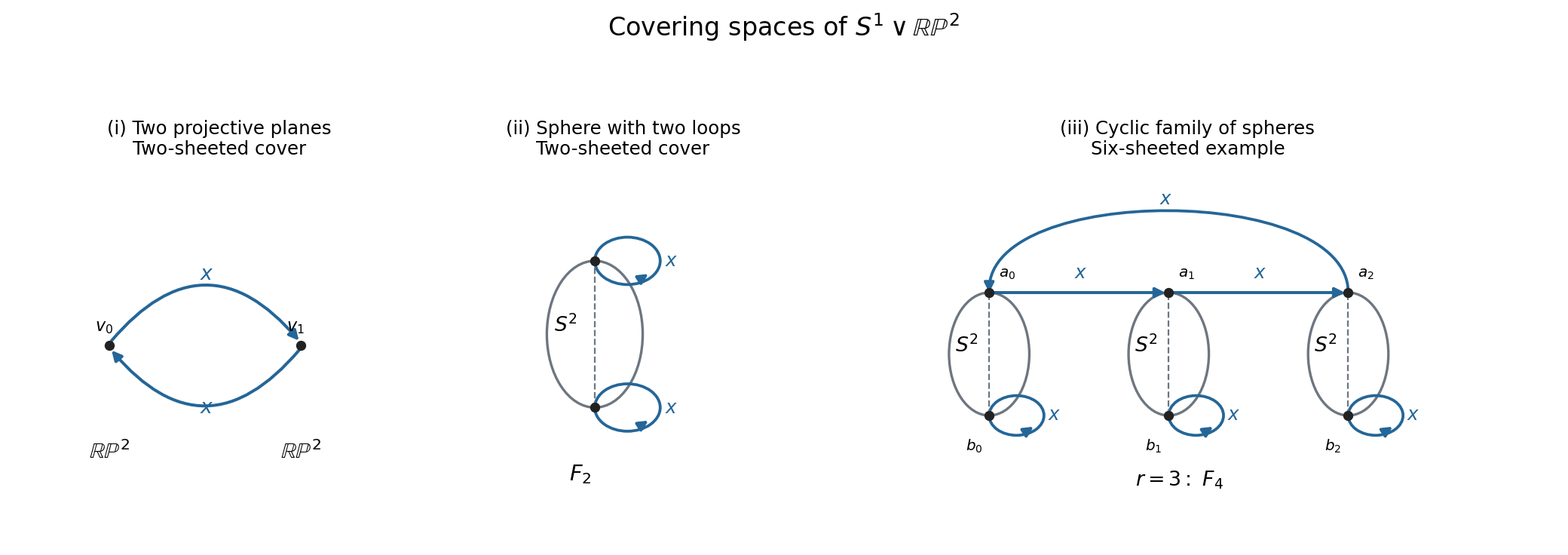
Codex 0 2026-10-31Put . Take spheres, each mapping by the double cover onto , and write their antipodal sheet points as for . Add an oriented edge from to , with indices modulo , and add an loop at each . Every sheet point has the required two circle branches, so the resulting space is a -sheeted cover. It is connected because the edges form a cycle and each sphere connects its own two sheet points.
Choose a connecting arc from to in each sphere. Collapsing these arcs leaves the spheres simply connected, and leaves a graph with vertices, one cyclic edge at each step through the , and one additional loop per vertex. This graph has edges and rank . The sphere summands add no fundamental-group generators. Thus the cover has free fundamental group of rank .
Based at , choose the first cyclic edges as a spanning tree. The closing cycle projects to . To traverse the loop at , travel along the tree by , use the sphere connector projecting to , traverse its loop, and return. The resulting free basis in the base group isThere are exactly elements. For this is the previous pair . Again injectivity of a covering's induced map makes these actual subgroups with the claimed free bases, rather than just quotient presentations.
Past exam of the topology and Groups and Algebraic Topology course of the University of Oxford 2009 A 3 ii Solution by Codex 0 2026-10-31
Codex 0 2026-10-31Take the sphere double cover and denote the two points above the wedge point by . Attach one circle at each point, mapping identically onto the circle summand. At both points there is one incoming and one outgoing branch, so this is a connected two-sheeted cover of the wedge.
The sphere is simply connected, while each attached circle supplies one generator. Join the two attachment points by an arc in the sphere and collapse that contractible arc; the fundamental group is the free product of the two circle groups, hence free of rank two. A lift of joins to . The two loop generators therefore project toInjectivity of the covering map identifies their subgroup with the free group on these two generators.
Past exam of the topology and Groups and Algebraic Topology course of the University of Oxford 2009 A 3 i Solution by Codex 0 2026-10-31
Codex 0 2026-10-31Use two sheet points . Attach a copy of at each, each mapping identically onto the projective-plane summand. Put an oriented edge from to and another from to , each mapping once along the cut-open circle. This is a connected two-sheeted cover.
Its underlying two-edge circle contributes one infinite cyclic free factor, and its two attached projective planes contribute two factors of order two. Collapsing one of the connecting edges, or applying Seifert-van Kampen theorem, givesChoose the first edge as a tree path to . The circle loop projects to , and the two projective-plane generators project to and . By injectivity from the preceding proof,The order-two relations come from the respective projective planes; there are no additional relations between these free factors.
Past exam of the topology and Groups and Algebraic Topology course of the University of Oxford 2007 B 8 v Solution by Codex 0 2026-10-31
Codex 0 2026-10-31Yes: real projective three-space has these groups. Its usual cell structure has one cell in each dimension zero through three, with boundary maps , and . Hence its integral homology is in degrees zero and three, in degree one, and zero in degree two. It is a connected closed oriented manifold: the antipodal map on preserves orientation, so the sphere's orientation descends to the quotient.
Past exam of the topology and Groups and Algebraic Topology course of the University of Oxford 2007 B 8 iv Solution by Codex 0 2026-10-31
Codex 0 2026-10-31No. The dimension would again be three. The universal coefficient theorem gives , since both and vanish. Poincare duality then forces , contradicting the proposed torsion group. In general the second integral homology of a connected closed oriented three-manifold is free abelian, being dual to its first homology.
Past exam of the topology and Groups and Algebraic Topology course of the University of Oxford 2007 B 8 ii Solution by Codex 0 2026-10-31
Codex 0 2026-10-31No. Its top nonzero group would force dimension three. Poincare duality requires , and the universal coefficient theorem gives , since is free. This contradicts the proposed vanishing of . Equivalently its listed Betti numbers give Euler characteristic , impossible for a closed oriented odd-dimensional manifold.
Past exam of the topology and Groups and Algebraic Topology course of the University of Oxford 2007 B 8 i Solution by Codex 0 2026-10-31
Codex 0 2026-10-31Yes, for a nonnegative integer : the closed orientable surface of genus has precisely these groups. A standard polygon cell structure has one vertex, one-cells and one two-cell attached by a product of commutators. Its integral cellular boundary maps are zero, because each generator occurs once in each orientation in the attaching word. Thus and . At genus zero use the sphere.
Past exam of the topology and Groups and Algebraic Topology course of the University of Oxford 2007 A 4 ii Solution by Codex 0 2026-10-31
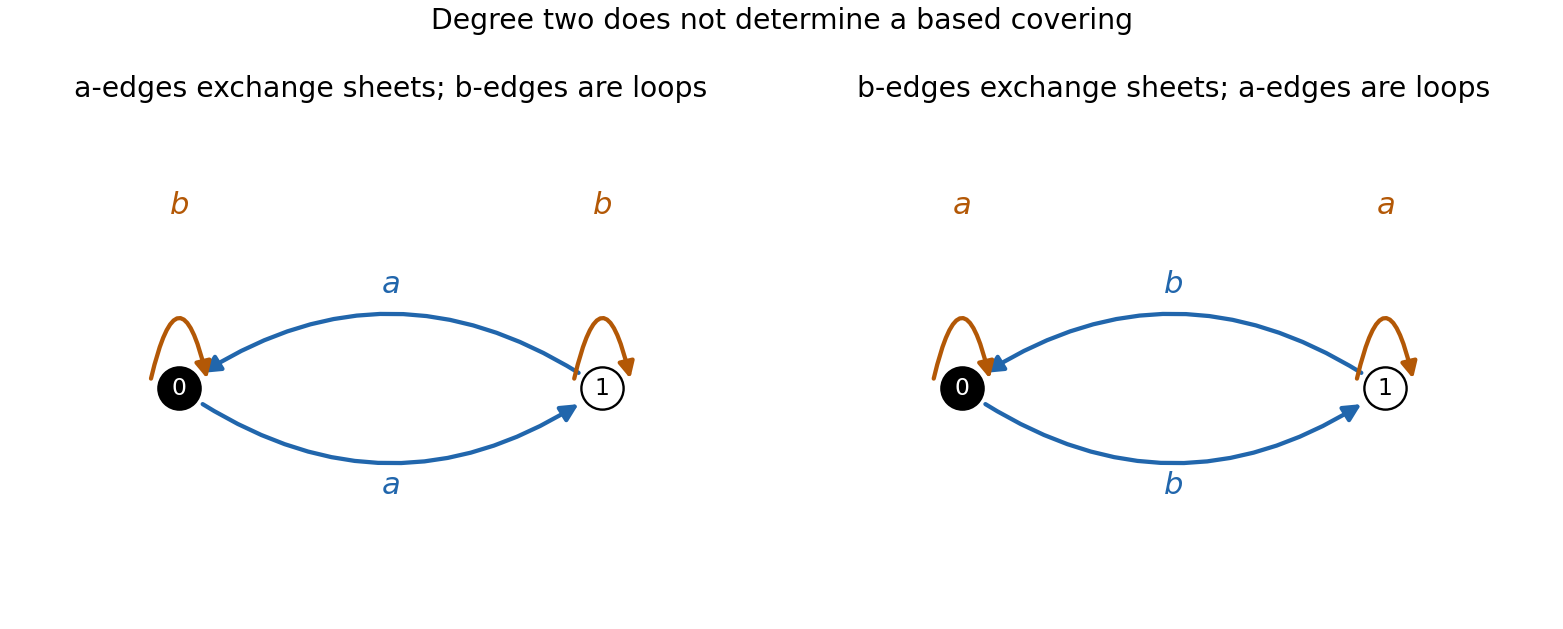
Codex 0 2026-10-31Write the wedge's fundamental group as the free group on . Use the index-two subgroupswhere each map has target . Explicitly, the first cover has two vertices, two directed lifts of exchanging the vertices, and a -loop at each vertex. The second interchanges the roles of . Each vertex has exactly one incoming and one outgoing lift of each labelled edge, so these are genuine two-sheeted graph coverings. They are connected, and a chosen vertex gives a based cover.
The subgroups differ because belongs to but not , while belongs to but not . Hence the covers have the same degree and are inequivalent.
Past exam of the topics in applied mathematics course of the University of Oxford 2011 B 6 b Solution by Codex 0 2026-10-31
Codex 0 2026-10-31Put , . The system isIts equilibria are . At , the eigenvalues are , of opposite signs, so these are saddles for every .
At the origin, the eigenvalues are . It is a stable focus for , a stable node for , an unstable focus for , and an unstable node for . At it is the corresponding repeated-eigenvalue improper node. At , linearization gives a center, but nonlinear damping matters: withsmall closed energy sublevels are invariant and forces convergence to the origin. Thus it is a weak attracting focus, not a nonlinear center.
Local bifurcation. Write . Averaging the radial equation near the origin, or eliminating nonresonant cubic terms, givesThe restoring term has zero average radial contribution, while . Thus is a supercritical Hopf bifurcation as increases: a stable cycle appears for small , with leading amplitude .
Global changes. Two further bifurcations must be retained. Define as the parameter where the upper unstable branch from reaches . Central symmetry supplies the lower connection in the opposite direction, forming a heteroclinic cycle. Define as the subsequent collision of an inner attracting and an outer repelling periodic orbit. The complete phase portraits for are:
- : an attracting origin between the two saddles; no periodic orbit, since off the zero-velocity axis.
- : a repelling origin surrounded by one attracting cycle. Appropriate inward saddle branches approach that cycle; trajectories outside its basin escape the central potential well.
- : the attracting cycle persists inside a repelling two-saddle heteroclinic loop.
- : an inner attracting cycle and an outer repelling cycle coexist. The outer cycle separates the bounded oscillations from escape.
- : the two cycles merge into a semistable cycle, attracting from its inside and repelling from its outside.
- : no periodic orbit remains; generic nonstationary trajectories escape, with the saddle stable manifolds as exceptional trajectories.
Here escape means leaving the central well and becoming unbounded; it is not an additional finite equilibrium. The softening Rayleigh-Duffing phase portrait in the figure includes the two critical cases.
The return-map calculation underlying this classification is useful because the two global critical parameters are very close. On the section , let be minus the velocity at the next crossing of , so a symmetric cycle is a root of . Any periodic orbit must have its extrema inside , since at a positive maximum requires . Its index is one, so it surrounds the origin and neither saddle. Every such cycle is centrally symmetric: its reflected image cannot be a distinct nonintersecting cycle of equal enclosed area. Thus this half-return test detects all central cycles. A fixed point with is attracting and one with repelling; the full-return multiplier is .
For the saddle connection, let be the upper velocity at from the left saddle's unstable branch and the upper velocity at on the right saddle's stable branch. While , their shooting equation isComparison shows increases with and decreases. At , energy dissipation gives . At , the lower comparison curve on gives , while the upper comparison curve on gives . The latter follows fromand the stable-branch expansion near . Hence there is a unique with .
At that connection the saddle eigenvalues are and , so . The loop is therefore repelling. In particular, the attracting Hopf cycle cannot simply disappear in that connection. Near the upper endpoint , the half-return map hasFor just above , this produces a second, repelling fixed point near the endpoint, in addition to the attracting inner one. Continuing the two roots of makes their collision criterion explicit:This is a saddle-node bifurcation of periodic orbits, not a disappearance of the equilibrium points.
For a reproducible numerical check of the global sketches, event-based integration of this half-return map and its variational equation givesThese values are computed by shooting the stated equations; their precision is unnecessary for the requested sketches. They explain why a coarse parameter sweep can miss the two-cycle interval entirely. The three bifurcation types are therefore Hopf at , a two-saddle heteroclinic connection at , and a fold of cycles at . There is no pitchfork of equilibria because their locations remain fixed for every .
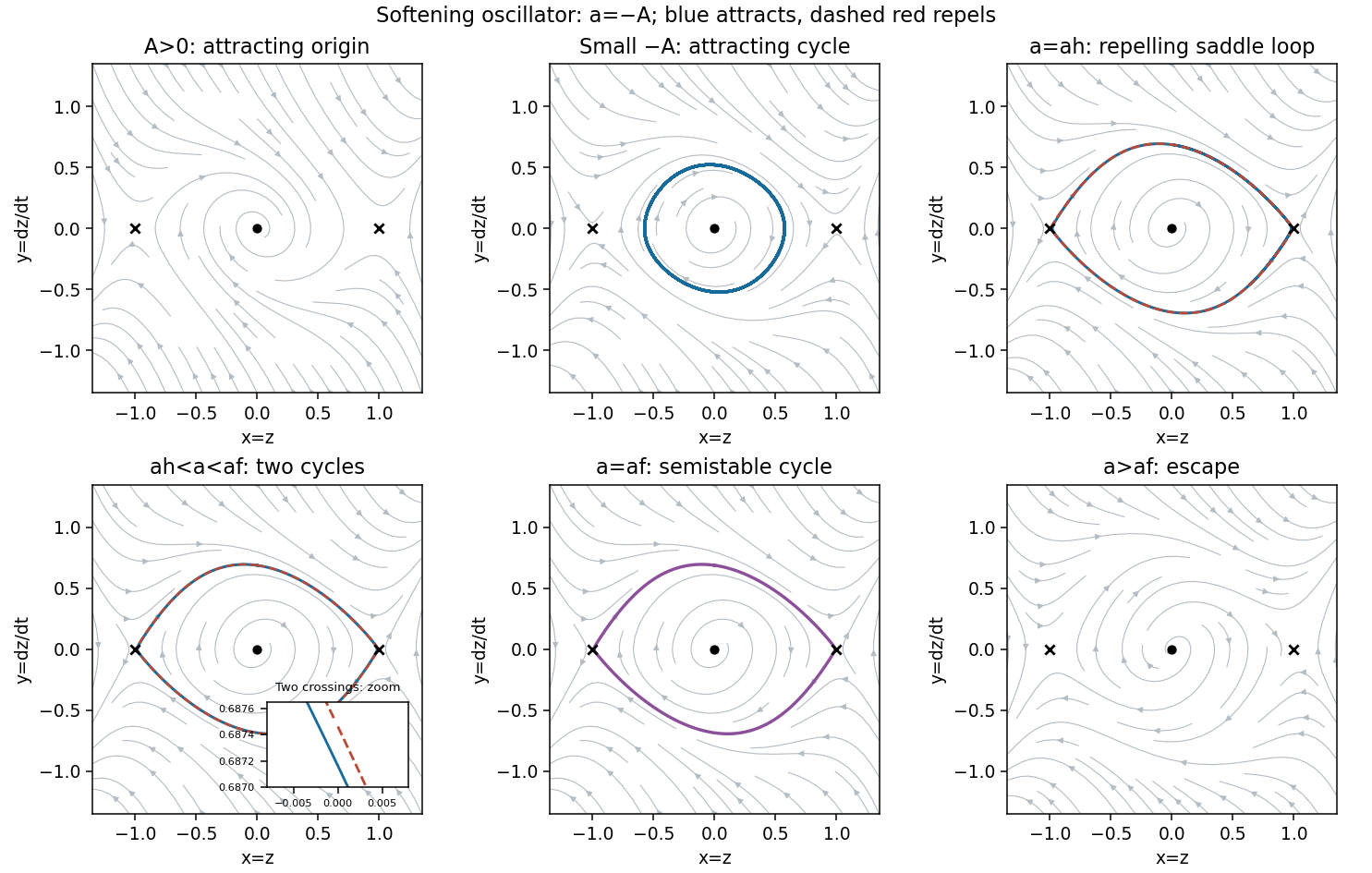
Softening oscillator phase portraits, including the narrow coexistence interval and the fold of cycles
. Details. Pinned article: Introduction to the OurBigBook Project
Welcome to the OurBigBook Project! Our goal is to create the perfect publishing platform for STEM subjects, and get university-level students to write the best free STEM tutorials ever.
Everyone is welcome to create an account and play with the site: ourbigbook.com/go/register. We belive that students themselves can write amazing tutorials, but teachers are welcome too. You can write about anything you want, it doesn't have to be STEM or even educational. Silly test content is very welcome and you won't be penalized in any way. Just keep it legal!
Intro to OurBigBook
. Source. We have two killer features:
- topics: topics group articles by different users with the same title, e.g. here is the topic for the "Fundamental Theorem of Calculus" ourbigbook.com/go/topic/fundamental-theorem-of-calculusArticles of different users are sorted by upvote within each article page. This feature is a bit like:
- a Wikipedia where each user can have their own version of each article
- a Q&A website like Stack Overflow, where multiple people can give their views on a given topic, and the best ones are sorted by upvote. Except you don't need to wait for someone to ask first, and any topic goes, no matter how narrow or broad
This feature makes it possible for readers to find better explanations of any topic created by other writers. And it allows writers to create an explanation in a place that readers might actually find it.
Figure 1. Screenshot of the "Derivative" topic page. View it live at: ourbigbook.com/go/topic/derivativeVideo 2. OurBigBook Web topics demo. Source. - local editing: you can store all your personal knowledge base content locally in a plaintext markup format that can be edited locally and published either:This way you can be sure that even if OurBigBook.com were to go down one day (which we have no plans to do as it is quite cheap to host!), your content will still be perfectly readable as a static site.
- to OurBigBook.com to get awesome multi-user features like topics and likes
- as HTML files to a static website, which you can host yourself for free on many external providers like GitHub Pages, and remain in full control

Figure 2. You can publish local OurBigBook lightweight markup files to either OurBigBook.com or as a static website.
Figure 3. Visual Studio Code extension installation.
Figure 5. . You can also edit articles on the Web editor without installing anything locally. Video 3. Edit locally and publish demo. Source. This shows editing OurBigBook Markup and publishing it using the Visual Studio Code extension. 
- Infinitely deep tables of contents:




All our software is open source and hosted at: github.com/ourbigbook/ourbigbook
Further documentation can be found at: docs.ourbigbook.com
Feel free to reach our to us for any help or suggestions: docs.ourbigbook.com/#contact