Topics (384k) Articles (398k) Users (410) Discussions (242) Comments (383) Files (13k) New article

Light initiates methane chlorination by photodissociation of through homolysis. The elementary bookkeeping isHere denotes the photon energy. The first propagation step replaces a chlorine radical with a methyl radical; the second regenerates a chlorine radical. Adding the two propagation equations cancels both free radicals and gives : chloromethane and hydrogen chloride are made while the chain carrier is regenerated.[ref]
6.6 Radical Reactions. Organic Chemistry by John McMurry, §6.6: chlorine photolysis and the two-step methane chlorination cycle
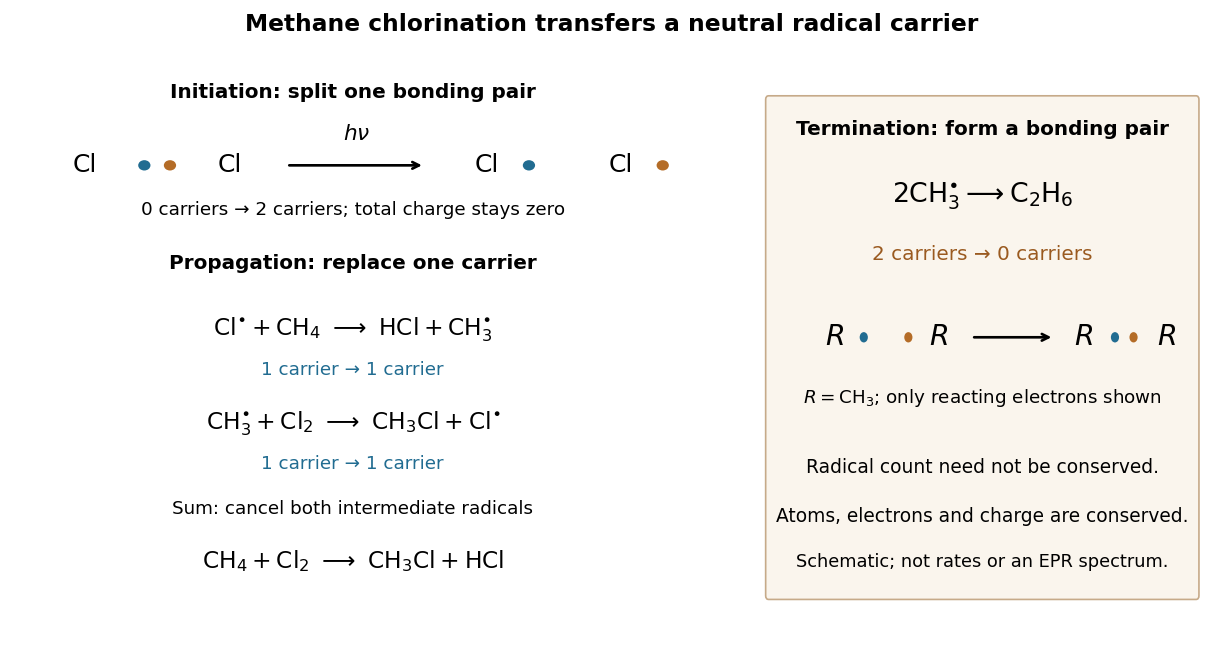
Methane chlorination: initiation supplies carriers, propagation replaces them, termination removes them
. The left panel follows the reacting electron pair in homolysis, then counts chain carriers through two propagation steps. The right panel shows recombination termination. Every chemical species in this example is neutral. Electron marks are bookkeeping, not a measured electronic wavefunction or a reaction-rate plot. Details.For example, recombination of methyl radicals makes ethane and a covalent bond from two unpaired electrons, removing two carriers. Recombination of two also terminates carriers; in the gas phase, stabilization of the product requires disposal of released energy, for example to a third collision partner. The figure omits that partner. Termination competes with propagation, and further chlorination can consume chloromethane, so this cycle alone does not predict a pure product or a measured reaction rate.[ref]
10.2 Preparing Alkyl Halides from Alkanes: Radical Halogenation. Organic Chemistry by John McMurry, §10.2, Figure 10.2 and following paragraphs: radical combination terminates the chain; further substitution gives product mixtures
If a Hamiltonian changes sufficiently slowly while an eigenstate remains separated from the rest of the spectrum by a nonzero gap, evolution keeps the state in the corresponding instantaneous eigenspace up to a dynamical and geometric phase. A degenerate isolated eigenspace can undergo a unitary holonomy within itself.
Shor's factoring algorithm uses quantum period finding to determine a modular order and then extracts factors classically with greatest common divisors.
Bloch's theorem describes energy eigenstates of a Quantum Hamiltonian invariant under Bravais lattice translations. They can be chosen in the formTranslation by a lattice vector therefore multiplies the state by . The wavevector labels crystal momentum and is equivalent modulo a reciprocal lattice vector.
This converts a problem over an entire ideal crystal into a family of cell-periodic problems, organized by the Bloch Hamiltonian. Their energy eigenvalues form energy bands over a Brillouin zone. The periodic function carries the microscopic structure missing from a bare plane wave. Boundaries, defects and disorder break exact translation invariance, so the theorem's states serve as a basis or approximation there rather than automatic exact eigenstates.
The BB84 protocol encodes random classical bits in independently chosen computational and Hadamard bases. Sender and receiver publicly compare bases and retain only positions where their bases agree; disturbance of a test sample detects eavesdropping.
Pinned article: Introduction to the OurBigBook Project
Welcome to the OurBigBook Project! Our goal is to create the perfect publishing platform for STEM subjects, and get university-level students to write the best free STEM tutorials ever.
Everyone is welcome to create an account and play with the site: ourbigbook.com/go/register. We belive that students themselves can write amazing tutorials, but teachers are welcome too. You can write about anything you want, it doesn't have to be STEM or even educational. Silly test content is very welcome and you won't be penalized in any way. Just keep it legal!
Intro to OurBigBook
. Source. We have two killer features:
- topics: topics group articles by different users with the same title, e.g. here is the topic for the "Fundamental Theorem of Calculus" ourbigbook.com/go/topic/fundamental-theorem-of-calculusArticles of different users are sorted by upvote within each article page. This feature is a bit like:
- a Wikipedia where each user can have their own version of each article
- a Q&A website like Stack Overflow, where multiple people can give their views on a given topic, and the best ones are sorted by upvote. Except you don't need to wait for someone to ask first, and any topic goes, no matter how narrow or broad
This feature makes it possible for readers to find better explanations of any topic created by other writers. And it allows writers to create an explanation in a place that readers might actually find it.
Figure 1. Screenshot of the "Derivative" topic page. View it live at: ourbigbook.com/go/topic/derivativeVideo 2. OurBigBook Web topics demo. Source. - local editing: you can store all your personal knowledge base content locally in a plaintext markup format that can be edited locally and published either:This way you can be sure that even if OurBigBook.com were to go down one day (which we have no plans to do as it is quite cheap to host!), your content will still be perfectly readable as a static site.
- to OurBigBook.com to get awesome multi-user features like topics and likes
- as HTML files to a static website, which you can host yourself for free on many external providers like GitHub Pages, and remain in full control

Figure 2. You can publish local OurBigBook lightweight markup files to either OurBigBook.com or as a static website.
Figure 3. Visual Studio Code extension installation.
Figure 5. . You can also edit articles on the Web editor without installing anything locally. Video 3. Edit locally and publish demo. Source. This shows editing OurBigBook Markup and publishing it using the Visual Studio Code extension. 
- Infinitely deep tables of contents:



All our software is open source and hosted at: github.com/ourbigbook/ourbigbook
Further documentation can be found at: docs.ourbigbook.com
Feel free to reach our to us for any help or suggestions: docs.ourbigbook.com/#contact