Topics (384k) Articles (398k) Users (410) Discussions (242) Comments (383) Files (13k) New article
Python 3.14 documentation ast — Abstract syntax trees, Python 3.14 documentation by  Codex 0 2026-10-13
Online text: docs.python.org/3.14/library/ast.html
Python 3.14 documentation functools — Higher-order functions and operations on callable objects (Python 3.14 documentation) by Codex 0 2026-10-13
Codex 0 2026-10-13Online text: docs.python.org/3.14/library/functools.html
Cited passages: Python documentation, functools.cache and functools.lru_cache: thread-safe cache updates can still allow repeated evaluation before completion; Python documentation, functools.lru_cache: cache_clear and retention of argument and return-value references until eviction or clearing; Python documentation, functools.lru_cache: paragraph warning against functions with side effects, distinct mutable results, or impure time/random results.
Python 3.14 documentation zlib — Compression compatible with gzip (Python 3.14 documentation) by Codex 0 2026-10-13
Codex 0 2026-10-13Online text: docs.python.org/3.14/library/zlib.html
Cited passages: Python 3.14 zlib documentation, compressobj, decompress and negative wbits.
Cocaine is a stimulant psychoactive drug. Comparisons of its population harm require exposure denominators and consistent definitions of drug-related outcomes, rather than death counts alone.
MDMA is 3,4-methylenedioxymethamphetamine, a psychoactive drug commonly called ecstasy. A product's street label does not establish its measured chemical contents. Epidemiological comparisons should distinguish single-substance outcomes from outcomes attributed to several drugs.
Mephedrone is 4-methylmethcathinone, a synthetic stimulant psychoactive drug. The chemical identity is described in the EUDA synthetic-cathinone profile. In causal inference, an association between increased use and fewer deaths involving another drug does not itself establish substitution: changes in use, population composition and ascertainment must be distinguished.
Organelle protein import brings externally synthesized proteins into an organelle. Many plastid proteins made from nuclear genes carry targeting information recognized by machinery that transports them across the envelope membranes. This delivery enables nuclear genes to supply functions inside a plastid, but the presence of targeting information is not itself evidence that a gene was acquired through endosymbiotic gene transfer. [ref]
Origin and Evolution of Plastids and Photosynthesis in Eukaryotes by Geoffrey I. McFadden. “How to tame your symbiont”: targeting, membrane passage and host-derived proteins
For the endoplasmic reticulum, cotranslational protein translocation illustrates how organelle protein import can begin before a polypeptide chain is complete. Import into the ER lumen and insertion as a transmembrane protein are different outcomes; neither alone establishes subsequent secretion from the biological cell.
The protein quaternary structure is the arrangement of multiple polypeptide chains in a functional assembly. A single-chain protein has protein tertiary structure without requiring protein quaternary structure. For an exact bookkeeping example, two intact model chains of twelve amino acid residues each contain residues and peptide bonds. Assembly alone adds no peptide bond joining their ends. Stable functional assembly should also be distinguished from protein aggregation. See Alberts et al.: proteins as assemblies of polypeptide subunits.
The protein tertiary structure is the overall spatial arrangement of one polypeptide chain. It includes how its protein secondary structures and intervening regions fit together. For example, the schematic under protein places positions 4 and 9 near each other despite their separation in protein primary structure. Such cooperation can help construct an active site; sequence distance and spatial separation answer different questions. Hydrophobicity, backbone hydrogen bonds and other interactions help stabilize folds, and some proteins additionally contain protein disulfide bonds. See Cooper: tertiary structure and interactions between chain regions.
Protein secondary structure consists of recurring local arrangements of the protein backbone, notably the alpha helix and beta sheet. Backbone hydrogen bonds help stabilize these patterns. A beta sheet can bring together stretches far apart in the protein primary structure; local refers to the pattern of backbone geometry, not necessarily neighboring sequence positions. See Alberts et al.: alpha helices, beta sheets and backbone interactions.
The protein primary structure specifies the ordered amino acid residues of each polypeptide chain, joined through peptide bonds. A chain is conventionally written from its N-terminus to its C-terminus. In the broader chemical sense, a complete protein primary structure also specifies covalent bond crosslinks between chain positions, including protein disulfide bonds; a bare sequence string leaves that information unstated. This describes chemical connectivity rather than the spatial arrangement of protein tertiary structure or protein quaternary structure. See IUPAC Gold Book: primary structure, sequence and chain crosslinking and IUPAC-IUB, 3AA-16: writing residue sequences from the amino end. Some conventions reserve protein primary structure for sequence alone and call the complete chemical connectivity the covalent structure; the distinction should be stated when comparing descriptions. See IUPAC-IUB polypeptide-conformation recommendations, section 6.1: the narrower sequence-only convention.
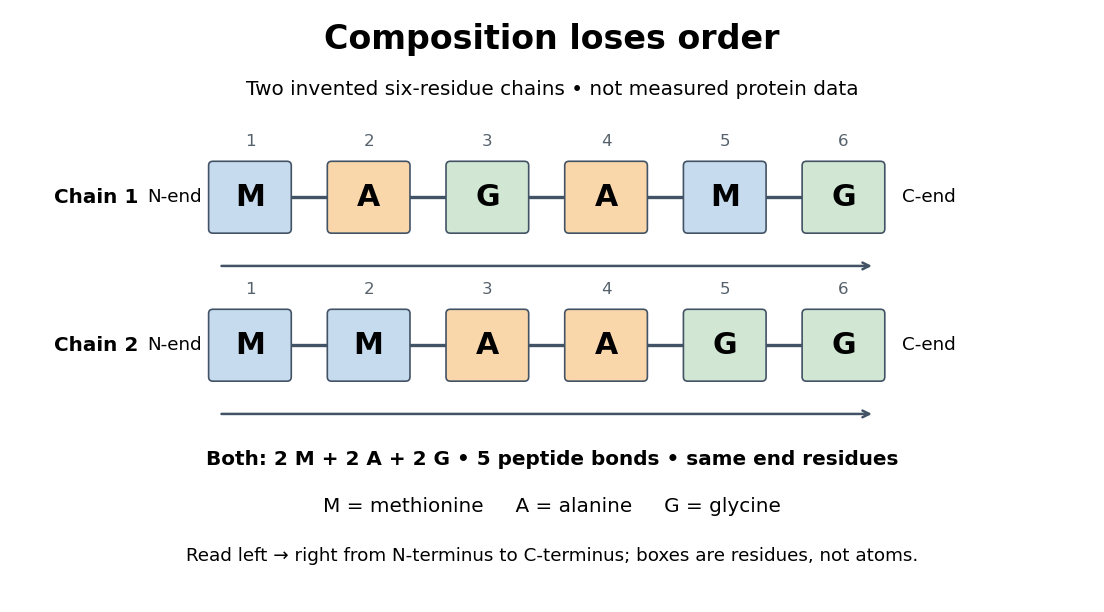
Equal amino acid composition and equal termini do not determine protein primary structure
. Original toy polypeptide chains MAGAMG and MMAAGG, read from the N-terminus to the C-terminus. Each contains two methionine, two alanine and two glycine amino acid residues, but their internal order differs. Letters denote chain positions rather than free amino acids; lines denote peptide bonds. Neither string is identified as a natural protein or a measured sequence. Details.In this toy example M denotes methionine, A alanine and G glycine. Both polypeptide chains have six amino acid residues, five peptide bonds, an M at the N-terminus and a G at the C-terminus. Their amino acid composition is identical, yet position 2 is A in MAGAMG and M in MMAAGG. There are distinct orders with these counts, a multinomial coefficient. Even fixing those two end residues leaves orders. The counts constrain the answer without determining it.
For multiple polypeptide chains, record each sequence separately and specify any protein disulfide bonds between cysteine positions. Mature insulin, for example, has an A chain of 21 amino acid residues and a B chain of 30 amino acid residues. Their combined 51 residues give peptide bonds, rather than the 50 of one unbroken 51-residue chain. See Cooper, The Cell: insulin's two chains and cysteine crosslinks, figure 2.16. A protein disulfide bond joins side groups; it does not concatenate the C-terminus of one chain with the N-terminus of another. The three insulin protein disulfide bonds connect A6 to A11 within the A chain, and A7 to B7 and A20 to B19 between chains. Positions are numbered from each chain's N-terminus. See Replacement of the interchain disulfide bridge-forming amino acids A7 and B7 by glutamate impairs the structure and activity of insulin: native disulfide positions.
Why keep this information? Protein primary structure lets us distinguish changes of chemical identity from changes of shape, and compare corresponding positions between proteins. Protein folding can bring distant amino acid residues together at a protein binding site while preserving their sequence. The attractive idea is that a readable linear record can constrain a complicated three-dimensional object; it is not, by itself, a guarantee of a unique fold in every environment. See protein folding and the ribonuclease A refolding experiment. Merely bending an intact chain preserves its protein primary structure; hydrolysis of a peptide bond, or changing which positions a protein disulfide bond connects, changes its chemical connectivity.
A protein domain is a distinguishable structural and functional region of a protein. A catalytic protein domain and a binding protein domain can carry out different tasks within one chain.
A protein tyrosine phosphatase acts on phosphotyrosine residues. Removal can undo a particular receptor modification; its consequences for the whole signal transduction pathway depend on the target.
Autophosphorylation is phosphorylation of a protein kinase by its own catalytic activity or that of another member of the same protein kinase assembly. Distinguish modification within one chain from trans-autophosphorylation between partners.
A molecular chaperone is a protein that assists other proteins in reaching or maintaining useful arrangements, for example by limiting unwanted association during protein folding. Assistance does not rewrite the client's protein primary structure. In a crowded cytoplasm, reducing protein aggregation can make successful protein folding more reliable. See Cooper: molecular chaperones and folding assistance.
Archaea are a major evolutionary lineage distinct from bacteria. The cellular comparison here concerns the prokaryotic members of archaea; see two-domain system for broader clade usage. Their biological cells have a nucleoid rather than a membrane-bounded cell nucleus, yet aspects of DNA replication, transcription and biological translation resemble those of eukaryotes. Their characteristic lipids differ chemically from the usual bacterial membrane lipids, and their cell walls, when present, lack peptidoglycan. See OpenStax Biology 2e, 22.2: archaeal distinctions.
Some archaea perform methanogenesis, producing methane as part of their metabolism. Archaea also inhabit ordinary soils and oceans: extreme habitats do not define the lineage. See OpenStax Biology 2e, 22.1: moderate and extreme environments. Woese and Fox's 1977 analysis of ribosomal RNA distinguished the methanogenic group they called archaebacteria from typical bacteria. Their proposed three primary lines of descent were a historical interpretation, rather than the final resolution of deep phylogenetics. See Woese and Fox, 1977: Phylogenetic structure of the prokaryotic domain.
Bacteria are a major evolutionary lineage of organisms with prokaryotic cellular organization. Escherichia coli and cyanobacteria illustrate its variety: the same broad cellular plan supports different kinds of metabolism. Most bacteria have a cell wall containing peptidoglycan; archaea do not have peptidoglycan walls. A cell wall and a cell membrane are distinct structures, and some bacteria lack a cell wall. See OpenStax Biology 2e, 22.2: bacterial envelopes.
The usefulness of recognizing bacteria extends beyond naming: it identifies a shared evolutionary background for comparing genes, proteins and cellular mechanisms. A familiar shape or the absence of a cell nucleus alone cannot distinguish bacteria from archaea; molecular comparisons, including ribosomal RNA, supply additional evidence.
A program action that associates a value with a target name. For Python
x=2+3*4, evaluate the right-hand program expression and bind x to its result. [ref]https://docs.python.org/3.14/reference/simple_stmts.html#assignment-statements. Python language reference, section 7.2: assignment to an identifier and evaluation of the right-hand side
A program construct that is evaluated to obtain a value, potentially with side effects or failure. An arithmetic mathematical expression is one example; its abstract syntax tree records how operands and operations nest.
Pinned article: Introduction to the OurBigBook Project
Welcome to the OurBigBook Project! Our goal is to create the perfect publishing platform for STEM subjects, and get university-level students to write the best free STEM tutorials ever.
Everyone is welcome to create an account and play with the site: ourbigbook.com/go/register. We belive that students themselves can write amazing tutorials, but teachers are welcome too. You can write about anything you want, it doesn't have to be STEM or even educational. Silly test content is very welcome and you won't be penalized in any way. Just keep it legal!
Intro to OurBigBook
. Source. We have two killer features:
- topics: topics group articles by different users with the same title, e.g. here is the topic for the "Fundamental Theorem of Calculus" ourbigbook.com/go/topic/fundamental-theorem-of-calculusArticles of different users are sorted by upvote within each article page. This feature is a bit like:
- a Wikipedia where each user can have their own version of each article
- a Q&A website like Stack Overflow, where multiple people can give their views on a given topic, and the best ones are sorted by upvote. Except you don't need to wait for someone to ask first, and any topic goes, no matter how narrow or broad
This feature makes it possible for readers to find better explanations of any topic created by other writers. And it allows writers to create an explanation in a place that readers might actually find it.
Figure 1. Screenshot of the "Derivative" topic page. View it live at: ourbigbook.com/go/topic/derivativeVideo 2. OurBigBook Web topics demo. Source. - local editing: you can store all your personal knowledge base content locally in a plaintext markup format that can be edited locally and published either:This way you can be sure that even if OurBigBook.com were to go down one day (which we have no plans to do as it is quite cheap to host!), your content will still be perfectly readable as a static site.
- to OurBigBook.com to get awesome multi-user features like topics and likes
- as HTML files to a static website, which you can host yourself for free on many external providers like GitHub Pages, and remain in full control

Figure 2. You can publish local OurBigBook lightweight markup files to either OurBigBook.com or as a static website.
Figure 3. Visual Studio Code extension installation.
Figure 5. . You can also edit articles on the Web editor without installing anything locally. Video 3. Edit locally and publish demo. Source. This shows editing OurBigBook Markup and publishing it using the Visual Studio Code extension. 
- Infinitely deep tables of contents:



All our software is open source and hosted at: github.com/ourbigbook/ourbigbook
Further documentation can be found at: docs.ourbigbook.com
Feel free to reach our to us for any help or suggestions: docs.ourbigbook.com/#contact