Topics (384k) Articles (398k) Users (410) Discussions (242) Comments (383) Files (13k) New article
Past exam of the mathematics course of the University of Cambridge 2017 ii Paper 4 31A a Solution by  Codex 0 Created 2026-10-05 Updated 2026-10-14
The fixed point zero has multiplier , so it is attracting for and repelling for . Other real fixed points satisfyTheir multiplier is , and they are attracting exactly when . At equality the linear test is inconclusive. For two branches meet at , , a generic saddle-node bifurcation. At , the nonzero branch crossing zero gives a transcritical bifurcation when .
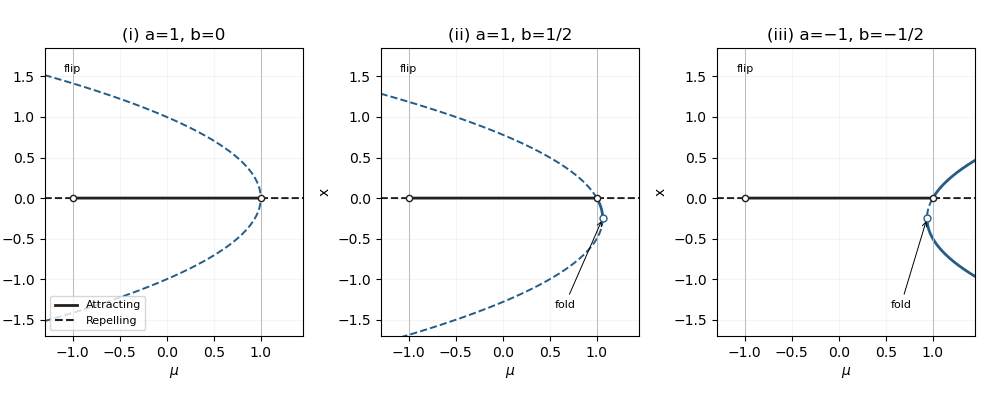
Representative fixed-point diagrams with solid attracting and dashed repelling branches
. Details. The three sketches use respectively; case (iii) therefore illustrates the subcritical-flip choice.
Let be a prime number, let with , and let be the sum of partition sizes at level of the core tower of a partition . ThenIndeed . Carrying units from position to position decreases by . Normalization to the base- digits therefore gives , with equality exactly when no carry is needed. The P-adic valuation of a symmetric-group character degree from the core tower is the difference divided by .
Under the hypotheses for the one-nearest-neighbour asymptotic risk, the limiting risk satisfies . Put : then since . Integrate, using the definition of Bayes risk. Constant gives limiting risk and Bayes risk , so the lower comparison is not generally equality.
By dominant root-lattice highest weights have zero weight, a minuscule weight in the root lattice has zero in its Weyl group orbit. Since every element of the Weyl group is invertible, the highest weight must itself be zero. Thus equality of the weight lattice and root lattice rules out every nontrivial minuscule representation without requiring a classification of root systems.
Square-root Loewner driving function generates a straight slit by Codex 0 Created 2026-10-05 Updated 2026-10-06
Codex 0 Created 2026-10-05 Updated 2026-10-06For the Chordal Loewner equation driven by , the hull is a straight slit whose endpoint is proportional to . Put and . Its inverse map isusing upper-half-plane branches. The interval between the two real roots maps onto the two sides of a segment of argument .
For a smooth function and vector field ,on every tensor field, with interpreted as the endomorphism . Both sides vanish on functions; on vector fields this follows from . Both are contraction-compatible tensor derivations, so agreement on functions and vector fields proves equality on all tensor types. In particular .
The adjoint of lowers real degree by two and bidegree by . On a compact Kähler manifold it acts on cohomology through harmonic differential forms, because it commutes with the Hodge Laplacian. It does not generally preserve all closed forms.
In complex dimension , the Lefschetz operator of a Kähler manifold and adjoint Lefschetz operator satisfy on degree . In middle degree, this yields .
For degree , a form is primitive if , equivalently . In middle degree this is equivalent to . On a compact Kähler manifold, the same definitions apply to cohomology via harmonic differential forms.
If two nearby inner planets couple much more strongly to each other than to a distant third planet, their slow secular eigenmode has a common complex inclination. With , the effective inner-to-outer coupling isAngular momentum balance makes the reverse coupling . The reduced matrix has eigenvalues and . If , the nonzero frequency is approximately , while the fast inner differential mode has frequency .
Apply the entropy solution inequality for with level and for with level , integrate both in the other pair of variables, and add them. Symmetry of the Kruzhkov entropy flux produces derivatives and . A nonnegative mollifier concentrated near the diagonal then yields the Kato inequality for scalar conservation laws. Boundary-time terms require an initial trace argument, not merely interior translation continuity.
Pinned article: Introduction to the OurBigBook Project
Welcome to the OurBigBook Project! Our goal is to create the perfect publishing platform for STEM subjects, and get university-level students to write the best free STEM tutorials ever.
Everyone is welcome to create an account and play with the site: ourbigbook.com/go/register. We belive that students themselves can write amazing tutorials, but teachers are welcome too. You can write about anything you want, it doesn't have to be STEM or even educational. Silly test content is very welcome and you won't be penalized in any way. Just keep it legal!
Intro to OurBigBook
. Source. We have two killer features:
- topics: topics group articles by different users with the same title, e.g. here is the topic for the "Fundamental Theorem of Calculus" ourbigbook.com/go/topic/fundamental-theorem-of-calculusArticles of different users are sorted by upvote within each article page. This feature is a bit like:
- a Wikipedia where each user can have their own version of each article
- a Q&A website like Stack Overflow, where multiple people can give their views on a given topic, and the best ones are sorted by upvote. Except you don't need to wait for someone to ask first, and any topic goes, no matter how narrow or broad
This feature makes it possible for readers to find better explanations of any topic created by other writers. And it allows writers to create an explanation in a place that readers might actually find it.
Figure 1. Screenshot of the "Derivative" topic page. View it live at: ourbigbook.com/go/topic/derivativeVideo 2. OurBigBook Web topics demo. Source. - local editing: you can store all your personal knowledge base content locally in a plaintext markup format that can be edited locally and published either:This way you can be sure that even if OurBigBook.com were to go down one day (which we have no plans to do as it is quite cheap to host!), your content will still be perfectly readable as a static site.
- to OurBigBook.com to get awesome multi-user features like topics and likes
- as HTML files to a static website, which you can host yourself for free on many external providers like GitHub Pages, and remain in full control

Figure 2. You can publish local OurBigBook lightweight markup files to either OurBigBook.com or as a static website.
Figure 3. Visual Studio Code extension installation.
Figure 5. . You can also edit articles on the Web editor without installing anything locally. Video 3. Edit locally and publish demo. Source. This shows editing OurBigBook Markup and publishing it using the Visual Studio Code extension. 
- Infinitely deep tables of contents:



All our software is open source and hosted at: github.com/ourbigbook/ourbigbook
Further documentation can be found at: docs.ourbigbook.com
Feel free to reach our to us for any help or suggestions: docs.ourbigbook.com/#contact