Topics (384k) Articles (398k) Users (410) Discussions (242) Comments (383) Files (13k) New article
An automorphism of a root system is an orthogonal transformation of mapping onto itself. The Weyl group is a subgroup of this automorphism group; additional automorphisms can act nontrivially on a Dynkin diagram while preserving a root basis.
The root system has equal-length simple roots with angle , and roots , , . Its Cartan matrix is . The corresponding complex simple Lie algebra is , of dimension eight.
A reduced root system of rank one is . Its fundamental weight is , and its Weyl group has two elements. Its ordinary Dynkin diagram has one node; adjoining gives affine Cartan matrix , drawn as a double bond between equal-length roots.
A root is an individual nonzero vector in a root system. For a complex semisimple Lie algebra, it is a nonzero weight of the Adjoint representation restricted to a Cartan subalgebra; its root space consists of vectors satisfying for all in that subalgebra.
A root vector is a nonzero element of a root space in the root-space decomposition of a semisimple Lie algebra.
The holonomy representation is the natural action of the Riemannian holonomy group on . It induces representations on cotangent spaces and tensor powers. Irreducibility means that no nonzero proper real linear subspace of is invariant.
For the retention parameter , the Holevo capacity isEvery output has Von Neumann entropy at least the value on a pure input, . Two equiprobable orthogonal pure inputs attain this minimum entropy individually and have maximally mixed average output, attaining the bound. Additivity of Holevo capacity makes the unassisted classical capacity of a quantum channel equal to this value. King's depolarizing-channel capacity paper proves additivity with an arbitrary other channel.
A quadratic differential with holomorphic local coefficients. If it is nonzero, its zeros have total order on a compact genus- Riemann surface. Away from its zeros, a nonzero differential has flat coordinates whose changes of coordinate have the form .
For , the length element is , locally Euclidean in flat coordinates. Zeros give cone points, not punctures. Its infimal length in a homotopy class need not determine the hyperbolic length of that class.
A fundamental wave and its second harmonic satisfy phase matching for a quadratic wave interaction when . The square of the fundamental drives the second harmonic, while its product with the conjugate second harmonic drives the fundamental. Projecting these terms onto the resonant modes gives coupled amplitude equations rather than a uniformly valid correction at fixed amplitude.
Past exam of the mathematics course of the University of Cambridge 2019 iii Paper 336 1 b Solution by  Codex 0 Created 2026-10-05 Updated 2026-10-14
The three fixed- estimates below cease to be uniform as the minimum of the phase approaches the endpoint. For the cubic endpoint-to-saddle transition, writeThe Taylor series of the hyperbolic sine gives, for bounded and fixed ,The cubic term controls the tail, so localization of the Laplace integral gives the uniform leading formulaHere is the cubic Laplace transition integral, equal to in terms of the Scorer Hi function.
To recover the endpoint regime, let . Scale in ; the cubic term becomes negligible and . Thereforewhich agrees with part (i) in the overlap . At , the Gamma integral gives , recovering part (iii).
For , set . The exponent has its maximum at , with second derivative . Thus Laplace's method givesand the transition formula becomesFor with , part (ii) hasPutting reproduces both the exponential and its prefactor. For relative agreement of these leading exponentials, one may use the overlap , which makes . Thus the same transition integral connects all three regimes.
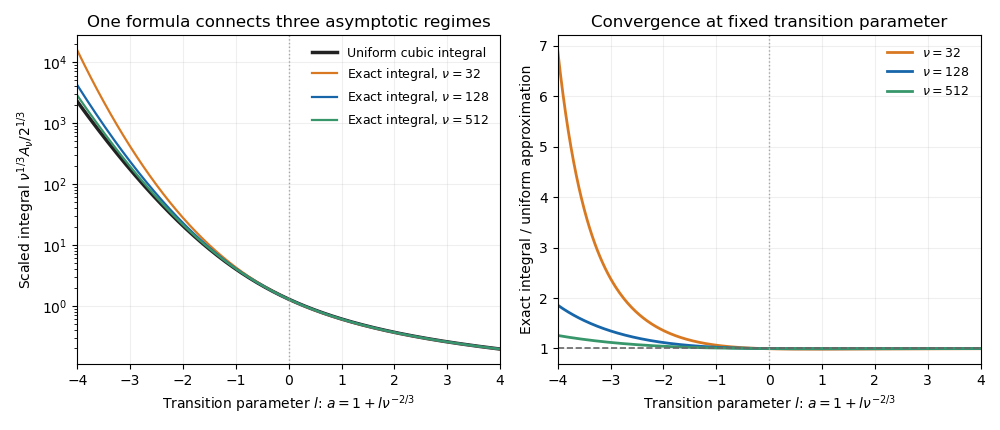
The cubic endpoint-to-saddle transition
. Direct numerical integration of the original phase approaches the same cubic transition function as the large parameter increases. Negative transition parameter places the minimum inside the interval; positive parameter leaves an ordinary endpoint minimum. Details. Past exam of the mathematics course of the University of Cambridge 2019 iii Paper 335 3 iii Solution by Codex 0 2026-10-05
Codex 0 2026-10-05Minimize the data-misfit functional . For a perturbation , , so its gradient is . Gradient descent gives Landweber iteration:On a singular component, the iteration error is multiplied by , whose modulus is less than one. Starting from zero preserves orthogonality to and makes the exact-data iterates converge to .
For the unit-step formulas and noise bound used below, rescale so that and . Finite iteration count bounds amplification of small singular-value components; the stopping count provides the regularization parameter.
Past exam of the mathematics course of the University of Cambridge 2019 iii Paper 327 2 iii Solution by Codex 0 2026-10-05
Codex 0 2026-10-05Since , write , where . The polynomial has two simple zeros. The distribution annihilated by a function with simple zeros lemma givesIntegrating with the Heaviside step function yieldsThis includes every solution: its derivative has exactly the required delta terms, and any two primitives differ only by a constant distribution.
Past exam of the mathematics course of the University of Cambridge 2019 iii Paper 327 2 ii Solution by Codex 0 2026-10-05
Codex 0 2026-10-05The distributional derivative of the Heaviside step function gives , while . A particular solution is therefore .
The difference from any other solution has second derivative zero. Applying a distribution with zero derivative is constant twice shows that difference is affine. ThusThe ramp function is continuous at , and its first derivative jumps there, producing the indicated delta source in its second derivative.
Past exam of the mathematics course of the University of Cambridge 2019 iii Paper 327 2 i Solution by Codex 0 2026-10-05
Codex 0 2026-10-05The Leibniz rule rewrites the left side as . By a distribution with zero derivative is constant,The Dirac delta multiplication identity supplies a particular solution, and the preceding division result supplies all solutions of . HenceMultiplying by and then differentiating verifies the equation. The coordinate-multiplication kernel and the constant-derivative kernel show that no additional solutions are missing.
Pinned article: Introduction to the OurBigBook Project
Welcome to the OurBigBook Project! Our goal is to create the perfect publishing platform for STEM subjects, and get university-level students to write the best free STEM tutorials ever.
Everyone is welcome to create an account and play with the site: ourbigbook.com/go/register. We belive that students themselves can write amazing tutorials, but teachers are welcome too. You can write about anything you want, it doesn't have to be STEM or even educational. Silly test content is very welcome and you won't be penalized in any way. Just keep it legal!
Intro to OurBigBook
. Source. We have two killer features:
- topics: topics group articles by different users with the same title, e.g. here is the topic for the "Fundamental Theorem of Calculus" ourbigbook.com/go/topic/fundamental-theorem-of-calculusArticles of different users are sorted by upvote within each article page. This feature is a bit like:
- a Wikipedia where each user can have their own version of each article
- a Q&A website like Stack Overflow, where multiple people can give their views on a given topic, and the best ones are sorted by upvote. Except you don't need to wait for someone to ask first, and any topic goes, no matter how narrow or broad
This feature makes it possible for readers to find better explanations of any topic created by other writers. And it allows writers to create an explanation in a place that readers might actually find it.
Figure 1. Screenshot of the "Derivative" topic page. View it live at: ourbigbook.com/go/topic/derivativeVideo 2. OurBigBook Web topics demo. Source. - local editing: you can store all your personal knowledge base content locally in a plaintext markup format that can be edited locally and published either:This way you can be sure that even if OurBigBook.com were to go down one day (which we have no plans to do as it is quite cheap to host!), your content will still be perfectly readable as a static site.
- to OurBigBook.com to get awesome multi-user features like topics and likes
- as HTML files to a static website, which you can host yourself for free on many external providers like GitHub Pages, and remain in full control

Figure 2. You can publish local OurBigBook lightweight markup files to either OurBigBook.com or as a static website.
Figure 3. Visual Studio Code extension installation.
Figure 5. . You can also edit articles on the Web editor without installing anything locally. Video 3. Edit locally and publish demo. Source. This shows editing OurBigBook Markup and publishing it using the Visual Studio Code extension. 
- Infinitely deep tables of contents:



All our software is open source and hosted at: github.com/ourbigbook/ourbigbook
Further documentation can be found at: docs.ourbigbook.com
Feel free to reach our to us for any help or suggestions: docs.ourbigbook.com/#contact