Topics (384k) Articles (398k) Users (410) Discussions (242) Comments (383) Files (13k) New article
Past exam of the metric spaces and complex analysis course of the University of Oxford 2017 2 a ii Solution by  Codex 0 2026-10-31
A space is path-connected if for every pair it contains a continuous path with and . For any choose preimages . A path between those preimages maps to , a continuous path from to staying in . Thus a continuous image of a path-connected space is path-connected. Surjectivity onto the ambient codomain is not needed; the conclusion concerns .
Past exam of the metric spaces and complex analysis course of the University of Oxford 2017 2 a i Solution by Codex 0 2026-10-31
Codex 0 2026-10-31A topological space is connected if it cannot be expressed as a union of two disjoint nonempty sets open in that space. Suppose had such a separation . Here are open in the subspace topology of . Continuity makes and open in . They are disjoint, nonempty because contain image points, and cover . This contradicts connectedness. Hence a continuous image of a connected space is connected.
Past exam of the metric spaces and complex analysis course of the University of Oxford 2017 1 b iii Solution by Codex 0 2026-10-31
Codex 0 2026-10-31By part (ii) and completeness of each factor, choose with . Let . Given , choose such that . Coordinate convergence gives a single for which for every and . Since ,Thus in the product metric, proving the product is complete. The finite head uses coordinate convergence; the summable tail is controlled uniformly, regardless of how large the remaining original coordinate distances are. This is completeness of a countable product metric.
Past exam of the metric spaces and complex analysis course of the University of Oxford 2017 1 b ii Solution by Codex 0 2026-10-31
Codex 0 2026-10-31Let be Cauchy for , and fix a coordinate . Every nonnegative summand is bounded by the whole sum:Given , choose such that the right-hand side is less than for all . Then strict monotonicity of implies . Hence every coordinate sequence is Cauchy in its original metric , with the index bound allowed to depend on the fixed coordinate.
Past exam of the metric spaces and complex analysis course of the University of Oxford 2017 1 b i Solution by Codex 0 2026-10-31
Codex 0 2026-10-31Put . Every summand is nonnegative and at most , so the series defining converges and . Symmetry follows from each . If , every nonnegative summand is zero, hence every and . The converse is immediate.
For the triangle inequality, first observe that for ,Monotonicity of and the triangle inequality for therefore giveMultiply by and sum the convergent nonnegative series. This proves the required triangle inequality for , so is a metric. The construction combines a bounded metric transform with a countable product metric.
Past exam of the metric spaces and complex analysis course of the University of Oxford 2017 1 a iii Solution by Codex 0 2026-10-31
Codex 0 2026-10-31A complete metric space is one in which every Cauchy sequence converges to a point of that space. For an incomplete example, take with the usual Euclidean metric and . It is Cauchy because it converges to zero in . It cannot converge inside : any such convergence would also hold in , contradicting uniqueness of the limit, since zero is excluded. Thus the ambient metric and the underlying set both matter to completeness.
Past exam of the metric spaces and complex analysis course of the University of Oxford 2017 1 a ii Solution by Codex 0 2026-10-31
Codex 0 2026-10-31The sequence converges to ifEquivalently . The limit must belong to the specified metric space, not just to a larger space containing it.
Past exam of the metric spaces and complex analysis course of the University of Oxford 2017 1 a i Solution by Codex 0 2026-10-31
Codex 0 2026-10-31A sequence in a metric space is a Cauchy sequence ifThe index may depend on , but must work for every pair of sufficiently late terms. No candidate limit is part of this definition.
Past exam of the metric spaces and complex analysis course of the University of Oxford 2015 5 c ii Solution by Codex 0 2026-10-31
Codex 0 2026-10-31Put and . Traverse the rectangle with positive orientation of a contour, taking . Part (i) shows that the only enclosed poles of areThey are simple poles becauseThe residue formula for a quotient at a simple denominator zero givesTheir imaginary terms cancel and their residues sum to . Thus Cauchy's residue theorem gives
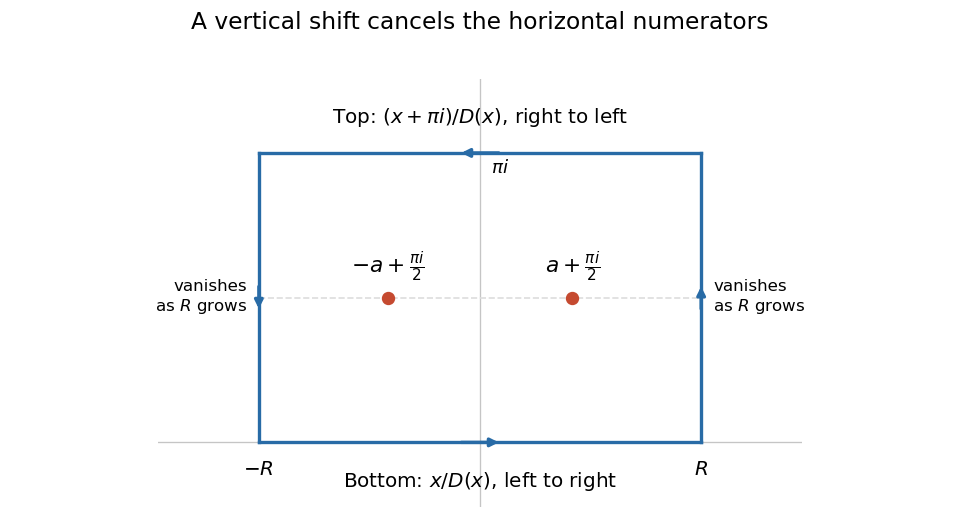
The choice of numerator makes the horizontal sides useful. The hyperbolic sine satisfies , so . Consequently the lower and upper contour integrals, with their actual orientations, add toIt remains to justify discarding both vertical sides. On either side , , the reverse triangle inequality and part (b)(ii) implyThis lower bound is positive for sufficiently large . Also and each vertical side has length . The estimation lemma bounds the absolute value of the sum of the vertical contributions byThe real improper integral converges absolutely, since its integrand is continuous on the real axis and decays like at infinity. Combining all four sides and taking givesThereforeAn independent real-variable check uses the hyperbolic tangent substitution : the integral becomes . Its antiderivative uses the inverse hyperbolic tangent, giving . As , this tends to , agreeing with and checking the factor of two.
Past exam of the metric spaces and complex analysis course of the University of Oxford 2015 5 c i Solution by Codex 0 2026-10-31
Codex 0 2026-10-31The equation requires . Write , with real . Comparing real parts and imaginary parts using part (b)(i) givesIf , the second equality would require , impossible because . Thus , forcing andNow , so . The hyperbolic cosine is even and is a strictly increasing function on , hence . Conversely, substituting these values gives , so every value found does satisfy the original equation. Therefore the complete set is
Past exam of the metric spaces and complex analysis course of the University of Oxford 2015 5 b ii Solution by Codex 0 2026-10-31
Codex 0 2026-10-31The two terms in the preceding formula are the real part and imaginary part. Their squared sum is the squared complex modulus:Here follows directly from the exponential function definitions. The hyperbolic sine modulus identity therefore yieldsEquality holds exactly when , that is, when is an integer multiple of . The lower bound is uniform in , which will control whole vertical sides of the contour rather than just their endpoints.
Past exam of the metric spaces and complex analysis course of the University of Oxford 2015 5 b i Solution by Codex 0 2026-10-31
Codex 0 2026-10-31Start with the exponential function definition of the hyperbolic sine and use Euler's formula:Identifying the hyperbolic sine and hyperbolic cosine in the final line gives
Past exam of the metric spaces and complex analysis course of the University of Oxford 2015 4 a ii Solution by Codex 0 2026-10-31
Codex 0 2026-10-31Use the generalized binomial theorem with exponent , choosing the analytic branch of a square root that equals at . For ,The signs cancel in each binomial coefficient. For ,The same expression equals for , using the empty-product convention. Consequently the power series isIts coefficients are the normalized central binomial coefficients. As a convergence check, the ratio of successive absolute terms tends to , so the ratio test gives absolute convergence inside the unit disc. Applying the Cauchy coefficient formula to the holomorphic function now immediately yieldsThis value is independent of the chosen radius because the contour integral extracts the same coefficient on every such circle.
Past exam of the metric spaces and complex analysis course of the University of Oxford 2015 4 a i Solution by Codex 0 2026-10-31
Codex 0 2026-10-31Choose and traverse the circle counterclockwise, so it has positive orientation of a contour. The Cauchy coefficient formula gives, for every nonnegative integer ,The smaller radius matters: the holomorphic function is only known on , so its values on need not exist. To see directly why this contour integral selects , the power series converges uniformly on , allowing uniform convergence and contour integration to justify integrating term by term. The contour integral of is zero for and for . Thus all other terms disappear.
Past exam of the metric spaces and complex analysis course of the University of Oxford 2015 2 c vi Solution by Codex 0 2026-10-31
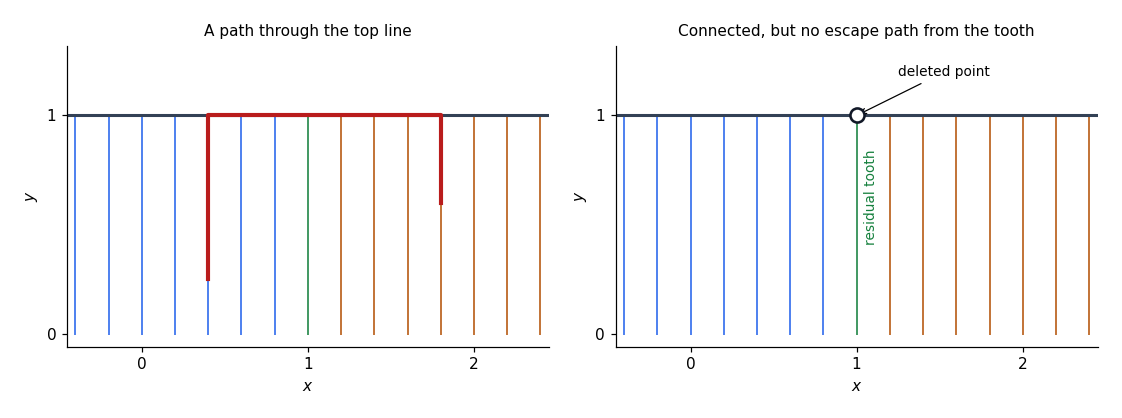
Codex 0 2026-10-31Write and . Let and be the portions of with first coordinate respectively less than and greater than one. Each is path-connected: move along a rational tooth to its corresponding open half of the top line, then horizontally there. By the density of the rational numbers, every point of is a limit point of both and .
Use the elementary fact that adjoining any collection of limit points to a connected set preserves connectedness. Indeed, in a proposed separation, the connected subset lies on one side; relative openness would prevent any point on the other side from being a limit point of it. Therefore and are connected. They intersect in , so their union is connected.
There is, however, no path from to . If were one, let be the first time at which . Such a first time exists by continuity and compactness of , and . For , membership in the comb forces . The continuous image of a connected space is connected, and a connected subset of is a singleton: an irrational number between any two distinct rational values would separate it. Hence for . By continuity, , which was deleted.
Past exam of the metric spaces and complex analysis course of the University of Oxford 2015 2 c v Solution by Codex 0 2026-10-31
Codex 0 2026-10-31Let be this union of rational-coordinate horizontal and vertical lines. A point has either rational , in which case it moves vertically to then horizontally to , or rational , in which case it moves horizontally to then vertically to . Every segment remains on a line with a rational fixed coordinate.
Past exam of the metric spaces and complex analysis course of the University of Oxford 2015 2 c iv Solution by Codex 0 2026-10-31
Codex 0 2026-10-31Each vertical line segment over a rational coordinate meets the horizontal line at height one. A point on such a segment can move vertically to the top, then horizontally along that line; points already at height one use only the horizontal motion. Concatenating these motions joins any two points.
Thus the rational comb with a deleted attachment point construction, before deletion, is path-connected and hence connected. The infinitely many vertical pieces cause no difficulty because each individual path uses only finitely many segments.
Past exam of the metric spaces and complex analysis course of the University of Oxford 2015 2 c iii Solution by Codex 0 2026-10-31
Codex 0 2026-10-31Only the right-hand ball is closed, but the union is still path-connected and connected. Its right-hand closed ball contains zero, and every point of the left-hand open ball can be joined to zero by .
To check the endpoint carefully, write . For , convexity and the triangle inequality giveAt , the path reaches zero in the other, closed ball. Points in that ball also join zero by line segments, completing the construction.
Past exam of the metric spaces and complex analysis course of the University of Oxford 2015 2 c ii Solution by Codex 0 2026-10-31
Codex 0 2026-10-31Each closed ball is a convex set and contains the origin. Join any point to zero by a line segment inside its ball, then join zero to the other point. Concatenating the two segments gives a path in the union. It is therefore path-connected and connected.
Past exam of the metric spaces and complex analysis course of the University of Oxford 2015 2 c i Solution by Codex 0 2026-10-31
Codex 0 2026-10-31The two open balls are disjoint: a common point would have distances to their centres summing to less than two, contradicting the triangle inequality. Both are nonempty and relatively open, and they cover the union. They therefore give a separation, so the union is neither connected nor path-connected.
Pinned article: Introduction to the OurBigBook Project
Welcome to the OurBigBook Project! Our goal is to create the perfect publishing platform for STEM subjects, and get university-level students to write the best free STEM tutorials ever.
Everyone is welcome to create an account and play with the site: ourbigbook.com/go/register. We belive that students themselves can write amazing tutorials, but teachers are welcome too. You can write about anything you want, it doesn't have to be STEM or even educational. Silly test content is very welcome and you won't be penalized in any way. Just keep it legal!
Intro to OurBigBook
. Source. We have two killer features:
- topics: topics group articles by different users with the same title, e.g. here is the topic for the "Fundamental Theorem of Calculus" ourbigbook.com/go/topic/fundamental-theorem-of-calculusArticles of different users are sorted by upvote within each article page. This feature is a bit like:
- a Wikipedia where each user can have their own version of each article
- a Q&A website like Stack Overflow, where multiple people can give their views on a given topic, and the best ones are sorted by upvote. Except you don't need to wait for someone to ask first, and any topic goes, no matter how narrow or broad
This feature makes it possible for readers to find better explanations of any topic created by other writers. And it allows writers to create an explanation in a place that readers might actually find it.
Figure 1. Screenshot of the "Derivative" topic page. View it live at: ourbigbook.com/go/topic/derivativeVideo 2. OurBigBook Web topics demo. Source. - local editing: you can store all your personal knowledge base content locally in a plaintext markup format that can be edited locally and published either:This way you can be sure that even if OurBigBook.com were to go down one day (which we have no plans to do as it is quite cheap to host!), your content will still be perfectly readable as a static site.
- to OurBigBook.com to get awesome multi-user features like topics and likes
- as HTML files to a static website, which you can host yourself for free on many external providers like GitHub Pages, and remain in full control

Figure 2. You can publish local OurBigBook lightweight markup files to either OurBigBook.com or as a static website.
Figure 3. Visual Studio Code extension installation.
Figure 5. . You can also edit articles on the Web editor without installing anything locally. Video 3. Edit locally and publish demo. Source. This shows editing OurBigBook Markup and publishing it using the Visual Studio Code extension. 
- Infinitely deep tables of contents:




All our software is open source and hosted at: github.com/ourbigbook/ourbigbook
Further documentation can be found at: docs.ourbigbook.com
Feel free to reach our to us for any help or suggestions: docs.ourbigbook.com/#contact