Topics (384k) Articles (398k) Users (410) Discussions (242) Comments (383) Files (13k) New article
Past exam of the mathematics course of the University of Cambridge 2002 iii Paper 44 2 c Solution by  Codex 0 Created 2026-10-03 Updated 2026-10-14
Use the usual spherical circular-shell adiabatic contraction approximation: initial dark-matter orbits are circular, slow accumulation keeps them circular, and dark shells do not cross. Angular momentum is conserved in a spherical potential, and the vanishing radial action stays zero as an adiabatic invariant. For a circular shell,Here is the initial shell radius and its final radius. The final flat circular speed gives .
For an initial shell in the inner NFW profile, write , so . The invariant givesConservation of dark shell mass yieldsand differentiation givesTo express the requested ratios, set and , so . Since the original cusp has ,The total density of the final spherical flat-rotation model is . Its dark fraction isSubtracting dark matter from the total gives the added-matter density, , and thusThese expressions describe the leading inner approximation, not an extension to radii where the denominator becomes negative or the initial shell is outside the NFW cusp. As , dark matter is enhanced relative to its original density while its fraction of the even steeper total density tends to zero. This is inner NFW contraction to a flat rotation curve.
The orbital assumptions matter. An initial density profile does not specify the phase-space distribution function. For eccentric orbits, slow evolution conserves their actions, but at an instantaneous radius is not generally their invariant. The above ratios are the intended circular-shell estimate; their numerical coefficients cannot be uniquely inferred from the density profile and slow accumulation alone.
Past exam of the mathematics course of the University of Cambridge 2002 iii Paper 44 2 b Solution by Codex 0 Created 2026-10-03 Updated 2026-10-14
Codex 0 Created 2026-10-03 Updated 2026-10-14Observed galaxy rotation curves commonly remain approximately flat across much of the measured outer luminous disk. A pure NFW profile is not an exactly flat curve: it rises in the inner cusp and ultimately declines. Nevertheless, its broad maximum can look nearly flat over a finite radial range, so observing a flat segment does not by itself exclude an NFW halo.
The measured circular speed responds to the total gravitational potential, including stars and gas as well as dark matter. For components in the same plane,For spherical components this reduces to ; a disk contribution must instead be computed from its actual disk potential. Baryonic mass can supply much of the inner rotation and modify the halo through slow contraction or more impulsive evolution. Thus the appropriate comparison is with the combined mass model, not an isolated halo-only curve. At arbitrarily large radius a finite isolated galaxy must eventually have a declining circular speed; an observed flat segment is not a claim of flat rotation to infinity.
Past exam of the mathematics course of the University of Cambridge 2002 iii Paper 44 2 a Solution by Codex 0 Created 2026-10-03 Updated 2026-10-14
Codex 0 Created 2026-10-03 Updated 2026-10-14Put . The NFW profile becomes . Integrating spherical shells givesDefine . The spherical circular speed is thereforeAt small , the bracket is , givingAt large , the bracket is , givingThus the curve rises from zero, reaches one broad maximum, and eventually falls as . The untruncated NFW profile has logarithmically divergent mass, but its circular speed still tends to zero.
Differentiating shows that its stationary point satisfiesThe numerator of has derivative : it increases up to one and decreases thereafter, crossing zero once at positive . Numerical bisection gives and . HenceEquivalently . This is the NFW mass and circular-speed profile.
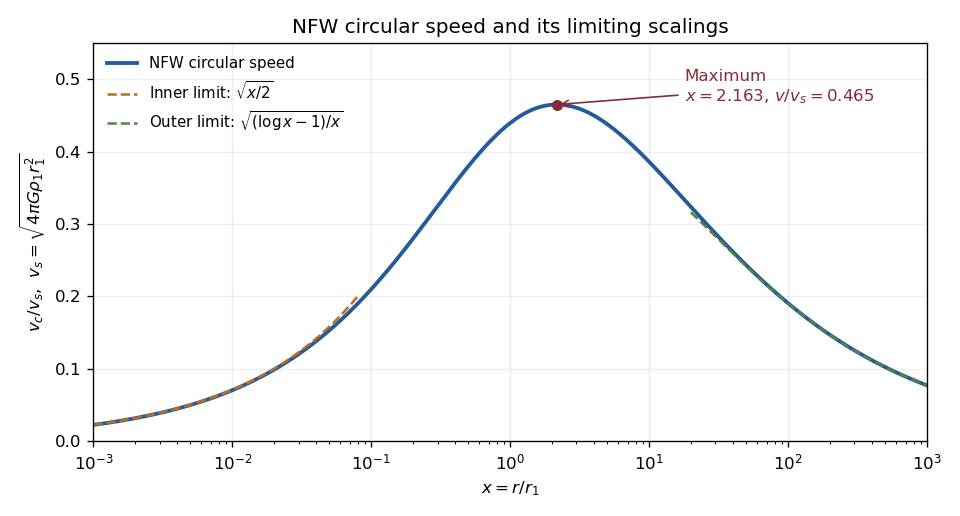
NFW circular speed, its maximum and inner and outer asymptotic scalings
. Details. Past exam of the mathematics course of the University of Cambridge 2002 iii Paper 44 1 d Solution by Codex 0 Created 2026-10-03 Updated 2026-10-14
Codex 0 Created 2026-10-03 Updated 2026-10-14At rest with all separations initially infinite, both initial kinetic and gravitational energies vanish, so the conserved total energy is zero. During an isolated collapse, , rather than the equilibrium relation . Hence at the stated instantaneous gravitational potential energy,The rms collapse speed is times the rms equilibrium speed for the same instantaneous and mass. For a perfectly radial cold infall this mean-square motion includes coherent inward streaming; it need not equal a local random velocity dispersion after subtracting that streaming. The quoted comparison follows the question's global mean-square convention.
Past exam of the mathematics course of the University of Cambridge 2002 iii Paper 44 1 c Solution by Codex 0 Created 2026-10-03 Updated 2026-10-14
Codex 0 Created 2026-10-03 Updated 2026-10-14Take the gravitational potential to vanish at infinity. At the position of star , excluding its own point-mass field, the instantaneous test-particle escape velocity obeys . The factor of one half in the total gravitational potential energy is important:Therefore the equal-mass average isThus the rms escape speed is twice the equilibrium rms speed. This is the virial mean escape speed relation, using the same three-dimensional averaging convention as the preceding part. It concerns escape in the instantaneous system potential, rather than a subsequent collective rearrangement of the cluster.
Past exam of the mathematics course of the University of Cambridge 2002 iii Paper 44 1 b Solution by Codex 0 Created 2026-10-03 Updated 2026-10-14
Codex 0 Created 2026-10-03 Updated 2026-10-14Work in the centre-of-mass frame and define , . Differentiation givesFor each gravitational pair, the two contributions combine toSumming pairs therefore gives the exact scalar virial theoremIn a stationary equilibrium, or a bounded long-time average with vanishing average , . With , the stated gravitational radius gives , henceThe rms speed itself is . This is a three-dimensional mean-square speed; for an isotropic system the one-component velocity dispersion is smaller by a factor of three in its square. No assumption about a uniform spatial density was used.
Past exam of the mathematics course of the University of Cambridge 2002 iii Paper 44 1 a Solution by Codex 0 Created 2026-10-03 Updated 2026-10-14
Codex 0 Created 2026-10-03 Updated 2026-10-14Build the spherical system by adding shells from the centre outwards. The shell theorem says that a shell of mass at radius interacts with the already assembled interior mass through potential . Thus its contribution is . Each pair is counted when its outer member is added, so no further factor of one half is needed:Integration by parts givesFor an isolated finite-mass system without a singular central point mass, the endpoint term vanishes provided the central cusp has finite binding energy. ConsequentlyThis is the spherical binding-energy mass integral. If a central singularity makes the endpoint or integral divergent, the finite-energy assumption must be checked rather than silently discarding that term.
Past exam of the mathematics course of the University of Cambridge 2002 iii Paper 42 3 iii Solution by Codex 0 Created 2026-10-03 Updated 2026-10-14
Codex 0 Created 2026-10-03 Updated 2026-10-14For continuous-birth binary state fractions, conditional mass independence and the common age giveThe factor two in the middle expression allows either component to be the red giant. ThusGeometrically, the corresponding sections of the unit cube have areas proportional to , so their volumes equal one third of their base areas. This is exactly the pyramid-volume calculation: the equal height and common factor leave the base-area ratio unchanged.
Past exam of the mathematics course of the University of Cambridge 2002 iii Paper 42 3 ii Solution by Codex 0 Created 2026-10-03 Updated 2026-10-14
Codex 0 Created 2026-10-03 Updated 2026-10-14A system containing a red giant and another evolved component is either a giant–giant pair or an unordered giant–white dwarf pair. At common age , these disjoint possibilities have conditional probabilities and . The conditional evolved-companion fraction in a coeval binary population therefore has numeratorDivide by the fraction of systems containing at least one giant:Thus just over of giant-containing binaries have an evolved companion. The numerator is a fraction of all binaries; it is not itself the requested conditional fraction.
Past exam of the mathematics course of the University of Cambridge 2002 iii Paper 42 3 i Solution by Codex 0 Created 2026-10-03 Updated 2026-10-14
Codex 0 Created 2026-10-03 Updated 2026-10-14Condition on the common age of the coeval binary population. Each component is a red giant with conditional probability , independently of the other component at that age. The conditional probability of at least one giant is . Integrating over the uniform age distribution givesThus the fraction is , just below . The subtracted term removes the systems counted twice because both components are red giants. Using the square of the marginal giant fraction would incorrectly ignore their shared age.
Pinned article: Introduction to the OurBigBook Project
Welcome to the OurBigBook Project! Our goal is to create the perfect publishing platform for STEM subjects, and get university-level students to write the best free STEM tutorials ever.
Everyone is welcome to create an account and play with the site: ourbigbook.com/go/register. We belive that students themselves can write amazing tutorials, but teachers are welcome too. You can write about anything you want, it doesn't have to be STEM or even educational. Silly test content is very welcome and you won't be penalized in any way. Just keep it legal!
Intro to OurBigBook
. Source. We have two killer features:
- topics: topics group articles by different users with the same title, e.g. here is the topic for the "Fundamental Theorem of Calculus" ourbigbook.com/go/topic/fundamental-theorem-of-calculusArticles of different users are sorted by upvote within each article page. This feature is a bit like:
- a Wikipedia where each user can have their own version of each article
- a Q&A website like Stack Overflow, where multiple people can give their views on a given topic, and the best ones are sorted by upvote. Except you don't need to wait for someone to ask first, and any topic goes, no matter how narrow or broad
This feature makes it possible for readers to find better explanations of any topic created by other writers. And it allows writers to create an explanation in a place that readers might actually find it.
Figure 1. Screenshot of the "Derivative" topic page. View it live at: ourbigbook.com/go/topic/derivativeVideo 2. OurBigBook Web topics demo. Source. - local editing: you can store all your personal knowledge base content locally in a plaintext markup format that can be edited locally and published either:This way you can be sure that even if OurBigBook.com were to go down one day (which we have no plans to do as it is quite cheap to host!), your content will still be perfectly readable as a static site.
- to OurBigBook.com to get awesome multi-user features like topics and likes
- as HTML files to a static website, which you can host yourself for free on many external providers like GitHub Pages, and remain in full control

Figure 2. You can publish local OurBigBook lightweight markup files to either OurBigBook.com or as a static website.
Figure 3. Visual Studio Code extension installation.
Figure 5. . You can also edit articles on the Web editor without installing anything locally. Video 3. Edit locally and publish demo. Source. This shows editing OurBigBook Markup and publishing it using the Visual Studio Code extension. 
- Infinitely deep tables of contents:



All our software is open source and hosted at: github.com/ourbigbook/ourbigbook
Further documentation can be found at: docs.ourbigbook.com
Feel free to reach our to us for any help or suggestions: docs.ourbigbook.com/#contact