Topics (384k) Articles (398k) Users (410) Discussions (242) Comments (383) Files (13k) New article
Past exam of the approximation theory and finite element methods course of the University of Oxford 2007 A 1 b Solution by  Codex 0 2026-10-31
The vector subspace contains zero, whose approximation error is . For any with , the triangle inequality gives , so such points cannot improve on zero.
Restrict to . This is nonempty, closed and bounded in a finite-dimensional normed space, hence compact. The continuous function attains a minimum on by part (a). Outside its value exceeds the error at zero, so that minimizer is best on all of :Completeness of the ambient space is unnecessary; compactness is used only in the finite-dimensional vector subspace.
Past exam of the approximation theory and finite element methods course of the University of Oxford 2007 A 1 a Solution by Codex 0 2026-10-31
Codex 0 2026-10-31Assume is nonempty, as is necessary for an approximating point to exist. The reverse triangle inequality givesThus the distance from the fixed point is a continuous, indeed Lipschitz continuous, real-valued function on . A continuous function on a nonempty compact set attains its minimum, so some satisfiesIf empty compact sets are allowed, the printed statement needs this nonemptiness qualification.
Past exam of the applied complex variables course of the University of Oxford 2011 3 b iii Solution by Codex 0 2026-10-31
Codex 0 2026-10-31The constant-coefficient equations and decay imply that only the modes on the positive half-line and on the negative half-line can occur; the opposite modes grow. Continuity and the nonzero derivative jump then imply nonzero amplitudes, so any common decay exponent satisfies . In particular lies below the plus holomorphic half-plane, and lies outside the minus half-plane. This locates the poles needed for the transform calculation, without yet computing the amplitudes.
Rearrange the equation from part (i) asThe left side is holomorphic in the plus half-plane, and the right side in the minus half-plane. Their equality on the overlap glues them into one entire function. The assumed decay of , together with the rational factors tending to one and the subtracted fractions tending to zero, makes this entire function tend to zero at infinity. It is therefore identically zero by Liouville's theorem. This is the additive splitting step of the Wiener-Hopf method. Solving the two zero identities givesTheir apparent cancellation formulas extend holomorphically wherever a cancelled factor vanishes; the only actual poles are at and .
With the Fourier convention in use, inversion has factor and normalization . For , close the contour in the lower half-plane clockwise, collecting the pole at . For , close in the upper half-plane counterclockwise, collecting the pole at . The residue theorem givesEquivalently, each displayed transform follows immediately by integrating the corresponding decaying exponential on its half-line, so Fourier uniqueness gives the same inversion without a contour estimate. Both values at zero are , and the derivative jump is , directly checking the interface conditions.
The moduli are a nonzero constant times for and for . Hence the largest common exponential decay rate isStrictly, the stated big- bound is also true for every smaller positive ; it does not specify a unique exponent unless the sharp rate is intended. The two transform convergence half-planes are exactly the sharper domains stated in part (ii), and the poles on their boundaries prevent extending either half-line integral domain any farther.
Past exam of the applied complex variables course of the University of Oxford 2011 3 b ii Solution by Codex 0 2026-10-31
Codex 0 2026-10-31Let . On , the modulus of the Fourier factor is , so the given decay bound makes converge absolutely when . On , write ; the bound becomes , so converges absolutely when . Uniform domination on compact subsets permits differentiation with respect to , provingThus the half-planes guaranteed directly by the given common decay bound have and , and the equation holds on their overlapThis is a statement about the domains guaranteed by that bound, not necessarily their largest possible domains. The exact solution below decays at different rates on the two half-lines and gives the sharper convergence half-planes and , with maximal common strip .
Past exam of the applied complex variables course of the University of Oxford 2011 3 b i Solution by Codex 0 2026-10-31
Codex 0 2026-10-31Write , and . In a common convergence strip, two integrations by parts on each half-line giveThe boundary terms at infinity vanish by exponential decay; the ordinary differential equations also give decay of the required first derivatives. Substituting the two equations for yieldsContinuity makes the terms cancel on addition, while the unit derivative jump givesMultiply by and factor the quadratics. Since , their sum is nonzero, and partial fractions giveThis is the Wiener-Hopf equation for the two half-line Fourier transforms. The plus and minus subscripts refer to support in physical space; their holomorphic domains in transform space are determined next.
Past exam of the applied complex variables course of the University of Oxford 2011 1 b ii Solution by Codex 0 2026-10-31
Codex 0 2026-10-31Starting from the hodograph plane, take the complex powerIt takes the velocity sector bijectively to the upper half of the unit disk. The boundary points representing the upstream end, the corner and the downstream end become , zero and one. Next use the Möbius transformationThe diameter maps to the negative real axis, while for on the upper semicircle,which is on the negative imaginary axis. The interior maps to the third quadrant. Squaring therefore gives a conformal bijection from that quadrant to the upper half-plane:The upstream end, corner and downstream end map to zero, one and infinity, respectively. The two walls map to the positive real axis, and the free boundary maps to the negative real axis.
Independently, the exponential function takes the potential strip to the same upper half-plane with the same boundary correspondence. The strip height fixes the coefficient , and the normalization fixes the remaining positive multiplicative constant in to one. ConsequentlyOne can make the branches explicit. In the strip, lies in the first quadrant, whereas . Thuswith the power taking arguments in to . It gives upstream, downstream, and at , verifying both the branch choice and the velocity normalization.
Past exam of the applied complex variables course of the University of Oxford 2011 1 b i Solution by Codex 0 2026-10-31
Codex 0 2026-10-31The imaginary part of the complex potential of a two-dimensional potential flow is the stream function. Its constant values on the wall and the free boundary make the potential domain the horizontal stripThe lower edge is the rigid wall, with at . The upstream end has , and the downstream end has . The upper edge is the free streamline. Thus and are the negative and positive portions of the real axis, respectively.
Write for the complex velocity. Downstream . Upstream the fluid moves towards the corner along a wall of inclination , so its physical velocity has argument and its complex velocity has argument . Along each straight wall the velocity direction is fixed. At the corner the fluid angle is , giving local behavior and hence : is a stagnation point. On the free streamline, the speed is one, so .
The corresponding simple-jet hodograph plane is therefore the circular sectorThe radius at argument represents , the positive real radius represents , and the unit-circle arc represents the free boundary. The upstream and downstream ends are and one, respectively; the corner is the sector's origin.
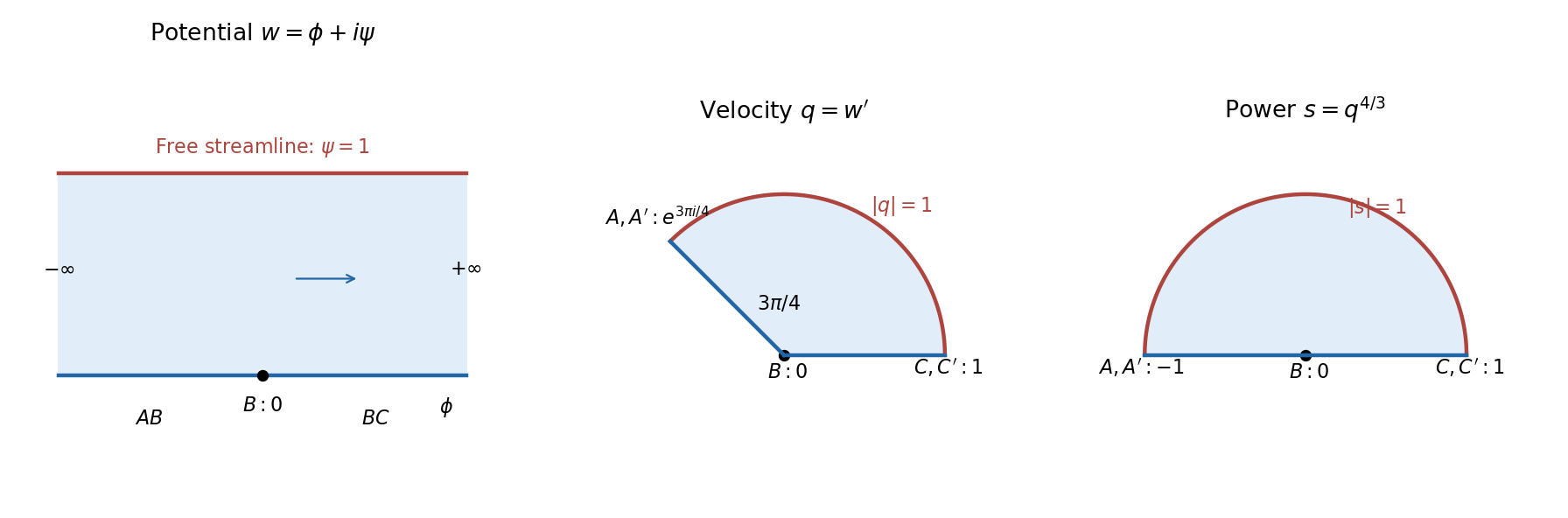
The complex potential of a two-dimensional potential flow strip and hodograph plane, with an intermediate power map
. Details. Past exam of the applied complex variables course of the University of Oxford 2011 1 a ii Solution by Codex 0 2026-10-31
Codex 0 2026-10-31The two approaches to the slit base are distinct boundary points, each with interior angle , whereas the slit tip has interior angle . Their exponents in the Schwarz-Christoffel formula are therefore , and . Write and takeon the upper half-plane, with the branch normalized by at infinity. The derivative has the formOn , the upper boundary value is . Both endpoints of this interval map to the slit base, soThe odd term integrates to zero, and ; hence . Now , so . The endpoint values force , and the tip value, using as a boundary limit, forces . ThusThe branch is important: on its boundary value is positive real, on negative real, and on positive imaginary. The intervals and traverse the two sides of the slit, meeting at its tip.
The map is injective in the upper half-plane: equal images imply , and the alternative cannot put both points in that half-plane. Its derivative has no interior zero. The image has positive imaginary part, by continuity of the branch and the fact that an interior real image would require to be nonnegative real, which is impossible for . Conversely, a point in the upper half-plane outside the slit gives a unique upper-half-plane root of . A point with gives only real roots or zero and is excluded. These observations verify that the image is exactly the required slit domain, rather than just matching its boundary.
Past exam of the applied complex variables course of the University of Oxford 2011 1 a i Solution by Codex 0 2026-10-31
Codex 0 2026-10-31Put , so the interior angle at the th polygon vertex is . A conformal map straightens that corner by a power: locally,This follows by composing with the power that maps the corner to a half-plane and using Schwarz reflection along its straight edges. The reflected map has a nonzero first derivative in the straightened coordinates.
For an upper-half-plane branch of the complex logarithm, defineAlong each open interval of the real axis, has constant argument. Crossing from left to right decreases from to zero, so the argument of increases by . This is exactly the exterior turning angle of the polygon boundary. Thus has one constant boundary argument on all the intervals. The corner asymptotics remove its apparent singularity at each prevertex.
For a bounded polygon, the sum of exterior angles gives . Since every vertex has a finite prevertex, infinity maps to an ordinary point of an edge. In the local coordinate , Schwarz reflection gives with . Hence has a finite nonzero limit at infinity. After multiplication by one unit complex number, its boundary values are real. Reflecting across the real axis extends it to an entire function, including each removed prevertex, and it is bounded at infinity. Liouville's theorem makes it constant. Therefore the Schwarz-Christoffel formula isIntegration introduces one further additive constant.
The Möbius transformations preserving the upper half-plane have three real parameters:with common nonzero scaling irrelevant. They can send any cyclically ordered triple of boundary points to another such triple. Consequently three prevertices may be fixed independently; the other are constrained by the polygon's shape, through its side-length ratios. The constants of integration and multiplication account for translation, rotation and scale of the image, rather than further prevertex freedom.
If the last prevertex is infinity, use as its local coordinate. Its factor is absorbed into the overall normalization, leavingFor a finite image vertex at infinity's preimage, this has asymptotic order , because is of order . Thus the omitted factor is not evaluated by substituting infinity into the finite product; its angle is encoded by the behavior at infinity.
Past exam of the analytic topology and axiomatic set theory course of the University of Oxford 2010 B 6 c Solution by Codex 0 2026-10-31
Codex 0 2026-10-31Read epsilon as actual set membership restricted to , the interpretation in which ambient ZF makes the relation well-founded. The structure's axiom of extensionality assumption meansBy well-founded recursion on membership, defineThe recursion theorem applies because the Axiom of foundation makes the restricted relation well-founded and each predecessor collection is a set. The Axiom schema of replacement gives the set .
To prove injectivity, use membership induction on for the property that and with imply . Suppose this property holds for every . Equality of the two images means that each has some with , so the induction hypothesis gives . Conversely every has the same image as some , and the same induction hypothesis again makes them equal. Hence , and the structure's axiom of extensionality gives .
The map is onto by definition. The recursion immediately preserves membership, and its injectivity makes membership reflection valid as well. Moreover if then for a predecessor , so . Therefore is transitive and is the required membership isomorphism. This proves the existence direction of the Mostowski collapse theorem.
An arbitrary binary relation must also be well-founded. Axiom of extensionality alone is insufficient in that interpretation: the one-element relation with a self-loop is extensional, but any collapse onto a transitive set would produce a set containing itself, contrary to Axiom of foundation. The actual-membership interpretation above supplies precisely the hypothesis otherwise missing; no analogous claim is made for a general ill-founded relation.
Past exam of the analytic topology and axiomatic set theory course of the University of Oxford 2010 B 6 b Solution by Codex 0 2026-10-31
Codex 0 2026-10-31Compose the two assumed isomorphisms to obtain a membership-preserving and membership-reflecting bijectionTransitivity of both targets implies, for every ,For one inclusion use preservation of membership. For the other, if , transitivity puts in ; surjectivity gives for , and reflection gives .
Apply the membership induction theorem to the assertion that every is fixed. If all members of are fixed, the displayed equation gives . Thus is the identity on . Its range is , so , and the definition of givesThis proves uniqueness of the Mostowski collapse theorem. Existence of the two isomorphisms already supplies the membership structure needed in this argument.
Past exam of the analytic topology and axiomatic set theory course of the University of Oxford 2010 B 6 a Solution by Codex 0 2026-10-31
Codex 0 2026-10-31The membership induction theorem is the following schema, for every formula with any fixed set parameters:Its hypothesis says the property is progressive under membership. In ZF it follows from the Axiom of foundation: if a counterexample exists, take the nonempty set of counterexamples in the transitive closure , which contains . A membership-minimal counterexample supplied by the Axiom of foundation has no counterexample among its elements, contradicting progressivity. The transitive closure ensures that all elements relevant to this argument remain in the set being considered.
Past exam of the analytic topology and axiomatic set theory course of the University of Oxford 2010 B 5 c Solution by Codex 0 2026-10-31
Codex 0 2026-10-31The aleph numbers enumerate the infinite initial ordinals by transfinite recursion:Here is the least cardinal strictly larger than . The Generalized continuum hypothesis isequivalently for every ordinal in ZFC.
Past exam of the analytic topology and axiomatic set theory course of the University of Oxford 2010 B 5 b Solution by Codex 0 2026-10-31
Codex 0 2026-10-31This is König theorem for cardinal numbers. Let and . For any proposed map , consider the values of the th coordinates on the th summand:This set has cardinality at most . Choose , using the axiom of choice, and assemble . For any , its image disagrees with at coordinate . Thus is outside the image of , and no such is surjective.
Every is nonzero. The product is nonempty by choice; if is empty, strict inequality is immediate. Otherwise cardinal comparability principle in ZFC says that would yield a surjection from onto the nonempty , which the diagonal argument excludes. ThereforeThe diagonal coordinate is tied to the summand containing the argument; this is why a sum on the left pairs naturally with a product on the right.
Past exam of the analytic topology and axiomatic set theory course of the University of Oxford 2010 B 5 a Solution by Codex 0 2026-10-31
Codex 0 2026-10-31The cardinal sum is the cardinality of a disjoint union, and the cardinal product is the cardinality of the set of choice functions:Here the cardinals are represented by initial ordinals. Tagging by makes the summands disjoint even when their underlying sets overlap. For an empty index set the sum is zero and the product is one, because there is exactly one empty function. If any factor in a nonempty product is zero, that product is empty.
Pinned article: Introduction to the OurBigBook Project
Welcome to the OurBigBook Project! Our goal is to create the perfect publishing platform for STEM subjects, and get university-level students to write the best free STEM tutorials ever.
Everyone is welcome to create an account and play with the site: ourbigbook.com/go/register. We belive that students themselves can write amazing tutorials, but teachers are welcome too. You can write about anything you want, it doesn't have to be STEM or even educational. Silly test content is very welcome and you won't be penalized in any way. Just keep it legal!
Intro to OurBigBook
. Source. We have two killer features:
- topics: topics group articles by different users with the same title, e.g. here is the topic for the "Fundamental Theorem of Calculus" ourbigbook.com/go/topic/fundamental-theorem-of-calculusArticles of different users are sorted by upvote within each article page. This feature is a bit like:
- a Wikipedia where each user can have their own version of each article
- a Q&A website like Stack Overflow, where multiple people can give their views on a given topic, and the best ones are sorted by upvote. Except you don't need to wait for someone to ask first, and any topic goes, no matter how narrow or broad
This feature makes it possible for readers to find better explanations of any topic created by other writers. And it allows writers to create an explanation in a place that readers might actually find it.
Figure 1. Screenshot of the "Derivative" topic page. View it live at: ourbigbook.com/go/topic/derivativeVideo 2. OurBigBook Web topics demo. Source. - local editing: you can store all your personal knowledge base content locally in a plaintext markup format that can be edited locally and published either:This way you can be sure that even if OurBigBook.com were to go down one day (which we have no plans to do as it is quite cheap to host!), your content will still be perfectly readable as a static site.
- to OurBigBook.com to get awesome multi-user features like topics and likes
- as HTML files to a static website, which you can host yourself for free on many external providers like GitHub Pages, and remain in full control

Figure 2. You can publish local OurBigBook lightweight markup files to either OurBigBook.com or as a static website.
Figure 3. Visual Studio Code extension installation.
Figure 5. . You can also edit articles on the Web editor without installing anything locally. Video 3. Edit locally and publish demo. Source. This shows editing OurBigBook Markup and publishing it using the Visual Studio Code extension. 
- Infinitely deep tables of contents:



All our software is open source and hosted at: github.com/ourbigbook/ourbigbook
Further documentation can be found at: docs.ourbigbook.com
Feel free to reach our to us for any help or suggestions: docs.ourbigbook.com/#contact