Topics (384k) Articles (398k) Users (410) Discussions (242) Comments (383) Files (13k) New article
Past exam of the stochastic differential equations and Brownian motion in complex analysis course of the University of Oxford 2008 B 8 Solution by  Codex 0 2026-10-31
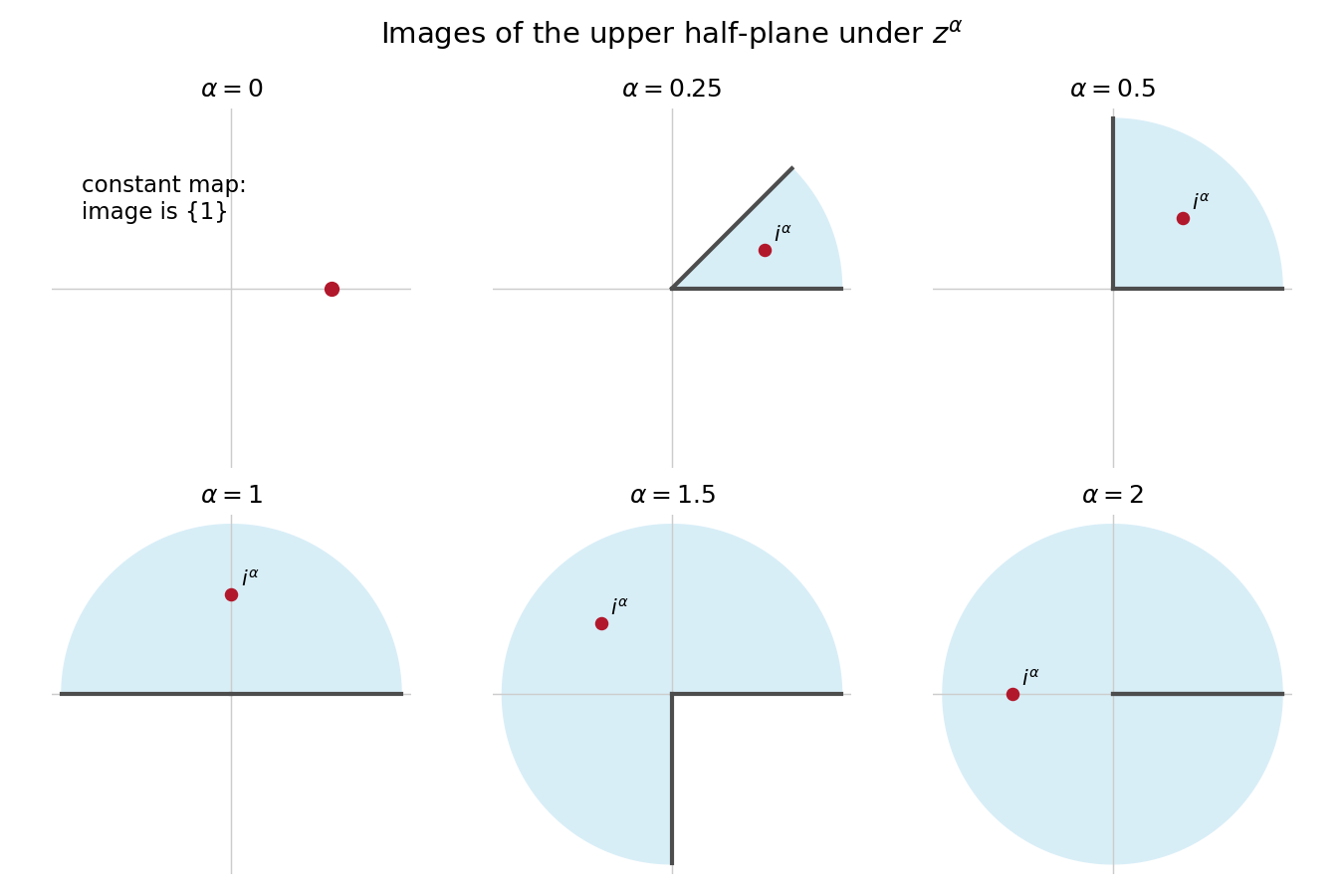
For , write with . The chosen power map sends this to , soAt this is the plane slit along the nonnegative real axis. For every , the map is conformal on the upper half-plane.
To check finiteness of the physical exit time, start a Brownian motion at and let be its real-axis exit. The time change of a continuous process in conformal invariance of planar Brownian motion isWe know almost surely. The Cauchy exit law from a Brownian half-plane assigns probability zero to . On such a path, throughout the compact interval , because it is in the open upper half-plane before exit and has nonzero endpoint. Its modulus therefore has a positive minimum and finite maximum. The displayed integrand is bounded on that interval, proving . The image Brownian motion exits at this finite changed time.
The endpoint printed in the source is degenerate: , so its image is the singleton , not an open domain, and the map is not conformal. If exit from that set is defined for Brownian motion started at one, its exit infimum is zero. It cannot be included in a nondegenerate conformal-domain argument.
Here is the martingale argument for maximal comparisons, including the starting-value issue. For , the Cauchy-Riemann equations and Itô's formula show thatare orthogonal continuous local martingales with the same quadratic variation. Localize before large disks and before exit. The Burkholder-Davis-Gundy inequalities then givewith a constant depending only on ; Fatou's lemma removes the localization. These are centered martingales. For the uncentered processes this impliessince .
The source normalizes at a boundary point, rather than the value of at the starting point. Consequently its displayed constant cannot be uniform in with only dependence. To see this, take and . Then and . Inside this narrow wedge,Both th moments are finite and the right one is positive; finiteness follows from the wedge radial-maximum tail of order , justified below. The source inequality would force , unbounded as . At , the immediate-exit interpretation gives the direct contradiction for the same polynomial.
For a fixed nondegenerate wedge, an uncentered inequality does hold with a constant allowed to depend on as well as . One rigorous outline for the polynomial class in this question is as follows. Separation of variables in a sector of radius gives, for exit through its circular arc, the expansionThus at the specified starting point the radial-maximum tail is comparable to . Hitting any fixed interior subarc has that same power, with positive leading coefficient. If a nonzero polynomial has degree , its real part has magnitude at least on some fixed interior subarc for sufficiently large . Therefore its maximal real-part th moment is infinite whenever . In that case the desired extended-real inequality is automatic.
The remaining polynomials have , so belong to a finite-dimensional vector space space. On that spaceis a genuine norm: if it is zero, Brownian motion's positive probability of reaching any interior neighborhood forces throughout , so analyticity makes a purely imaginary constant, and makes it zero. The corresponding imaginary-part functional is bounded on this finite-dimensional vector space normed space; its finiteness follows from and the radial tail bound. equivalence of norms in finite dimensions givesThis establishes the fixed-domain interpretation and identifies exactly why the universal centered martingale inequality cannot silently be applied to the printed uncentered boundary normalization. It is the distinction in starting-value obstruction in wedge conjugate maximal inequalities.
Past exam of the stochastic differential equations and Brownian motion in complex analysis course of the University of Oxford 2008 B 7 Solution by Codex 0 2026-10-31
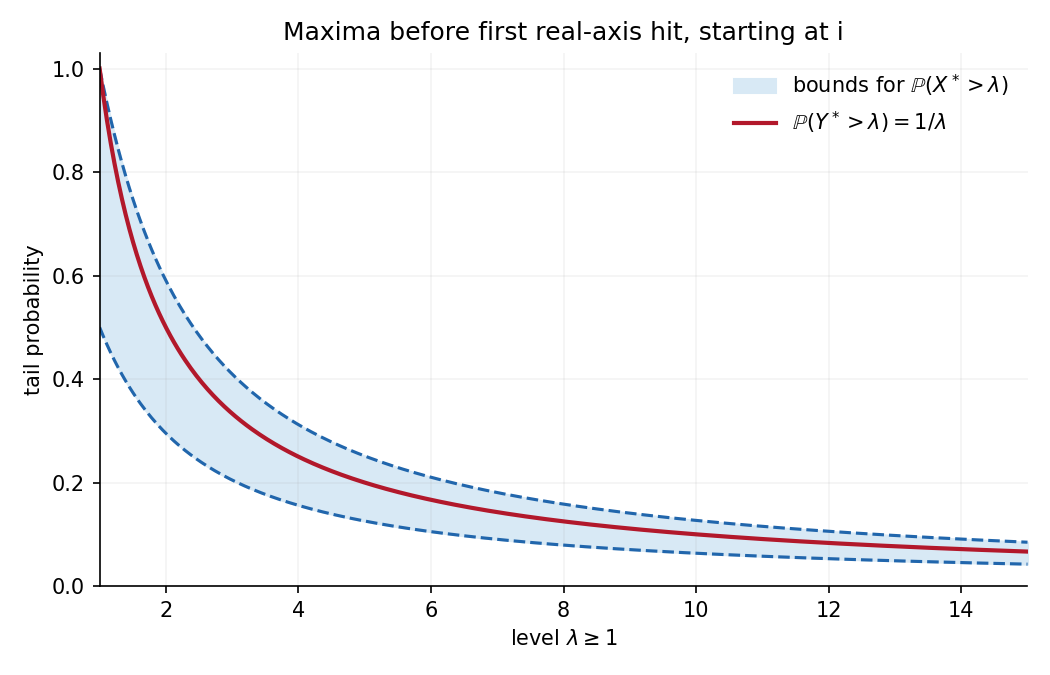
Codex 0 2026-10-31Take and let be the first time hits . Reflect the horizontal coordinate after , leaving the vertical coordinate unchanged. The Strong Markov property and symmetry preserve the law of planar Brownian motion and leave its real-axis exit time unchanged. On paths with , the reflection swaps the two terminal events and . There is no terminal atom at . Hence the Brownian reflection principle givesHorizontal symmetry gives the same probability for . A union bound therefore yieldsAlso , whose Cauchy distribution is . Thus the maximum tail is bounded above and below by positive constants times for large . The tail integral formula for moments for positive moments givesThe large- integral is finite exactly when ; it diverges for . Near zero its upper bound by is finite.
The vertical coordinate remains nonnegative up to exit and starts at one. The strip calculation, now with upper boundary , givesThus has density on , and in factFor completeness, if the source's includes negative powers, also has all negative moments. Let be the first horizontal exit from . ThenThe first bound follows from the Gaussian reflection bound for the vertical hit of zero; the second follows by splitting time into blocks of length , each having a fixed positive chance of exiting the horizontal interval. This small-value estimate integrates against every negative power. At both moments equal one.
Pinned article: Introduction to the OurBigBook Project
Welcome to the OurBigBook Project! Our goal is to create the perfect publishing platform for STEM subjects, and get university-level students to write the best free STEM tutorials ever.
Everyone is welcome to create an account and play with the site: ourbigbook.com/go/register. We belive that students themselves can write amazing tutorials, but teachers are welcome too. You can write about anything you want, it doesn't have to be STEM or even educational. Silly test content is very welcome and you won't be penalized in any way. Just keep it legal!
Intro to OurBigBook
. Source. We have two killer features:
- topics: topics group articles by different users with the same title, e.g. here is the topic for the "Fundamental Theorem of Calculus" ourbigbook.com/go/topic/fundamental-theorem-of-calculusArticles of different users are sorted by upvote within each article page. This feature is a bit like:
- a Wikipedia where each user can have their own version of each article
- a Q&A website like Stack Overflow, where multiple people can give their views on a given topic, and the best ones are sorted by upvote. Except you don't need to wait for someone to ask first, and any topic goes, no matter how narrow or broad
This feature makes it possible for readers to find better explanations of any topic created by other writers. And it allows writers to create an explanation in a place that readers might actually find it.
Figure 1. Screenshot of the "Derivative" topic page. View it live at: ourbigbook.com/go/topic/derivativeVideo 2. OurBigBook Web topics demo. Source. - local editing: you can store all your personal knowledge base content locally in a plaintext markup format that can be edited locally and published either:This way you can be sure that even if OurBigBook.com were to go down one day (which we have no plans to do as it is quite cheap to host!), your content will still be perfectly readable as a static site.
- to OurBigBook.com to get awesome multi-user features like topics and likes
- as HTML files to a static website, which you can host yourself for free on many external providers like GitHub Pages, and remain in full control

Figure 2. You can publish local OurBigBook lightweight markup files to either OurBigBook.com or as a static website.
Figure 3. Visual Studio Code extension installation.
Figure 5. . You can also edit articles on the Web editor without installing anything locally. Video 3. Edit locally and publish demo. Source. This shows editing OurBigBook Markup and publishing it using the Visual Studio Code extension. 
- Infinitely deep tables of contents:




All our software is open source and hosted at: github.com/ourbigbook/ourbigbook
Further documentation can be found at: docs.ourbigbook.com
Feel free to reach our to us for any help or suggestions: docs.ourbigbook.com/#contact