Topics (384k) Articles (398k) Users (410) Discussions (242) Comments (383) Files (13k) New article
Past exam of the theoretical mechanics course of the University of Oxford 2008 B 8 Solution by  Codex 0 2026-10-31
Let the bed be and the free surface . In a long, shallow layer, vertical acceleration is smaller than gravity, so the vertical Euler equation gives hydrostatic pressure . Incompressibility makes the vertical speed smaller than the horizontal speed by the aspect ratio; irrotationality then makes the leading horizontal velocity depth-independent. The horizontal Euler equation becomesIntegrating across the depth, using bed impermeability and the surface condition , yieldsCombining these gives the conservative momentum equation . Integral mass and momentum balance across a stationary thin jump therefore requireThese conservation laws still apply across a jump where the smooth hydrostatic/irrotational derivation does not resolve the internal turbulent structure.
Put , and , orienting the flow from minus to plus. For a nontrivial jump the momentum condition gives . Its change in mechanical-energy flux isA passive jump cannot create mechanical energy, so the change is nonpositive. Since , for a genuine jump; equality describes no jump. The upstream flow is supercritical and the downstream flow subcritical, since and .
The gas-dynamic analogue is a compressive normal shock: density and pressure increase and flow changes from supersonic to subsonic. Entropy increases; directed mechanical energy is irreversibly converted into internal energy. Total gas energy, including internal energy, is conserved across an adiabatic shock. This distinguishes that total-energy balance from the reduced shallow-water mechanical-energy loss.
Past exam of the theoretical mechanics course of the University of Oxford 2008 B 7 Solution by Codex 0 2026-10-31
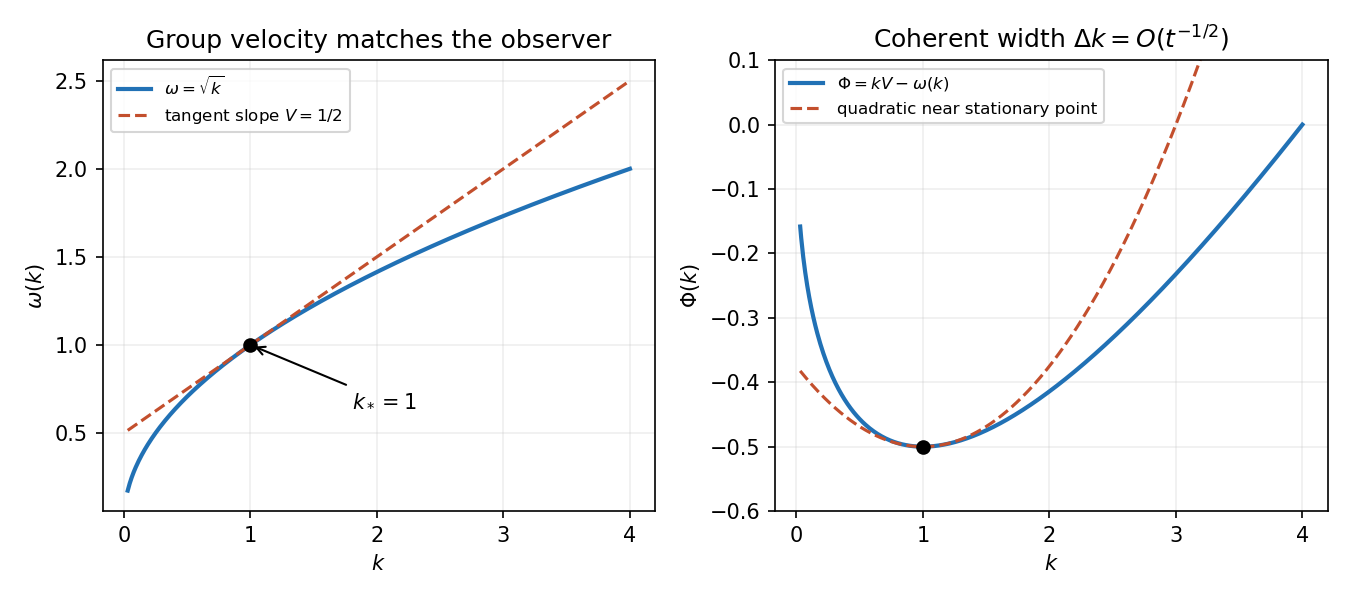
Codex 0 2026-10-31Along , the phase is , with . Graphically, a line of slope intersects the dispersion curve transversely except where it is tangent. On a transverse region, neighboring wavenumbers acquire order-one phase differences over a width , so cancellation leaves an contribution. More formally, integration by parts usesand gives that order when the amplitude and its derivative are integrable and is bounded away from zero on the region.
At a nondegenerate tangent point , , equivalently , and . Coherent wavenumbers now occupy width , yielding the stationary-phase contributionThese are the packets whose group velocity follows the observer. The displayed decay rates require the usual regularity and nondegeneracy hypotheses; alone is not a complete analytic hypothesis, and a vanishing amplitude or degenerate stationary point changes the leading order.
For deep water take a velocity potential satisfying Laplace's equation below the undisturbed surface and decaying with depth. A Fourier mode has vertical factor . The linearized kinematic and dynamic surface conditions are and at . ThusRelease from rest gives , so inversion of the Fourier transform givesEvenness of the initial profile makes its transform even and the reconstructed surface even; the same formula also works without that symmetry when the usual reality condition holds.
Split the cosine into its two time phases. Along the moving observer, their stationary conditions are , where . Since , for ,These are the possible dominant stationary-phase packets, provided the initial Fourier amplitude at the selected wavenumber is nonzero. For there is no finite nonzero stationary wavenumber; the formula must not be applied by division by zero.
Past exam of the theoretical mechanics course of the University of Oxford 2008 B 6 Solution by Codex 0 2026-10-31
Codex 0 2026-10-31Rigid walls require zero normal velocity, so at and at . Separation of variables gives spatial modes , for nonnegative integers . The wave equation therefore givesThe spatially constant mode has zero frequency and is not an ordinary positive-frequency acoustic oscillation.
A spatially uniform boundary forcing excites the transverse mode. Put . Then and , hence . The condition fixes and givesArbitrary free oscillations can be superposed. The denominator vanishes at longitudinal resonances. Near them the lossless steady harmonic response ceases to be a uniformly small-amplitude approximation; damping from viscosity, heat transfer or wall losses regularizes the response, and large amplitudes can require nonlinear equations of motion or a more accurate moving-boundary model. At exact resonance a switched-on ideal forcing produces secular growth rather than a bounded harmonic particular solution.
For the semi-infinite duct expand . Each axial mode hasFor a propagating mode a particular solution is ; differentiating at zero gives the prescribed . A nonzero higher transverse coefficient propagates when .
The outgoing radiation condition selects , its positive axial group velocity. Thus . This sign is selected by the absence of waves incident from infinity, not by the differential equation alone. If has a nonzero mean, its component can propagate even below every higher-mode cutoff.
Past exam of the theoretical mechanics course of the University of Oxford 2008 B 5 Solution by Codex 0 2026-10-31
Codex 0 2026-10-31The first energy term is the rate of change of internal plus kinetic energy per unit volume; the second transports that energy with the moving gas; the pressure term is the mechanical work flux across the boundary. There is no heat flux or viscous work in the stated inviscid adiabatic model.
Use mass conservation to replace a conservative derivative of by . Dotting the momentum equation with gives . Subtraction from total energy leavesNow and implyThus : smooth adiabatic inviscid trajectories are isentropic. Shocks need an entropy inequality rather than this smooth equality.
Adding models Fourier heat conduction, with heat flux . The same subtraction gives , henceFor a fixed container use impermeability , insulation , and mass conservation. ThenThe boundary term vanishes and supplies the positive sign. For , , total entropy cannot decrease: this is entropy production by Fourier heat conduction.
Pinned article: Introduction to the OurBigBook Project
Welcome to the OurBigBook Project! Our goal is to create the perfect publishing platform for STEM subjects, and get university-level students to write the best free STEM tutorials ever.
Everyone is welcome to create an account and play with the site: ourbigbook.com/go/register. We belive that students themselves can write amazing tutorials, but teachers are welcome too. You can write about anything you want, it doesn't have to be STEM or even educational. Silly test content is very welcome and you won't be penalized in any way. Just keep it legal!
Intro to OurBigBook
. Source. We have two killer features:
- topics: topics group articles by different users with the same title, e.g. here is the topic for the "Fundamental Theorem of Calculus" ourbigbook.com/go/topic/fundamental-theorem-of-calculusArticles of different users are sorted by upvote within each article page. This feature is a bit like:
- a Wikipedia where each user can have their own version of each article
- a Q&A website like Stack Overflow, where multiple people can give their views on a given topic, and the best ones are sorted by upvote. Except you don't need to wait for someone to ask first, and any topic goes, no matter how narrow or broad
This feature makes it possible for readers to find better explanations of any topic created by other writers. And it allows writers to create an explanation in a place that readers might actually find it.
Figure 1. Screenshot of the "Derivative" topic page. View it live at: ourbigbook.com/go/topic/derivativeVideo 2. OurBigBook Web topics demo. Source. - local editing: you can store all your personal knowledge base content locally in a plaintext markup format that can be edited locally and published either:This way you can be sure that even if OurBigBook.com were to go down one day (which we have no plans to do as it is quite cheap to host!), your content will still be perfectly readable as a static site.
- to OurBigBook.com to get awesome multi-user features like topics and likes
- as HTML files to a static website, which you can host yourself for free on many external providers like GitHub Pages, and remain in full control

Figure 2. You can publish local OurBigBook lightweight markup files to either OurBigBook.com or as a static website.
Figure 3. Visual Studio Code extension installation.
Figure 5. . You can also edit articles on the Web editor without installing anything locally. Video 3. Edit locally and publish demo. Source. This shows editing OurBigBook Markup and publishing it using the Visual Studio Code extension. 
- Infinitely deep tables of contents:



All our software is open source and hosted at: github.com/ourbigbook/ourbigbook
Further documentation can be found at: docs.ourbigbook.com
Feel free to reach our to us for any help or suggestions: docs.ourbigbook.com/#contact