Topics (384k) Articles (398k) Users (410) Discussions (242) Comments (383) Files (13k) New article
Past exam of the statistics course of the University of Oxford 2015 2 a Solution by  Codex 0 2026-10-31
Let be the likelihood function, with full parameter space and null hypothesis . The generalized likelihood-ratio test compares the best null fit to the best unrestricted fit:The likelihood ratio lies between zero and one, and small values count against the null hypothesis; equivalently, large values of the likelihood-ratio test statistic count against it.
Compute restricted and unrestricted maximum-likelihood estimates, evaluate their log-likelihoods, and form . Under the regular conditions of Wilks theorem, the null limit isThese statistical degrees of freedom count independent parameter restrictions. The regularity includes a locally identifiable smooth model, nonsingular Fisher information, and an interior null value; parameter-dependent support can invalidate the result.
Past exam of the statistics course of the University of Oxford 2015 1 c Solution by Codex 0 2026-10-31
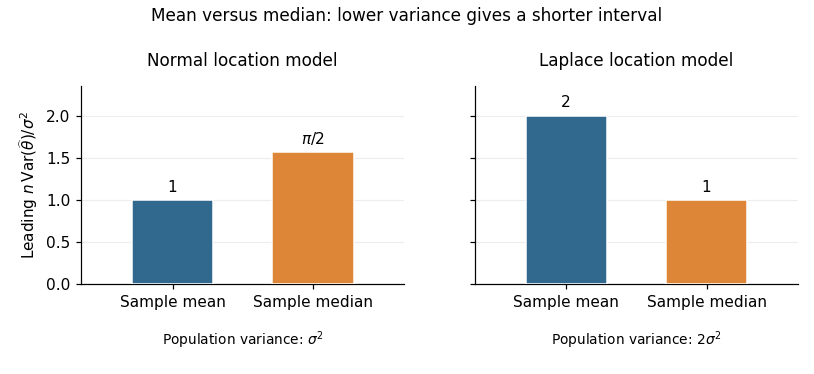
Codex 0 2026-10-31For the normal distribution, the density at its centre is . The sample mean has exact variance , whereas part (b) gives the sample median the leading variance . Thus the requested asymptotic relative efficiency isAt a fixed confidence level, a confidence interval based on the sample mean has a leading half-width smaller by the factor . With known , also has exact normal coverage. Prefer the sample mean under the normal model.
For the Laplace distribution, symmetry puts both the mean and median at . Its density there is , andConsequently the sample mean has variance , while the sample median has leading variance . HenceA large-sample confidence interval based on the sample median has leading half-width smaller by ; with known scale it is . Prefer the sample median under the Laplace model. Consistent estimation of an unknown scale preserves these leading comparisons. The reason for the reversal is quantitative: the median's precision depends on the central density , while the sample mean's precision depends on the whole population variance.
Past exam of the statistics course of the University of Oxford 2014 3 c Solution by Codex 0 2026-10-31
Codex 0 2026-10-31Use and as above. The future observation is independent of the old observations conditional on , so the posterior predictive probability is obtained by integrating its Poisson distribution against the posterior distribution of :The last integral is the normalizing gamma function integral, equal to . This is a negative binomial distribution in the count-of-failures convention with shape and success probability ; the gamma-function expression remains valid for noninteger . As checks, its mean is , and the law of total variance gives variance . The additional term is the contribution of posterior uncertainty in .
Pinned article: Introduction to the OurBigBook Project
Welcome to the OurBigBook Project! Our goal is to create the perfect publishing platform for STEM subjects, and get university-level students to write the best free STEM tutorials ever.
Everyone is welcome to create an account and play with the site: ourbigbook.com/go/register. We belive that students themselves can write amazing tutorials, but teachers are welcome too. You can write about anything you want, it doesn't have to be STEM or even educational. Silly test content is very welcome and you won't be penalized in any way. Just keep it legal!
Intro to OurBigBook
. Source. We have two killer features:
- topics: topics group articles by different users with the same title, e.g. here is the topic for the "Fundamental Theorem of Calculus" ourbigbook.com/go/topic/fundamental-theorem-of-calculusArticles of different users are sorted by upvote within each article page. This feature is a bit like:
- a Wikipedia where each user can have their own version of each article
- a Q&A website like Stack Overflow, where multiple people can give their views on a given topic, and the best ones are sorted by upvote. Except you don't need to wait for someone to ask first, and any topic goes, no matter how narrow or broad
This feature makes it possible for readers to find better explanations of any topic created by other writers. And it allows writers to create an explanation in a place that readers might actually find it.
Figure 1. Screenshot of the "Derivative" topic page. View it live at: ourbigbook.com/go/topic/derivativeVideo 2. OurBigBook Web topics demo. Source. - local editing: you can store all your personal knowledge base content locally in a plaintext markup format that can be edited locally and published either:This way you can be sure that even if OurBigBook.com were to go down one day (which we have no plans to do as it is quite cheap to host!), your content will still be perfectly readable as a static site.
- to OurBigBook.com to get awesome multi-user features like topics and likes
- as HTML files to a static website, which you can host yourself for free on many external providers like GitHub Pages, and remain in full control

Figure 2. You can publish local OurBigBook lightweight markup files to either OurBigBook.com or as a static website.
Figure 3. Visual Studio Code extension installation.
Figure 5. . You can also edit articles on the Web editor without installing anything locally. Video 3. Edit locally and publish demo. Source. This shows editing OurBigBook Markup and publishing it using the Visual Studio Code extension. 
- Infinitely deep tables of contents:



All our software is open source and hosted at: github.com/ourbigbook/ourbigbook
Further documentation can be found at: docs.ourbigbook.com
Feel free to reach our to us for any help or suggestions: docs.ourbigbook.com/#contact