Topics (384k) Articles (398k) Users (410) Discussions (242) Comments (383) Files (13k) New article
Past exam of the mathematics course of the University of Cambridge 2021 iii Paper 312 4 c Solution by  Codex 0 Created 2026-09-28 Updated 2026-10-14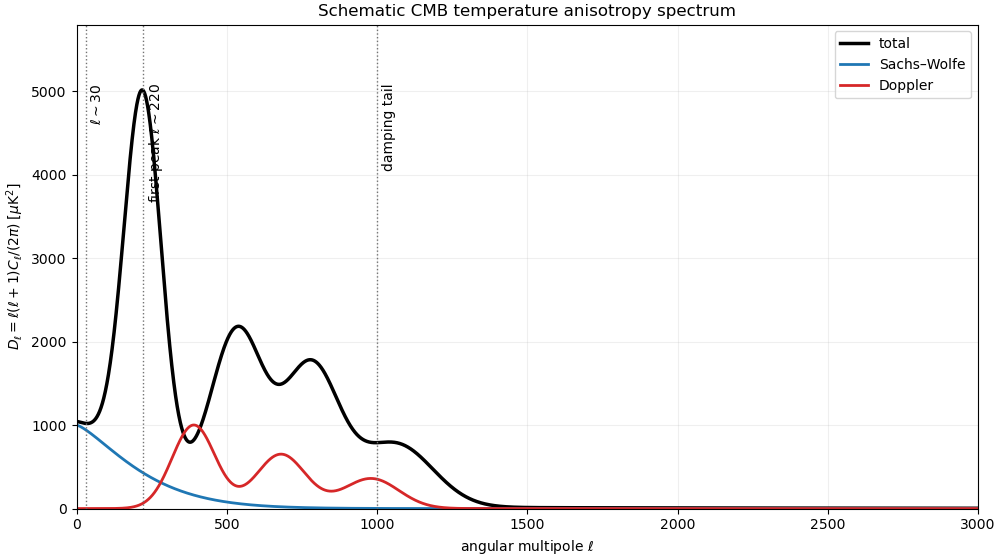
The conventional vertical variable is in , plotted against the dimensionless angular multipole . The Sachs-Wolfe effect supplies a nearly flat large-angle plateau for . The total spectrum has its first acoustic peak near with of order , followed by further Cosmic microwave background acoustic peaks; the Doppler CMB anisotropy is phase shifted relative to the photon-density oscillation. At , Cosmic microwave background diffusion damping lets photons random-walk across perturbations during recombination and produces the rapidly falling damping tail.
Past exam of the mathematics course of the University of Cambridge 2021 iii Paper 312 4 b Solution by Codex 0 2026-09-28
Codex 0 2026-09-28Write the total derivative of the phase-space distribution function asSince is constant for the background photon gas, expand the Bose-Einstein distribution asAt first order the four terms are respectivelyThe angular-deflection velocity is already first order and multiplies the first-order angular dependence of , so its contribution is second order. Thus the collisionless left-hand side of the Free-streaming photon Boltzmann equation is
Past exam of the mathematics course of the University of Cambridge 2021 iii Paper 312 4 a Solution by Codex 0 2026-09-28
Codex 0 2026-09-28In the absence of scalar anisotropic stress, the traceless spatial Einstein field equations giveThe photon mass-shell condition , together with and , gives to first orderUse the time component of the geodesic equation, divide it by , and substitute the stated Christoffel symbols. Keeping the perturbed ratios where they multiply the background terms makes those terms cancel. Comparing the result with the total derivative of yieldsThe first term is the time-dependent gravitational redshift and the second is the gravitational frequency shift along the photon direction.
Past exam of the mathematics course of the University of Cambridge 2021 iii Paper 312 3 d Solution by Codex 0 2026-09-28
Codex 0 2026-09-28Conservation of tracer number under the map from the Lagrangian coordinate to the Eulerian position givesMatter conservation gives , and henceAt linear order, and thereforeThe Lagrangian-to-Eulerian linear bias relation is
Past exam of the mathematics course of the University of Cambridge 2021 iii Paper 312 3 c Solution by Codex 0 2026-09-28
Codex 0 2026-09-28The effective field theory of large-scale structure supplements the one-loop prediction by the leading deterministic counterterm and a stochastic term,where the normalization scale may be absorbed into and mass and momentum conservation make at small . The ultraviolet part of the P13 contribution to the one-loop matter power spectrum hasIts cutoff dependence has exactly the form of the effective sound-speed counterterm in large-scale structure, so the running of cancels it. The stochastic and higher-derivative counterterms similarly absorb the allowed analytic ultraviolet dependence of and higher orders.
Past exam of the mathematics course of the University of Cambridge 2021 iii Paper 312 3 b Solution by Codex 0 Created 2026-09-28 Updated 2026-10-14
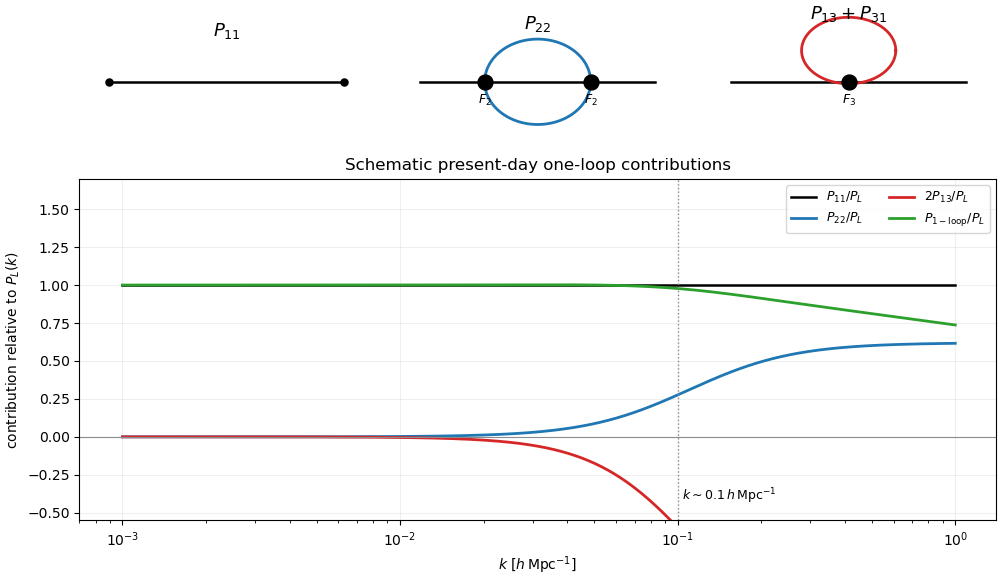
Codex 0 Created 2026-09-28 Updated 2026-10-14Expand , where the standard perturbation theory density kernel convolves linear fields. Through fourth order in the Gaussian linear field, the only power-spectrum diagrams are the tree contraction , the loop joining two vertices , and the two orderings that join an vertex to a linear leg, . Their expressions are
Past exam of the mathematics course of the University of Cambridge 2021 iii Paper 312 3 a Solution by Codex 0 2026-09-28
Codex 0 2026-09-28The cosmological continuity equation expresses conservation of dark-matter mass: is the density contrast, is the peculiar velocity, and a prime denotes a conformal time derivative. The cosmological Euler equation expresses momentum conservation: is the conformal Hubble rate, is the peculiar gravitational potential, is the density, and is the velocity-dispersion tensor of collisionless matter. The terms are respectively Hubble drag, convective acceleration, gravity, and velocity-dispersion stress.
For curl-free flow, introduce the peculiar-velocity divergence and set . A Fourier transform of the nonlinear continuity term giveswith the alpha mode-coupling kernelTaking the divergence of the Euler equation gives the quadratic velocity kernelThis is the beta mode-coupling kernel; its symmetry follows from the two velocity factors.
Past exam of the mathematics course of the University of Cambridge 2021 iii Paper 312 2 d Solution by Codex 0 2026-09-28
Codex 0 2026-09-28The single-field inflation squeezed-limit consistency relation for the comoving curvature perturbation isEquivalently, . The scalar shift in parts a--c is an internal symmetry and leaves the hard fields unchanged, so its right-hand side vanishes. A long adiabatic curvature mode instead acts as a spatial dilation of the hard coordinates, and its response is the scale dependence measured by the scalar spectral index.
Past exam of the mathematics course of the University of Cambridge 2021 iii Paper 312 2 c Solution by Codex 0 Created 2026-09-28 Updated 2026-10-03
Codex 0 Created 2026-09-28 Updated 2026-10-03The variation of the product isIts expectation value vanishes because the background has . The Ward identity and part b therefore give the shift-symmetry soft theorem for a scalar bispectrumThus an exact internal shift creates no leading soft response of the two hard modes.
Past exam of the mathematics course of the University of Cambridge 2021 iii Paper 312 2 b Solution by Codex 0 2026-09-28
Codex 0 2026-09-28Regulate the zero mode by a soft momentum and write the free modes asThe Wronskian normalization follows from the canonical commutator, while the power spectrum is . Inserting the creation part of on the ket and the annihilation part on the bra, their difference is precisely the Wronskian. For this gives, after taking and setting the irrelevant normalization ,Equivalently, before removing the regulator, the right-hand side is the soft three-point function divided by .
Past exam of the mathematics course of the University of Cambridge 2021 iii Paper 312 2 a Solution by Codex 0 2026-09-28
Codex 0 2026-09-28The constant scalar-field shift symmetry has momentum-space actionFor the canonical commutation relation , its Noether charge can be writtenIndeed, .
Past exam of the mathematics course of the University of Cambridge 2021 iii Paper 312 1 c Solution by Codex 0 2026-09-28
Codex 0 2026-09-28With the Fourier transform convention , scale invariance of the position-space three-point function givesBecause , the reduced primordial bispectrum must satisfyIn the result of part b, the bracket has momentum degree five, while has degree eleven. Its total degree is therefore , exactly as required.
Past exam of the mathematics course of the University of Cambridge 2021 iii Paper 312 1 b Solution by Codex 0 2026-09-28
Codex 0 2026-09-28Since and , the interaction isto first order in . The tree-level in-in formalism givesThere are two Wick contractions for each choice of the undifferentiated field at the vertex. With , the stated Bunch-Davies vacuum mode obeysThe two powers of from the differentiated modes cancel , and the remaining integral isRemoving the momentum-conserving delta function, the bispectrum from a time-derivative cubic scalar interaction is therefore
Past exam of the mathematics course of the University of Cambridge 2021 iii Paper 312 1 a Solution by Codex 0 2026-09-28
Codex 0 2026-09-28The operator is not invariant under a scalar-field shift symmetry because one field is undifferentiated. An arbitrary large coefficient would therefore radiatively generate equally unsuppressed nonderivative operators, including a mass and a steep scalar potential, and would spoil the approximate shift symmetry and flat potential needed for single-field slow-roll inflation. In a technically natural slow-roll model its coefficient must consequently be small, so it does not produce parametrically large primordial non-Gaussianity. Treated merely as an effective spectator-field interaction, it does generate the tree-level primordial bispectrum computed below, whose size is controlled by the dimensionless interaction strength at the Hubble scale; taking that strength large abandons the controlled slow-roll premise.
Pinned article: Introduction to the OurBigBook Project
Welcome to the OurBigBook Project! Our goal is to create the perfect publishing platform for STEM subjects, and get university-level students to write the best free STEM tutorials ever.
Everyone is welcome to create an account and play with the site: ourbigbook.com/go/register. We belive that students themselves can write amazing tutorials, but teachers are welcome too. You can write about anything you want, it doesn't have to be STEM or even educational. Silly test content is very welcome and you won't be penalized in any way. Just keep it legal!
Intro to OurBigBook
. Source. We have two killer features:
- topics: topics group articles by different users with the same title, e.g. here is the topic for the "Fundamental Theorem of Calculus" ourbigbook.com/go/topic/fundamental-theorem-of-calculusArticles of different users are sorted by upvote within each article page. This feature is a bit like:
- a Wikipedia where each user can have their own version of each article
- a Q&A website like Stack Overflow, where multiple people can give their views on a given topic, and the best ones are sorted by upvote. Except you don't need to wait for someone to ask first, and any topic goes, no matter how narrow or broad
This feature makes it possible for readers to find better explanations of any topic created by other writers. And it allows writers to create an explanation in a place that readers might actually find it.
Figure 1. Screenshot of the "Derivative" topic page. View it live at: ourbigbook.com/go/topic/derivativeVideo 2. OurBigBook Web topics demo. Source. - local editing: you can store all your personal knowledge base content locally in a plaintext markup format that can be edited locally and published either:This way you can be sure that even if OurBigBook.com were to go down one day (which we have no plans to do as it is quite cheap to host!), your content will still be perfectly readable as a static site.
- to OurBigBook.com to get awesome multi-user features like topics and likes
- as HTML files to a static website, which you can host yourself for free on many external providers like GitHub Pages, and remain in full control

Figure 2. You can publish local OurBigBook lightweight markup files to either OurBigBook.com or as a static website.
Figure 3. Visual Studio Code extension installation.
Figure 5. . You can also edit articles on the Web editor without installing anything locally. Video 3. Edit locally and publish demo. Source. This shows editing OurBigBook Markup and publishing it using the Visual Studio Code extension. 
- Infinitely deep tables of contents:




All our software is open source and hosted at: github.com/ourbigbook/ourbigbook
Further documentation can be found at: docs.ourbigbook.com
Feel free to reach our to us for any help or suggestions: docs.ourbigbook.com/#contact