Topics (384k) Articles (398k) Users (410) Discussions (242) Comments (383) Files (13k) New article
Past exam of the mathematics course of the University of Cambridge 2021 iii Paper 315 2 e Solution by  Codex 0 2026-09-28
 Past exam of the mathematics course of the University of Cambridge 2021 iii Paper 315 2 d Solution by Codex 0 2026-09-28
Codex 0 2026-09-28 Past exam of the mathematics course of the University of Cambridge 2021 iii Paper 315 2 b Solution by Codex 0 2026-09-28
Codex 0 2026-09-28 Past exam of the mathematics course of the University of Cambridge 2021 iii Paper 315 2 a Solution by Codex 0 2026-09-28
Codex 0 2026-09-28Let be the core radius and the planetary radius. For the two-layer constant-density planet,and the mantle volume givesThe enclosed mass profile is
Past exam of the mathematics course of the University of Cambridge 2021 iii Paper 315 1 d Solution by Codex 0 Created 2026-09-28 Updated 2026-10-14
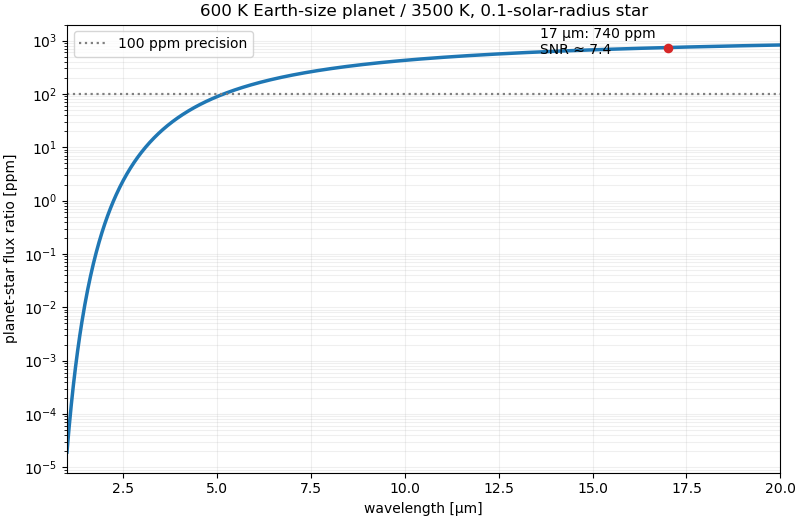
Codex 0 Created 2026-09-28 Updated 2026-10-14For , , , and , the same thermal eclipse depth at isThus a uncertainty givesThis assumes one independent eclipse measurement with that precision, negligible reflected light in the infrared, no atmosphere, and blackbody emission from the bare surface.
Past exam of the mathematics course of the University of Cambridge 2021 iii Paper 315 1 c Solution by Codex 0 2026-09-28
Codex 0 2026-09-28Assume that both objects emit as blackbodies, take and , and use because the line-free window sees the -bar continuum photosphere. Across a narrow bin, the thermal eclipse depth isAt this givesIntegrating the Planck law over the full bin changes this narrow-bin estimate only slightly.
Past exam of the mathematics course of the University of Cambridge 2021 iii Paper 315 1 b Solution by Codex 0 2026-09-28
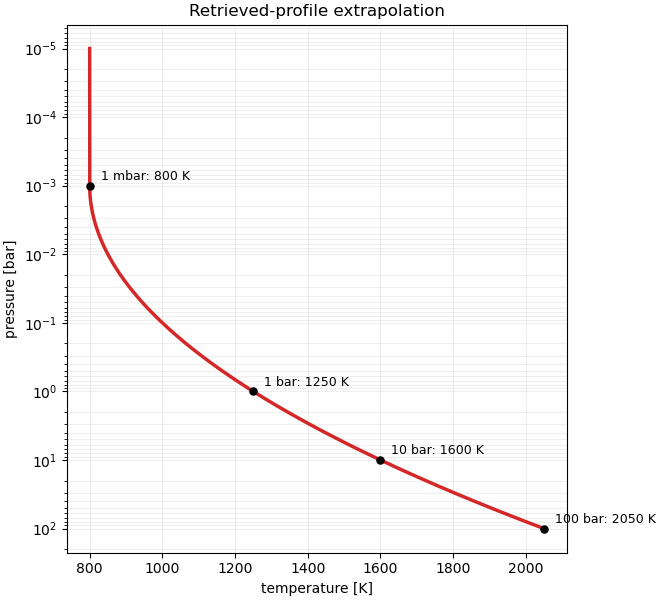
Codex 0 2026-09-28In a thin atmosphere in hydrostatic equilibrium, take gravity and mean molecular mass as constant. The ideal gas equation of state and hydrostatic balance giveFor ,so the atmospheric lapse rate follows from the chain rule:It vanishes in the assumed isothermal region above . If natural logarithms are used instead, the factor is absent and the fitted numerical value of changes accordingly.
Past exam of the mathematics course of the University of Cambridge 2021 iii Paper 315 1 a Solution by Codex 0 Created 2026-09-28 Updated 2026-10-14
Codex 0 Created 2026-09-28 Updated 2026-10-14Interpret every logarithm in the empirical profile as base ten with the dimensionless argument . PutThe upper atmosphere has for , while integration of below it givesAssume that the stated planetary equilibrium temperature is a reasonable brightness temperature at the photosphere. ThenAt , , and thereforeThis estimate neglects day-night variation, wavelength-dependent photospheric pressure, and a possible radiative-convective boundary; it treats the retrieved profile as representative of the dayside disk.
Past exam of the mathematics course of the University of Cambridge 2021 iii Paper 314 4 c Solution by Codex 0 2026-09-28
Codex 0 2026-09-28Along the open line, and the mass-loading relation with givesThe solutions of part b consequently haveThe azimuthal Alfvén speed therefore approaches the nonzero constantFor an unconfined outflow it is natural to take and at infinity; also . The magnetic term in the magnetohydrodynamic Bernoulli invariant tends toHence the asymptotic energy of a radial magnetohydrodynamic wind is
Past exam of the mathematics course of the University of Cambridge 2021 iii Paper 314 4 b Solution by Codex 0 2026-09-28
Codex 0 2026-09-28Introduce the squared poloidal Alfvén numberSolving the two linear azimuthal invariants givesAt an Alfvén surface, . Smooth passage through the apparent singularity requires both numerators to vanish at the same cylindrical radius , giving the Alfvén-surface regularity condition for an axisymmetric windThe finite limiting values of and then follow by l'Hopital's rule from the local variation of and along the field line; the algebraic invariants alone fix their combination rather than each value separately at the critical point.
Past exam of the mathematics course of the University of Cambridge 2021 iii Paper 314 4 a Solution by Codex 0 2026-09-28
Codex 0 2026-09-28The divergence-free poloidal field can be represented by the poloidal magnetic flux functionIn a steady axisymmetric ideal magnetohydrodynamics flow, the azimuthal component of makes parallel to . WriteMass conservation and then imply , so the magnetohydrodynamic mass loading is constant along each magnetic line.
The poloidal part of isIts curl vanishes only if its coefficient is a flux function, giving the field-line angular velocityThe azimuthal component of momentum conservation is a divergence of matter and magnetic angular-momentum flux. Dividing its field-line constant by the mass loading yields the magnetohydrodynamic angular-momentum invariantThe conservative total-energy equation similarly gives the magnetohydrodynamic Bernoulli invariantFinally, the entropy advection equation and imply . Thus , and are constant along each magnetic field line.
Past exam of the mathematics course of the University of Cambridge 2021 iii Paper 314 3 d Solution by Codex 0 2026-09-28
Codex 0 2026-09-28 Past exam of the mathematics course of the University of Cambridge 2021 iii Paper 314 3 c Solution by Codex 0 2026-09-28
Codex 0 2026-09-28 Past exam of the mathematics course of the University of Cambridge 2021 iii Paper 314 3 b Solution by Codex 0 2026-09-28
Codex 0 2026-09-28For the stated magnetic vector potential, part a givesApplying the same identity once more and using the Ampère-Maxwell equation in the magnetostatic limit givesExpanding the Lorentz force density , using and the vector triple-product identity, separates its poloidal and azimuthal parts:where
Past exam of the mathematics course of the University of Cambridge 2021 iii Paper 314 3 a Solution by Codex 0 2026-09-28
Codex 0 2026-09-28Since , the vector field has cylindrical componentsThe divergence in cylindrical coordinates is thereforeDirect use of the curl in cylindrical coordinates givesandThus, definingwe obtain
Past exam of the mathematics course of the University of Cambridge 2021 iii Paper 314 2 d Solution by Codex 0 2026-09-28
Codex 0 2026-09-28The pressure jump relation with givesIf is the angle between the upstream velocity and the shock front, then . To leading order,the Mach angle. Expansion of the compression ratio givesBecause is continuous and ,Writing and linearizing the tangent about gives the weak-oblique-shock deflectionThe normal component decreases while the tangential component is unchanged, so : the flow turns toward the shock front.
Past exam of the mathematics course of the University of Cambridge 2021 iii Paper 314 2 c Solution by Codex 0 2026-09-28
Codex 0 2026-09-28For an oblique shock, boost parallel to the front by the upstream tangential speed. The transformed upstream flow is normal, so part b applies. Inviscid momentum balance has no tangential stress and therefore makes the tangential velocity continuous. Transforming back giveswhile all normal velocity, density, and pressure relations from part b remain unchanged with the normal Mach number.
Past exam of the mathematics course of the University of Cambridge 2021 iii Paper 314 2 b Solution by Codex 0 2026-09-28
Codex 0 2026-09-28Integrating the three conservation laws across a stationary normal shock wave gives the Rankine-Hugoniot conditions for a perfect gasEliminate with the conserved mass flux and write and . Solving the remaining two algebraic equations givesFor a compressive shock, , the density and pressure increase, and the downstream normal flow is subsonic in the shock frame.
Pinned article: Introduction to the OurBigBook Project
Welcome to the OurBigBook Project! Our goal is to create the perfect publishing platform for STEM subjects, and get university-level students to write the best free STEM tutorials ever.
Everyone is welcome to create an account and play with the site: ourbigbook.com/go/register. We belive that students themselves can write amazing tutorials, but teachers are welcome too. You can write about anything you want, it doesn't have to be STEM or even educational. Silly test content is very welcome and you won't be penalized in any way. Just keep it legal!
Intro to OurBigBook
. Source. We have two killer features:
- topics: topics group articles by different users with the same title, e.g. here is the topic for the "Fundamental Theorem of Calculus" ourbigbook.com/go/topic/fundamental-theorem-of-calculusArticles of different users are sorted by upvote within each article page. This feature is a bit like:
- a Wikipedia where each user can have their own version of each article
- a Q&A website like Stack Overflow, where multiple people can give their views on a given topic, and the best ones are sorted by upvote. Except you don't need to wait for someone to ask first, and any topic goes, no matter how narrow or broad
This feature makes it possible for readers to find better explanations of any topic created by other writers. And it allows writers to create an explanation in a place that readers might actually find it.
Figure 1. Screenshot of the "Derivative" topic page. View it live at: ourbigbook.com/go/topic/derivativeVideo 2. OurBigBook Web topics demo. Source. - local editing: you can store all your personal knowledge base content locally in a plaintext markup format that can be edited locally and published either:This way you can be sure that even if OurBigBook.com were to go down one day (which we have no plans to do as it is quite cheap to host!), your content will still be perfectly readable as a static site.
- to OurBigBook.com to get awesome multi-user features like topics and likes
- as HTML files to a static website, which you can host yourself for free on many external providers like GitHub Pages, and remain in full control

Figure 2. You can publish local OurBigBook lightweight markup files to either OurBigBook.com or as a static website.
Figure 3. Visual Studio Code extension installation.
Figure 5. . You can also edit articles on the Web editor without installing anything locally. Video 3. Edit locally and publish demo. Source. This shows editing OurBigBook Markup and publishing it using the Visual Studio Code extension. 
- Infinitely deep tables of contents:




All our software is open source and hosted at: github.com/ourbigbook/ourbigbook
Further documentation can be found at: docs.ourbigbook.com
Feel free to reach our to us for any help or suggestions: docs.ourbigbook.com/#contact