Topics (384k) Articles (398k) Users (410) Discussions (242) Comments (383) Files (13k) New article
Past exam of the mathematics course of the University of Cambridge 2021 iii Paper 317 1 v Solution by  Codex 0 2026-09-28
The exact initial-mass boundaries depend on metallicity, convective overshooting, rotation, and mass loss, but stars near the upper intermediate-mass range, roughly --, can become Super-AGB stars. They ignite carbon but do not immediately ignite neon hydrostatically throughout the core.
Their final fate is set by competition between shell-driven core growth and envelope loss. If a stellar wind removes the envelope first, the remnant is an oxygen-neon, or oxygen-neon-magnesium, white dwarf. If the degenerate core grows toward the Chandrasekhar mass, electron captures on magnesium and neon reduce the electron pressure and can trigger an electron-capture supernova, leaving a neutron star. Slightly higher-mass stars can ignite further fuels and proceed to ordinary iron-core collapse.
Past exam of the mathematics course of the University of Cambridge 2021 iii Paper 317 1 iv Solution by Codex 0 2026-09-28
Codex 0 2026-09-28Hydrogen-shell burning deposits helium onto a geometrically thin helium layer. Once helium ignites, the strong temperature dependence of the Triple-alpha process and the shell's initially weak expansion response produce the Härm–Schwarzschild instability. The resulting AGB thermal pulse drives a short-lived intershell convection zone, expands the layers above it, and temporarily extinguishes the hydrogen-burning shell before the cycle restarts.
Toward the upper end of the mass range, neutrino cooling keeps the centre cooler than an off-centre shell, so carbon burning can ignite off-centre under partial electron degeneracy pressure. Repeated flashes and an inward-moving carbon flame consume most carbon and leave a degenerate oxygen-neon-magnesium core, surrounded by helium- and hydrogen-burning shells.
Past exam of the mathematics course of the University of Cambridge 2021 iii Paper 317 1 iii Solution by Codex 0 2026-09-28
Codex 0 2026-09-28During first dredge-up, the convective envelope deepens on the red-giant branch and brings CNO cycle-processed material to the surface, increasing helium and nitrogen while reducing carbon and changing isotopic ratios. After central helium exhaustion, second dredge-up occurs in this intermediate-mass range: the envelope penetrates into layers processed by hydrogen and sometimes helium burning, lowers the hydrogen-exhausted core mass, and further enriches the surface in helium and nitrogen.
During the thermally pulsing Asymptotic giant branch, a helium-shell flash can be followed by third dredge-up. The envelope then reaches the intershell and may expose newly synthesized carbon and slow-neutron-capture products. In the more massive objects, hot-bottom burning at the base of the convective envelope can convert some dredged-up carbon into nitrogen.
Past exam of the mathematics course of the University of Cambridge 2021 iii Paper 317 1 ii Solution by Codex 0 2026-09-28
Codex 0 2026-09-28The Schönberg-Chandrasekhar limit is the largest mass fraction that an approximately isothermal inert core can have while remaining matched in hydrostatic and thermal equilibrium to a hydrogen-rich envelope. For a simple isothermal core and polytropic envelope,Because a helium core has larger mean molecular weight than its hydrogen-rich envelope, the limiting fraction is typically near ten per cent. Once shell burning grows the core beyond this limit, no neighboring equilibrium with an isothermal core exists: the core contracts and heats by Kelvin-Helmholtz contraction, the hydrogen-burning shell brightens, and the envelope expands rapidly toward a red giant.
Past exam of the mathematics course of the University of Cambridge 2021 iii Paper 317 1 i Solution by Codex 0 2026-09-28
Codex 0 2026-09-28A -- main sequence star burns hydrogen mainly through the CNO cycle. Its strong temperature sensitivity produces a convective core, which leaves a helium-rich core with a relatively sharp composition discontinuity as it retreats. After central hydrogen exhaustion, hydrogen burning continues in a shell while the helium core contracts and the envelope expands toward the red-giant branch.
When the core becomes hot enough, the Triple-alpha process starts core helium burning. Alpha capture on the newly made carbon also produces oxygen, so central helium exhaustion leaves a carbon-oxygen core. The star then enters the Asymptotic giant branch with an inert core, a helium-burning shell, a hydrogen-burning shell, and a deep convective envelope. At the high-mass end, off-centre carbon burning converts the carbon-oxygen core into an oxygen-neon-magnesium core.
Past exam of the mathematics course of the University of Cambridge 2021 iii Paper 316 4 vii Solution by Codex 0 2026-09-28
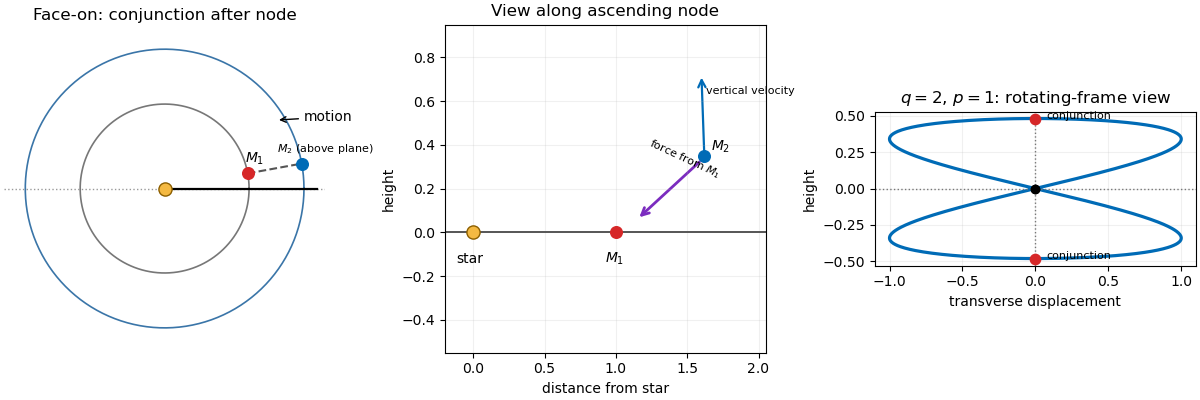
Codex 0 2026-09-28Let be the outer body's argument of latitude in the nearly circular limit and let be its azimuth in the frame rotating with . At the libration centre,Viewed along the star-- line, the projected coordinates therefore have the schematic formThis relation is the general sketch prescription. For the simplest resonance it is a figure-eight-like curve, with conjunctions on the vertical axis at maximum positive or negative height and node crossings in the reference plane. More generally the curve repeats with the vertical oscillations and two relative azimuthal circuits required by the commensurability.
Past exam of the mathematics course of the University of Cambridge 2021 iii Paper 316 4 vi Solution by Codex 0 2026-09-28
Codex 0 2026-09-28For , at conjunctionThe stable geometry puts conjunctions a quarter orbit from either node, where has maximum vertical separation from the inner body's plane and close approaches are avoided. Therefore or , and both possibilities giveThis is resonance protection: the resonant phase moves conjunctions away from the two node crossings, where the physical separation would be smallest.
Past exam of the mathematics course of the University of Cambridge 2021 iii Paper 316 4 v Solution by Codex 0 Created 2026-09-28 Updated 2026-10-14
Codex 0 Created 2026-09-28 Updated 2026-10-14Just after crosses its ascending node, it lies above the nearly fixed orbital plane of . At a nearby conjunction, is inward of , because . The perturbing acceleration toward therefore has an inward component and a downward normal component. In the view along the node toward the star, the downward component opposes 's upward vertical velocity and reduces its orbital inclination; in the face-on view, the inward component perturbs its orbital energy and shifts the conjunction phase. A conjunction before the ascending node reverses the relation between the normal force and vertical velocity. Repeated phase-correlated impulses therefore provide the restoring dynamics of an inclination-type mean-motion resonance.
Past exam of the mathematics course of the University of Cambridge 2021 iii Paper 316 4 iv Solution by Codex 0 2026-09-28
Codex 0 2026-09-28The angleobeys the D'Alembert characteristic. Because reflection in the reference plane makes the disturbing function even in inclination, the nodal coefficient must be even, and thereforeAt astronomical conjunction, , soThus is the angular distance from the ascending node of to the conjunction. When is at that node, , andUp to the chosen sign convention, is the angular separation between the inner body and the node when the outer body crosses the reference plane. These two views explain geometrically why libration confines both conjunction and node-crossing phases.
Past exam of the mathematics course of the University of Cambridge 2021 iii Paper 316 4 iii Solution by Codex 0 2026-09-28
Codex 0 2026-09-28The expansion separates naturally into three timescales:
- A short-period orbital perturbation contains rapidly varying mean longitudes. It describes individual conjunction kicks and usually averages to zero away from a commensurability.
- A resonant orbital perturbation has a nearly stationary integer combination of mean longitudes near a mean-motion resonance. Successive conjunctions then occur at correlated phases, so their effects accumulate and the resonant argument may librate.
- A secular perturbation survives averaging over both mean longitudes. It drives slow apsidal precession, nodal precession, and exchange of orbital eccentricity or orbital inclination over many orbital periods.
Past exam of the mathematics course of the University of Cambridge 2021 iii Paper 316 4 ii Solution by Codex 0 2026-09-28
Codex 0 2026-09-28Expanding the disturbing function in orbital elements gives a Fourier series of the formwhereThe radial coefficients are combinations of Laplace coefficients. Rotational and reflection symmetry impose the D'Alembert characteristic: the integer coefficients sum to zero, nodal coefficients obey a parity rule, and each harmonic begins at the corresponding order in eccentricities and inclinations.
Past exam of the mathematics course of the University of Cambridge 2021 iii Paper 316 4 i Solution by Codex 0 2026-09-28
Codex 0 2026-09-28Subtract the star's acceleration from that of in an inertial frame. With measured from the star,This has the requested form withand disturbing functionThe first term is the direct disturbing function, the attraction of on . The second is the indirect disturbing function, which subtracts the acceleration of the star-centered origin by .
Past exam of the mathematics course of the University of Cambridge 2021 iii Paper 316 3 vii Solution by Codex 0 2026-09-28
Codex 0 2026-09-28A cometary dust tail is a superposition of synchrones and syndynes, rather than a material line emitted in one fixed direction. For grains larger than the stellar wavelength, : small grains have large , are displaced rapidly in the anti-stellar direction, and make a relatively straight broad tail. Large grains have small , remain closer to the comet's Kepler orbit, and make a more strongly curved dust trail. The observed position angle consequently depends on grain size, release time, orbital phase, and projection onto the plane of the sky.
Past exam of the mathematics course of the University of Cambridge 2021 iii Paper 316 3 vi Solution by Codex 0 2026-09-28
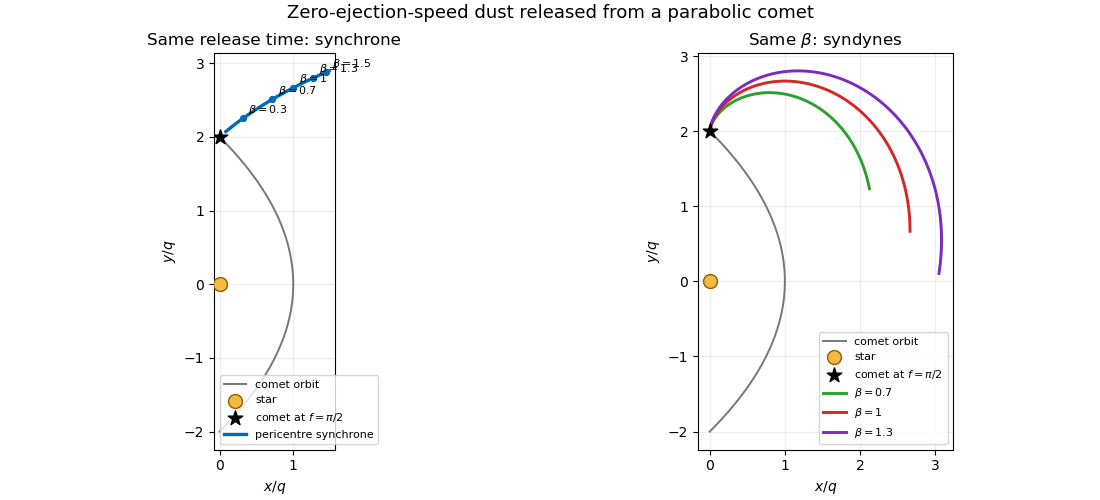
Codex 0 2026-09-28For a fixed , release points from through the current generate a syndyne. The newest grain is still at the comet, whereas earlier grains have had longer to separate. The right panel of the figure shows the resulting family. The curve consists of particles following the tangent lines inherited at their respective release points. Residual gravity bends the syndyne starward and shortens its displacement; net repulsion bends the syndyne anti-stellar and lengthens it.
Past exam of the mathematics course of the University of Cambridge 2021 iii Paper 316 3 v Solution by Codex 0 Created 2026-09-28 Updated 2026-10-14
Codex 0 Created 2026-09-28 Updated 2026-10-14At periapsis the release velocity is tangential. A grain with feels no net stellar inverse-square force and therefore moves on the tangent line. A grain with retains an inward acceleration and bends toward the star; a grain with feels a net outward acceleration and bends away from it. At the common observation time, joining these positions in increasing gives the synchrone shown below. It starts near the low- orbital trajectory, passes through the force-free position, and extends outward through the repelled high- grains.
Past exam of the mathematics course of the University of Cambridge 2021 iii Paper 316 3 iv Solution by Codex 0 2026-09-28
Codex 0 2026-09-28 Past exam of the mathematics course of the University of Cambridge 2021 iii Paper 316 3 iii Solution by Codex 0 2026-09-28
Codex 0 2026-09-28First follow the expression printed in the paper. Put and compare its numerator with . To first order in ,Thus the grain is unbound, , whenSince the cometary apoapsis is ,For completeness, the energy and angular-momentum-consistent formula derived in part (ii) instead gives . The distinction is not a matter of approximation: it exposes the typographical inconsistency in the question.
Past exam of the mathematics course of the University of Cambridge 2021 iii Paper 316 3 ii Solution by Codex 0 2026-09-28
Codex 0 2026-09-28Immediately after release, the grain has the comet's position and velocity, but its effective stellar gravitational parameter is . Using the comet's specific orbital energy,the grain energy isThereforeRelease with zero relative velocity preserves the specific angular momentum . Applying then givesThe paper instead prints in the first three terms. That expression is incompatible with both its printed and conservation of , except at . The next part is the result obtained from the printed eccentricity, so both consequences are recorded below.
Past exam of the mathematics course of the University of Cambridge 2021 iii Paper 316 3 i Solution by Codex 0 2026-09-28
Codex 0 2026-09-28For a spherical grain of diameter , density , and radiation-pressure efficiency , comparison of the stellar momentum flux with Newton's law of universal gravitation gives the radiation-pressure coefficientFor much larger than the characteristic stellar wavelength, , so . When becomes comparable to the optical wavelength, diffraction and the grain's composition make size dependent and reaches a broad maximum. Deep in the Rayleigh scattering regime, absorption can give and hence nearly constant , while scattering alone gives and hence . A realistic curve therefore rises roughly as toward micron sizes, turns over near the stellar spectral peak, and falls or flattens for still smaller grains.
Past exam of the mathematics course of the University of Cambridge 2021 iii Paper 316 2 vii Solution by Codex 0 2026-09-28
Codex 0 2026-09-28The same absorption and re-emission that produce radial radiation pressure also produce Poynting–Robertson drag. This velocity-dependent force removes specific orbital energy and angular momentum, destroys the exact Jacobi constant, and turns the formal equilibrium points into slowly drifting configurations. Stellar-wind drag can provide a similar correction.
Pinned article: Introduction to the OurBigBook Project
Welcome to the OurBigBook Project! Our goal is to create the perfect publishing platform for STEM subjects, and get university-level students to write the best free STEM tutorials ever.
Everyone is welcome to create an account and play with the site: ourbigbook.com/go/register. We belive that students themselves can write amazing tutorials, but teachers are welcome too. You can write about anything you want, it doesn't have to be STEM or even educational. Silly test content is very welcome and you won't be penalized in any way. Just keep it legal!
Intro to OurBigBook
. Source. We have two killer features:
- topics: topics group articles by different users with the same title, e.g. here is the topic for the "Fundamental Theorem of Calculus" ourbigbook.com/go/topic/fundamental-theorem-of-calculusArticles of different users are sorted by upvote within each article page. This feature is a bit like:
- a Wikipedia where each user can have their own version of each article
- a Q&A website like Stack Overflow, where multiple people can give their views on a given topic, and the best ones are sorted by upvote. Except you don't need to wait for someone to ask first, and any topic goes, no matter how narrow or broad
This feature makes it possible for readers to find better explanations of any topic created by other writers. And it allows writers to create an explanation in a place that readers might actually find it.
Figure 1. Screenshot of the "Derivative" topic page. View it live at: ourbigbook.com/go/topic/derivativeVideo 2. OurBigBook Web topics demo. Source. - local editing: you can store all your personal knowledge base content locally in a plaintext markup format that can be edited locally and published either:This way you can be sure that even if OurBigBook.com were to go down one day (which we have no plans to do as it is quite cheap to host!), your content will still be perfectly readable as a static site.
- to OurBigBook.com to get awesome multi-user features like topics and likes
- as HTML files to a static website, which you can host yourself for free on many external providers like GitHub Pages, and remain in full control

Figure 2. You can publish local OurBigBook lightweight markup files to either OurBigBook.com or as a static website.
Figure 3. Visual Studio Code extension installation.
Figure 5. . You can also edit articles on the Web editor without installing anything locally. Video 3. Edit locally and publish demo. Source. This shows editing OurBigBook Markup and publishing it using the Visual Studio Code extension. 
- Infinitely deep tables of contents:




All our software is open source and hosted at: github.com/ourbigbook/ourbigbook
Further documentation can be found at: docs.ourbigbook.com
Feel free to reach our to us for any help or suggestions: docs.ourbigbook.com/#contact