Blackbody peak and detector response
ID: blackbody-peak-and-detector-response

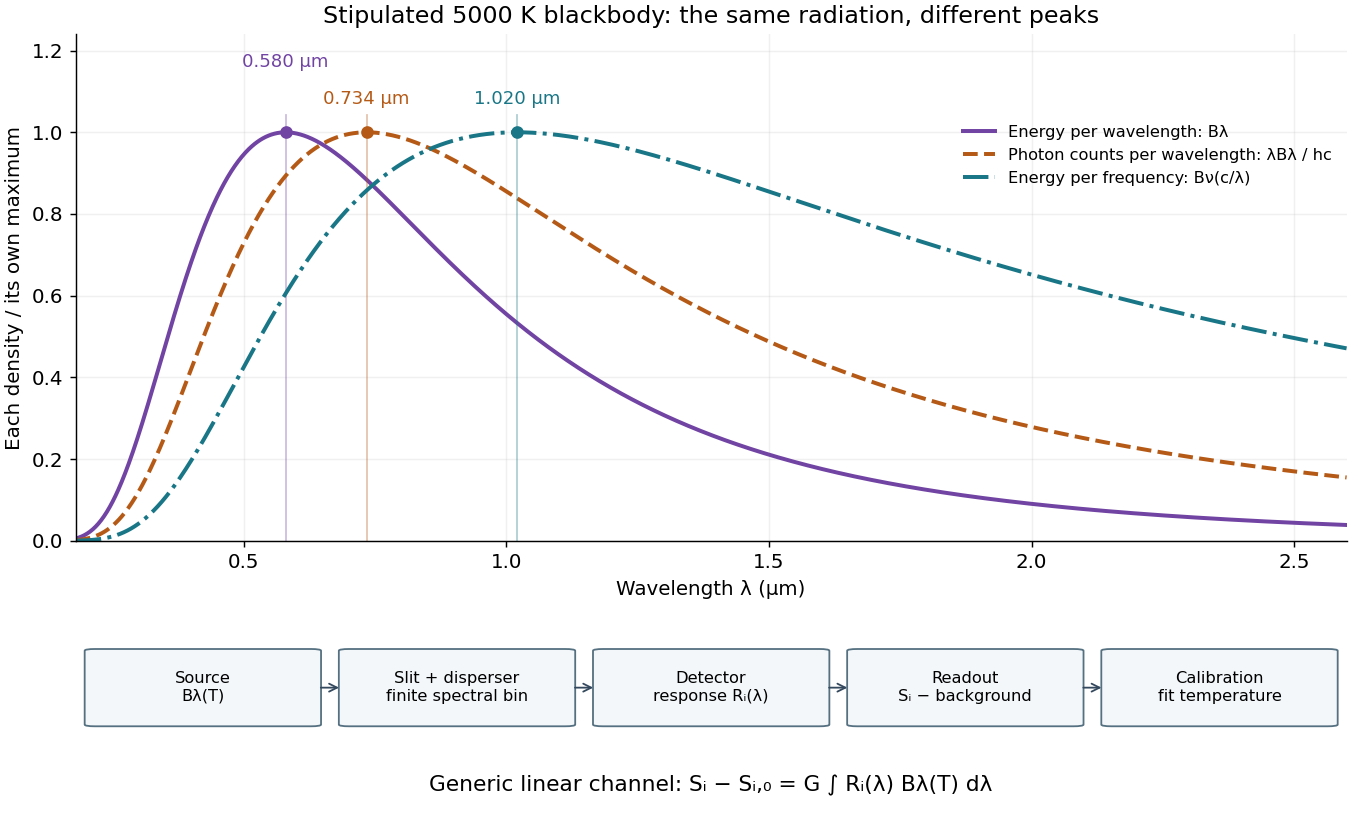
Consider a hypothetical star whose emitted specific intensity is exactly that of a uniform blackbody. Assume transparent propagation with negligible Doppler shift and interstellar extinction, so geometric dilution multiplies every spectral interval by the same factor. The stipulated temperature givesUsing the converted frequency peak as though it maximized would return , a substantial error caused solely by mixing spectral conventions.
Now stipulate a photodetector with constant quantum efficiency over the relevant wavelengths, collecting equal narrow wavelength bins. For fixed accepted projected area times solid angle , with dilution included in , its expected photon count rate density isThis follows by dividing the received power by the photon energy . It peaks where , at , giving for the same model star. Constant quantum efficiency is not constant energy spectral responsivity: the latter includes the wavelength-dependent photon energy conversion. For example, , and a bin centered at give approximately detected photons per second in the narrow-bin approximation. These are calculated model values, not observations of a named star.
A more general linear detector channel has outputwhere is the background reading and includes spectral selection, optical transmission and detector spectral responsivity. A raw channel maximum need not locate either Planck function maximum. Recovering a temperature requires an appropriate calibrated response and an emission model. For a real stellar atmosphere, opacity and radiative transfer can reshape the spectrum; interstellar extinction can reshape it again. A single peak does not establish a unique physical temperature without those assumptions.

New to topics? Read the docs here!