
A circulant matrix applies the same rule at every position of a finite ring: moving both the input and output indices one step leaves its entries unchanged. Its first column determines the whole matrix. For a length- vector , index rows and columns by and defineThe indices use modular arithmetic. Thus each column is the previous column shifted down one place, with the last entry wrapping around to the top. Multiplication is exactly circular convolution:This makes a circulant matrix a natural model for a periodic finite difference rule or a filter acting on a periodic record. Strang's MIT lecture develops this connection between circulant matrices, circular convolution and the discrete Fourier transform.[ref]
For example, the first column givesHere the indices wrap around modulo four. Each output compares a value with its two neighbors; this is the Graph Laplacian of a four-vertex cycle graph. A constant input gives zero, while an alternating input gives a large response. The Fourier diagonalization of a circulant matrix makes this distinction exact: its four eigenvalues are .
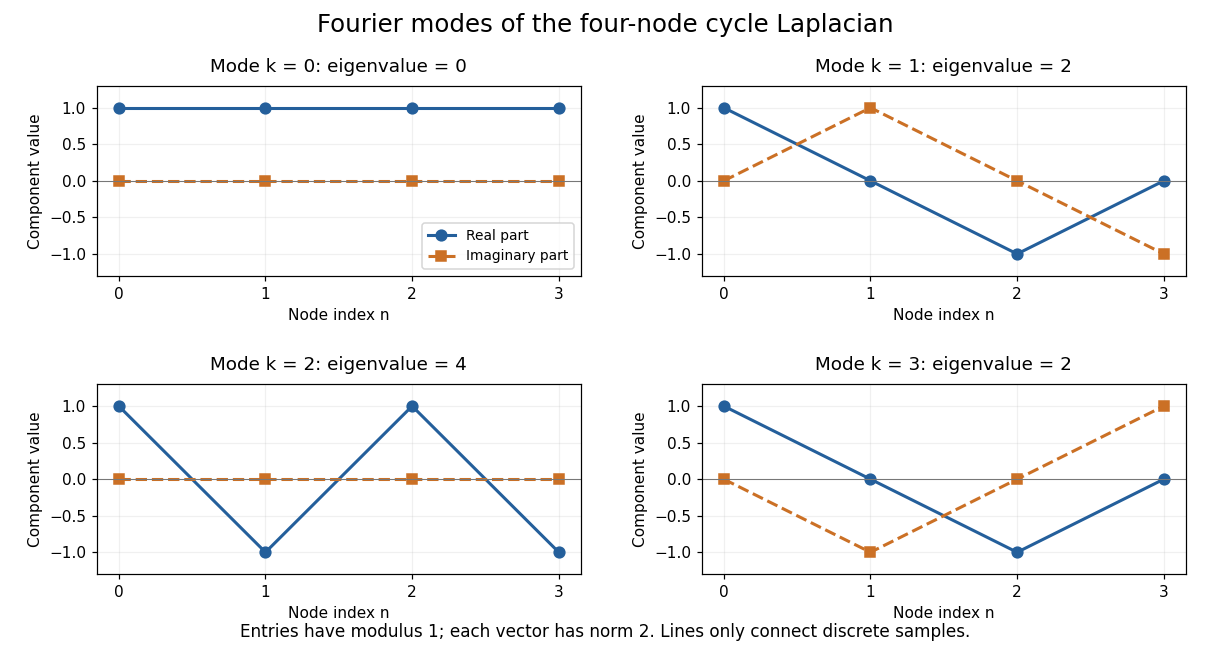
Fourier eigenvectors of the four-point cycle Laplacian
. Details. The plotted discrete Fourier modes are complex vectors, shown through their real and imaginary parts. Each entry has modulus one; the Euclidean norm of each length-four vector is two. In particular, modes and have the same real part but opposite imaginary parts, so they are distinct eigenvectors with the same eigenvalue.
The useful surprise is that every length- circulant matrix shares the same basis of eigenvectors, whatever its first column. One change of basis therefore simplifies an entire family of linear maps, instead of requiring a separate eigenvalue computation for each one. Bamieh's tutorial develops the discrete Fourier transform from precisely this simultaneous diagonalization problem.[ref]
https://arxiv.org/abs/1805.05533. Bamieh, Discovering Transforms: A Tutorial on Circulant Matrices, Circular Convolution, and the Discrete Fourier Transform (2018; revised 2022)


A **circulant matrix** is a special type of matrix where each row is a cyclic right shift of the row above it. This means that if the first row of a circulant matrix is defined, all subsequent rows can be generated by shifting the elements of the first row.
New to topics? Read the docs here!