Daniell cell voltage and load experiment
ID: daniell-cell-voltage-and-load-experiment

The motivating observation is that a chemical reaction can produce a signed electrical reading even when its reacting materials occupy separate vessels. UC San Diego's teaching demonstration places a copper strip in and a zinc strip in , using two beakers with about of chemical solution in each. The strips connect to a voltage meter. Initially there is no ionic connection; the demonstration specifies a zero reading. A filter-paper salt bridge containing aqueous then connects the chemical solutions. With the meter's positive lead on copper and negative lead on zinc, its reported readings are about ; exchanging the leads reverses the reading. These are observations reported by the university, not data generated for this article. See UC San Diego, demonstration 9B: apparatus, bridge control and meter polarity.
The controls answer different questions. Exchanging only the meter leads checks the sign convention; it does not reverse the chemical reaction or swap the anode and cathode. Interrupting only the salt bridge tests the need for an ionic return path. Its absence prevents sustained cell electric current, but a very high-input-resistance meter may still show a transient or unstable reading while interfaces store electric charge. The zero reading specified for the university's apparatus is therefore not a universal theorem for every meter. Reconnecting the same salt bridge distinguishes a reversible interruption from a disconnected wire or exhausted chemical solution. This interpretation follows from electric charge conservation in a model allowing interfacial electric charge storage; see IUPAC Gold Book: integral capacitance of an electrode for the capacitance associated with electrode charge.
To distinguish terminal electric potential difference from delivered power, compare the nearly open-circuit reading with readings across a known resistor load. In the nearly open-circuit condition, a meter with input electrical resistance much larger than the cell's effective internal electrical resistance draws little electric current. With a load, measure its terminal electric potential difference and infer using Ohm's law; track the readings over time and repeat the nearly open-circuit reading afterwards. Keep the temperature, chemical solution compositions, immersed electrode areas, bridge geometry and electrical contacts comparable. This is a model-based extension of the documented demonstration, not a claim that UC San Diego published a load sweep. A finite-current drop can reflect ionic electrical resistance, changes of interfacial reaction rates, or depletion near an electrode; a single voltage reading cannot identify which dominates. The interfacial and composition contributions are distinguished in IUPAC Gold Book: overpotential and [ref].
For a deliberately simplified calculation, model the cell by a constant electromotive force in series with a constant internal electrical resistance , and a passive load . Take positive from the cathode through the load to the anode. ThenThe nearly open-circuit limit gives but and . A straight -versus- line is a prediction of constant , not a general law for electrochemistry. See Ling, Sanny and Moebs, University Physics II, §10.1: internal resistance, terminal voltage and load.
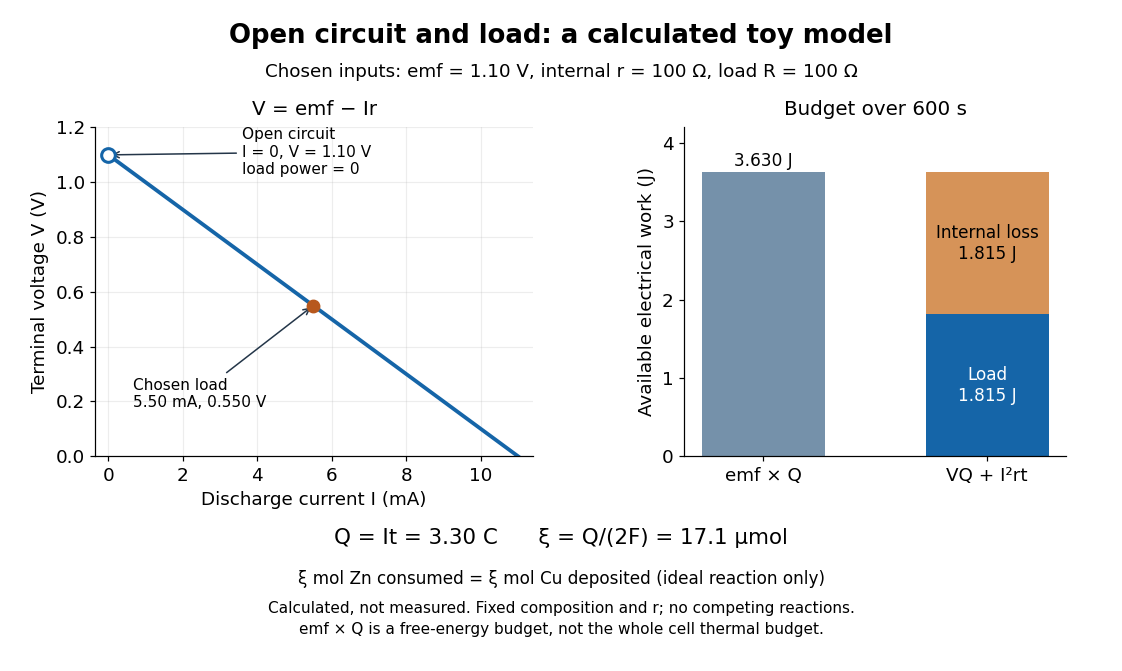
Toy Daniell cell load calculation: terminal electric potential difference, electric charge and available work
. Calculated line and energy bars, not measurements. Chosen inputs are , , and a interval. The fixed-composition approximation and unit efficiency for the two intended half-reactions are assumed. The open-circuit marker is an ideal limit; no fit to experimental data is made. Details.
For the chosen values, and . Holding these toy parameters fixed for gives transported electric charge and an extent of reaction , assuming all the electric current serves the two specified half-reactions. The same counts zinc consumed and copper deposited, rather than equal masses. The energy budget isThe load's electrical work also becomes Joule heating when the load is a resistor. Here accounts for the reaction's available reversible electrical work; a full cell thermal budget would also require its thermodynamic entropy contribution. Real measurements need uncertainty estimates, a specified meter input electrical resistance and calibration, and allowance for changing composition and unwanted chemical reactions. The toy value is not a measured property of the university's cell.
New to topics? Read the docs here!