Electrochemistry studies how chemical reactions, transport, and chemical equilibrium couple to electric charge and electric potential. In a cell, electrons travel through the external circuit, while mobile ions carry electric current through the electrolyte. At the electrodes, redox reactions connect these two forms of electric charge transport. This connection makes it possible both to obtain electrical work from a chemical reaction and to use electrical work to drive a chemical reaction.
An anode is an electrode where oxidation occurs; a cathode is an electrode where reduction occurs. These definitions refer to the chemical reactions, rather than universal positive or negative terminal signs. In a galvanic cell delivering electrical work, the anode is negative and the cathode positive. In an electrolytic cell driven by an external source, the anode is positive and the cathode negative. See Pingarrón et al., Terminology of electrochemical methods of analysis (IUPAC Recommendations 2019), §§3.1 and 3.4 and Flowers et al., Chemistry 2e, §17.2: galvanic cells.
For a worked example, consider an electrolytic cell containing molten sodium chloride, with the anode connected to the positive terminal and the cathode to the negative terminal of an external source. At the cathode, sodium cations gain electrons; at the anode, chlorine anions lose electrons:The first line has net electric charge zero on each side; the second has on each side. Adding the lines cancels the transferred electrons and preserves both chemical atom counts and net electric charge. The sodium product is neutral, and the chlorine product is a diatomic molecule. These equations specify molten sodium chloride; aqueous chemical solutions introduce competing water reactions. See 17.7 Electrolysis (§17.7: electrolysis of molten sodium chloride).
Electrochemistry underlies battery charging and the manufacture of chemicals by electrolysis. Its particularly useful idea is that an electron inventory in a balanced chemical equation also accounts for transported electric charge. Transport alone is a different question from an electrode chemical reaction: an ion may carry electric current through the electrolyte without itself being consumed at an electrode.
Historically, Michael Faraday introduced the terms electrode, electrolyte, anion, cation, and ion in the terminology section of his 1834 paper, Experimental Researches in Electricity, Seventh Series by Michael Faraday (§§662–667). His §667 explicitly treats the direction assigned to electric current as a convention. His ion language predates the modern electron and atomic nucleus picture used in the charge-counting example above.
For an electrolyte near chemical equilibrium, a Poisson-Boltzmann equation can approximate the distribution of ions in an electric potential. Such an equilibrium model does not by itself describe a cell carrying sustained electric current.
Coexistence of chemical species that could undergo a favorable oxidation-reduction reaction. A metabolic opportunity requires accessible reactants, reaction pathways and replenishment.
Electrochemical growth of cerium dioxide from dissolved cerium ions. Oxidation of cerium(III) to the solid oxide transfers one electron per cerium; proton activity affects the potential strongly. A poorly conducting film can slow further growth.
Coupled dissolution of a less noble solid metal and reduction/deposition of a more noble metal ion without an external power supply.
Transfer of an electron between chemical species or between a species and an electrode. Its rate depends on driving force, electronic coupling and nuclear/solvent reorganization.
Electron transfer through a ligand shared by two metal centres. Bridge formation, electron transfer and bridge cleavage can leave transferred-ligand connectivity in a substitution-inert product.
An abundant electrolyte used to carry solution current and suppress migration of the dilute electroactive species.
An electrochemical method that reverses a potential sweep and records the current response. Peak positions and return waves probe electron-transfer kinetics and coupled chemistry.
A sequence of electron transfer, chemical reaction, electron transfer and chemical reaction. Binding reactions can shift reduction potentials and separate reduction from product-release waves.
An electrode whose controlled rotation establishes a steady hydrodynamic boundary layer. In its diffusion-limited regime, current varies with the square root of angular speed.
Suppression of further interfacial reaction by a protective surface layer. A passive film can also impede useful charge transfer; its role depends on the electrode and operating conditions.
Slowing of electrochemical film growth as the deposited oxide restricts electron or ion transport. Increasing thickness increases the transport barrier even while dissolved precursor remains available.
An electrochemical energy converter supplied continuously with fuel and oxidant; operating voltage and current depend on kinetics and transport as well as equilibrium potential.
Displacement of electrode or cell voltage from equilibrium under current flow. Kinetic, transport and resistive contributions should be separated.
A kinetic model for the net electrode current near and away from equilibrium. For a single effective reaction with consistent activities and , . Near equilibrium it gives ; at sufficiently large overpotential one exponential gives the Tafel equation. Multistep reactions can require a different kinetic interpretation.
A limiting rate of charge transfer per area imposed by reactant transport or another bottleneck. In a simple diffusion film, and a consuming electrode has . Increasing internal roughness does not necessarily increase external mass-transfer flux proportionately.
The equal magnitudes of the opposing partial electrode-reaction current densities at equilibrium. Their net current is zero. The area convention, activities and temperature must be specified; an exchange current density alone does not specify a nonlinear current-potential curve.
An activation-controlled large-overpotential relation . The Tafel slope uses volts per decade when the logarithm is base ten. Exchange current density and operating current density must use the same area convention.
The change in overpotential per decade of current density in the activation-controlled regime of a Tafel equation. In a single-step Butler-Volmer equation with constant transfer coefficient, the anodic slope is , where is temperature, is the molar gas constant, is the number of transferred electrons and is the Faraday constant. The magnitude of the cathodic slope is . Inferring one from the other requires the model's relation between the two coefficients; the equality applies to this effective single-step model and need not describe a multistep reaction.
Additional voltage needed to nucleate or grow a new phase, or overcome a phase-transformation barrier. It can cause an initial voltage dip and voltage hysteresis.
A voltage loss from differences between interfacial and bulk reactant or product activities caused by finite mass transport.
For a cell reaction transferring electrons, , with dimensionless reaction quotient and consistently chosen standard states.
An electrode’s potential relative to a specified reference, conventionally tabulated for its reduction half-reaction.
The difference between an applied electrode potential and the relevant equilibrium potential. Increasing its magnitude can drive electron transfer toward a mass-transport limit.
A potential characterizing equal oxidized and reduced activities under stated conditions. For a reversible cyclic voltammogram, estimates its formal potential.
A redox mediator transfers reducing equivalents between components through changes in oxidation state. A current-enhancing additive is not necessarily a mediator unless its redox participation and regeneration are established.
A biophotovoltaic device couples photosynthetic biological activity to an external electrical circuit. Measured current depends on intracellular electron supply, export, electrode reactions and abiotic background.
An electrode is an electronic electrical conductor in contact with an electrolyte. In a cell carrying sustained redox electric current, chemical reactions at this interface exchange electrons with chemical species. An electrode can participate in the chemical reaction, as the dissolving zinc anode of a Daniell cell does, or provide a conducting surface without appearing in the net chemical equation. This distinction is illustrated by active and inert electrodes in Flowers, Theopold, Langley and Robinson, Chemistry 2e, §17.2.
The interface connects two kinds of electric charge transport: electrons in the external electrical circuit and ions in the electrolyte. The same electron does not travel through the wire, swim through the salt bridge, and complete a circuit! The half-reactions account for how electronic and ionic transport meet. This is the useful idea behind both obtaining electrical work in a galvanic cell and supplying electrical work in an electrolytic cell.
Name an electrode from its net chemical reaction: oxidation means anode, and reduction means cathode. State the operating mode before assigning terminal signs. For a galvanic cell supplying a passive load, the anode is negative and the cathode positive; for an ordinary two-terminal electrolytic cell driven by a source, the anode is positive and the cathode negative. Here positive means higher terminal electric potential than the other electrode, not a claim that the bulk material has a large positive net electric charge. See Pingarrón et al., Terminology of electrochemical methods of analysis (IUPAC Recommendations 2019), §§3.1 and 3.4.
An electronically conducting support connecting active material to an external circuit.
The anode is the electrode at which the net electrode chemical reaction is oxidation: the reacting chemical species loses electrons. This definition is independent of terminal sign. See IUPAC Gold Book: anode.
During Daniell cell discharge, a zinc chemical atom becomes a cation, leaving two electrons in the electrode; those electrons leave through the external electrical circuit. The zinc anode is the negative terminal. In an externally driven electrolytic cell, electrons instead leave the anode through the lead to the source's positive terminal. Conventional current in that lead points toward the anode, opposite to electron motion. The anode can therefore be positive while still being the site of oxidation. See Daniell cell for the balanced half-reaction and electrode for the operating-mode sign conventions.
The cathode is the electrode at which the net electrode chemical reaction is reduction: the reacting chemical species gains electrons. This definition is independent of terminal sign. During Daniell cell discharge, cations accept electrons arriving at the copper cathode and become neutral copper. The cathode is then the positive terminal. In an externally driven electrolytic cell, the source's negative terminal supplies electrons to the negative cathode. See Pingarrón et al., §3.4: cathode and Daniell cell.
An ion carrying electric current need not undergo reduction at the cathode. For example, in the ideal Daniell cell charge-balance picture, potassium cations arriving from a salt bridge remain dissolved while cations are consumed. Follow the half-reaction to identify the reacting species; follow electric charge conservation to account for the other moving ions.
A galvanic cell supplies electrical work from a spontaneous redox chemical reaction under the specified conditions. In discharge through a passive load, oxidation occurs at its negative anode and reduction at its positive cathode. Separating the reacting compartments makes the electrons take an external route, where their transport can deliver useful work. See Flowers et al., Chemistry 2e, §17.2: separated reactions and electrical work.
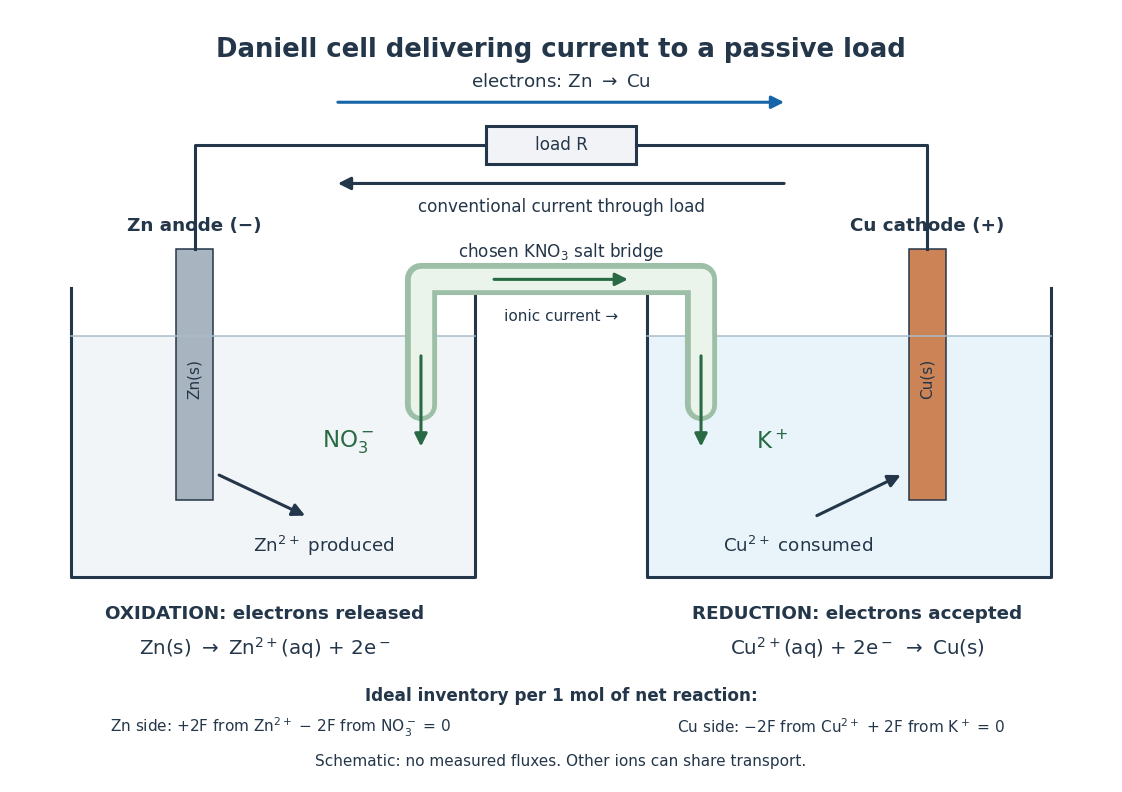
In the metallic external electrical circuit, electrons move from anode to cathode, while conventional current goes from cathode through the load to anode. Inside the cell, net ionic conventional current closes the loop from the anode compartment toward the cathode compartment. Oppositely moving cations and anions can both contribute to that direction; see electrolyte for the signed current density calculation. A cell can maintain a nonzero terminal electric potential difference near open circuit while delivering almost no power; the Daniell cell voltage and load experiment makes this distinction concrete.
A galvanic cell whose reversible electromotive force arises from different reactant activities at otherwise corresponding interfaces. The Nernst equation relates the measured voltage to the activity ratio, provided the transported charge and reaction stoichiometry are specified.
A cell comparing oxygen chemical potentials across an oxygen-ion-conducting electrolyte. With oxide-ion conduction and four electrons transferred per oxygen molecule, for consistently ordered terminals. Reference pressure, interface equilibrium and electronic leakage must be controlled.
The reversible cell voltage with reactants and products in specified standard states. It is the cathode reduction potential minus the anode reduction potential.
A Daniell cell uses the zinc/ and /copper pairs. In the separated-compartment teaching version, a zinc electrode contacts an aqueous chemical solution containing , and a copper electrode contacts one containing . A salt bridge supplies an ionic connection; a wire and load supply an electronic connection. During discharge,The zinc electrode loses material and copper is deposited at the cathode. Each half-reaction conserves chemical atom counts and electric charge: the first has net charge zero on each side, the second on the left and zero on the right. The net reaction has on both sides, with no electrons left in its chemical equation. The Zn/Cu teaching cell and these half-reactions are described in Florida State University, Redox Reactions in Voltaic Cells: Construction of a Potential Series, lab background.
Creating one mole of adds of positive electric charge to the anode compartment's ionic inventory; consuming one mole of removes of positive electric charge from the cathode compartment. Here is the Faraday constant. In an ideal bookkeeping example using a potassium nitrate salt bridge, two moles of nitrate anions entering the anode compartment compensate the first change, and two moles of potassium cations entering the cathode compartment compensate the second. Other ions in the cell can share the actual transport. The two compensating inventory changes do not mean that flowed through the load: the same series electric current transports through each cross-section of the circuit per mole of net reaction. See salt bridge.
Under standard-state conditions near , tabulated reduction potentials give a cell electromotive force of approximately . This is a reversible reference value, not a promised loaded reading; actual composition matters through thermodynamic activity. The tabulated copper and zinc values and their subtraction are given in Purdue University, Electrochemical Reactions: standard-state reduction potentials. For the net chemical equation as written, the molar Gibbs free energy change obeysThus corresponds to about of net reaction. At fixed temperature and pressure, is the maximum reversible electrical work per mole for this cell reaction. It is not automatically all the heat released by a finite-current cell. See 17.4 Potential, Free Energy, and Equilibrium (§17.4: cell potential and free energy).
The motivating observation is that a chemical reaction can produce a signed electrical reading even when its reacting materials occupy separate vessels. UC San Diego's teaching demonstration places a copper strip in and a zinc strip in , using two beakers with about of chemical solution in each. The strips connect to a voltage meter. Initially there is no ionic connection; the demonstration specifies a zero reading. A filter-paper salt bridge containing aqueous then connects the chemical solutions. With the meter's positive lead on copper and negative lead on zinc, its reported readings are about ; exchanging the leads reverses the reading. These are observations reported by the university, not data generated for this article. See UC San Diego, demonstration 9B: apparatus, bridge control and meter polarity.
The controls answer different questions. Exchanging only the meter leads checks the sign convention; it does not reverse the chemical reaction or swap the anode and cathode. Interrupting only the salt bridge tests the need for an ionic return path. Its absence prevents sustained cell electric current, but a very high-input-resistance meter may still show a transient or unstable reading while interfaces store electric charge. The zero reading specified for the university's apparatus is therefore not a universal theorem for every meter. Reconnecting the same salt bridge distinguishes a reversible interruption from a disconnected wire or exhausted chemical solution. This interpretation follows from electric charge conservation in a model allowing interfacial electric charge storage; see IUPAC Gold Book: integral capacitance of an electrode for the capacitance associated with electrode charge.
To distinguish terminal electric potential difference from delivered power, compare the nearly open-circuit reading with readings across a known resistor load. In the nearly open-circuit condition, a meter with input electrical resistance much larger than the cell's effective internal electrical resistance draws little electric current. With a load, measure its terminal electric potential difference and infer using Ohm's law; track the readings over time and repeat the nearly open-circuit reading afterwards. Keep the temperature, chemical solution compositions, immersed electrode areas, bridge geometry and electrical contacts comparable. This is a model-based extension of the documented demonstration, not a claim that UC San Diego published a load sweep. A finite-current drop can reflect ionic electrical resistance, changes of interfacial reaction rates, or depletion near an electrode; a single voltage reading cannot identify which dominates. The interfacial and composition contributions are distinguished in IUPAC Gold Book: overpotential and [ref].
For a deliberately simplified calculation, model the cell by a constant electromotive force in series with a constant internal electrical resistance , and a passive load . Take positive from the cathode through the load to the anode. ThenThe nearly open-circuit limit gives but and . A straight -versus- line is a prediction of constant , not a general law for electrochemistry. See Ling, Sanny and Moebs, University Physics II, §10.1: internal resistance, terminal voltage and load.
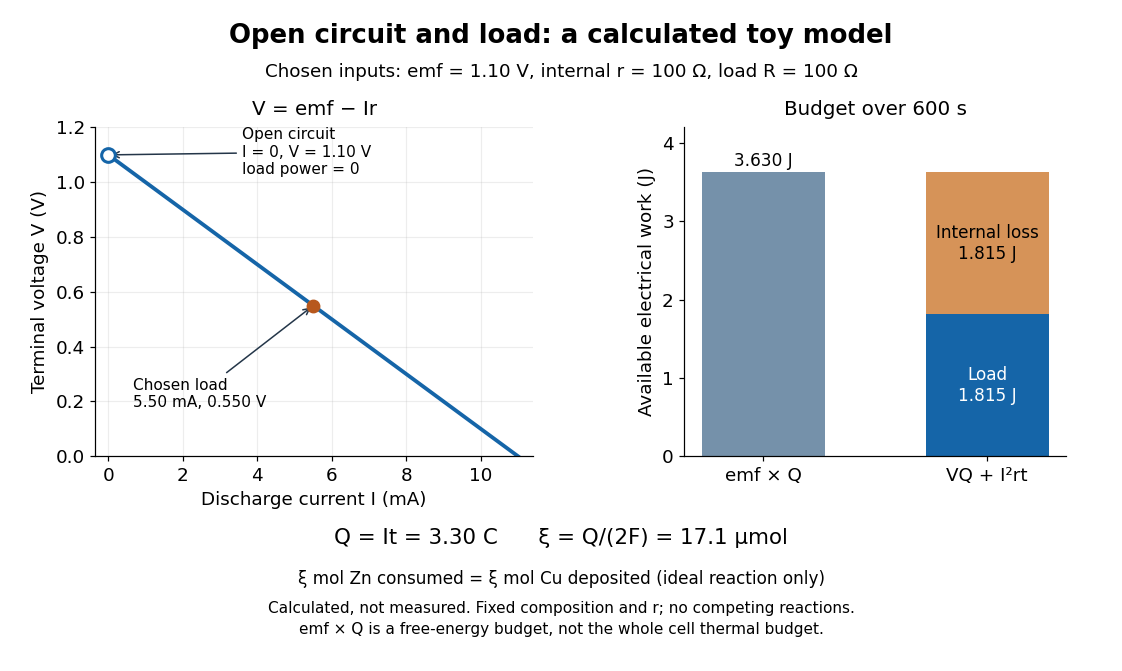
Toy Daniell cell load calculation: terminal electric potential difference, electric charge and available work
. Calculated line and energy bars, not measurements. Chosen inputs are , , and a interval. The fixed-composition approximation and unit efficiency for the two intended half-reactions are assumed. The open-circuit marker is an ideal limit; no fit to experimental data is made. Details.For the chosen values, and . Holding these toy parameters fixed for gives transported electric charge and an extent of reaction , assuming all the electric current serves the two specified half-reactions. The same counts zinc consumed and copper deposited, rather than equal masses. The energy budget isThe load's electrical work also becomes Joule heating when the load is a resistor. Here accounts for the reaction's available reversible electrical work; a full cell thermal budget would also require its thermodynamic entropy contribution. Real measurements need uncertainty estimates, a specified meter input electrical resistance and calibration, and allowance for changing composition and unwanted chemical reactions. The toy value is not a measured property of the university's cell.
Electrolysis uses an external source of electrical work to drive redox chemical reactions at the electrodes of an electrolytic cell. Its characteristic application is forcing a chemical reaction in a direction that is nonspontaneous under the specified conditions: a discharging galvanic cell supplies electrical work, whereas electrolysis consumes electrical work. This makes electrolysis useful for producing otherwise difficult-to-obtain chemical substances, charging a rechargeable battery, and depositing a metal coating on a conducting object.[ref]
17.7 Electrolysis. §17.7
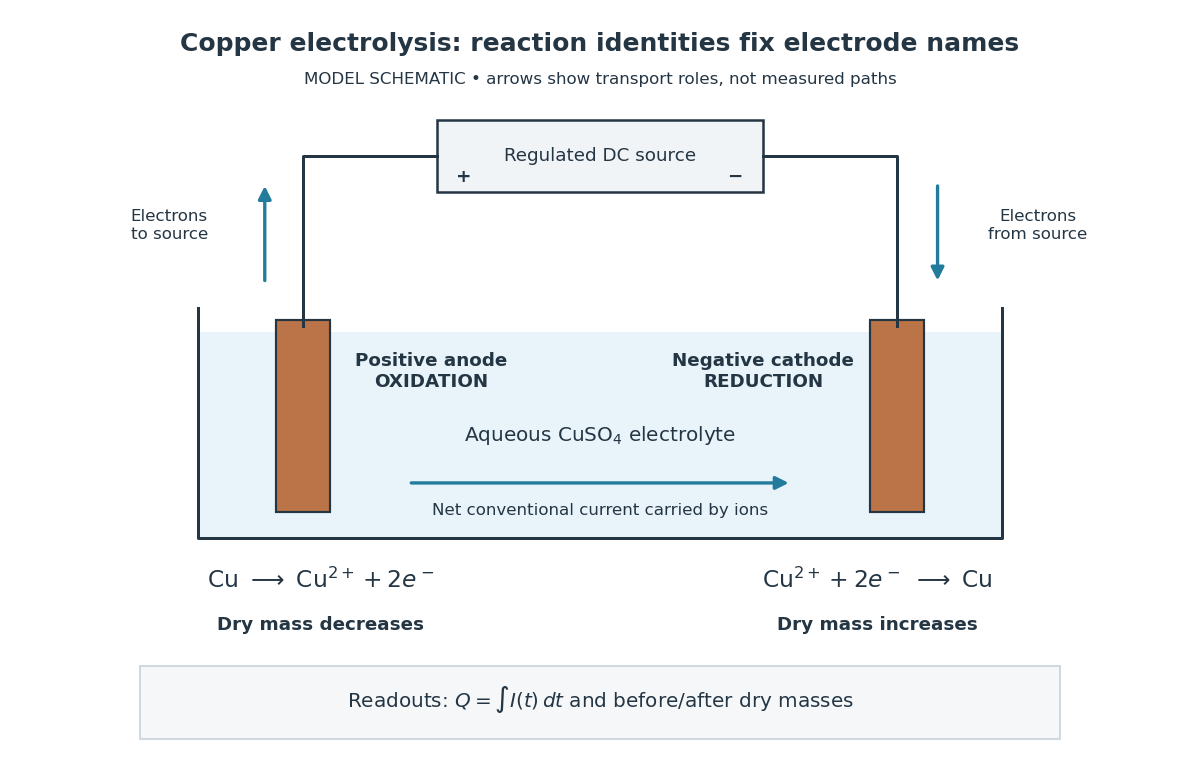
Always identify the anode by oxidation and the cathode by reduction. In ordinary driven two-terminal operation, the source withdraws electrons from the positive anode and delivers electrons to the negative cathode. In a discharging galvanic cell, the anode is negative and the cathode positive. Thus terminal signs change with operating mode, while the reaction definitions remain valid. Through the electrolyte, ions transport electric charge; they need not all be consumed at an electrode. The electrolyte and electrolytic cell articles explain this transport and its conventional current direction.
For a net chemical equation transferring electrons per reaction event, the molar reaction Gibbs free energy obeyswhere is the Faraday constant and is the reversible cell electromotive force for the reaction in the written direction. A nonspontaneous direction has and at fixed temperature and pressure. The ideal opposing voltage magnitude is ; sustaining a finite electric current generally needs additional drive because of electrical resistance and finite electrode reaction rates. This thermodynamic voltage concerns the actual composition, rather than necessarily standard conditions.[ref] Not every use of electrolysis increases bulk chemical Gibbs free energy: transferring copper between equivalent surfaces can have zero bulk while the source still supplies dissipated electrical work. See the existing electrolytic cell example.
A particularly revealing experiment measures copper transfer instead of merely looking for a coating. Two separated copper electrodes stand in aqueous electrolyte in a vessel, with insulated leads to a regulated direct-current power supply, a series ammeter and a switch. A balance reads each electrode's mass before and after a timed run. The Institute of Physics describes copper cells with ammeters, adjustable current and removable cathodes; its comparison uses three similar cells at for ten minutes, for ten minutes, and for twenty minutes. The specified observation to test is that deposited copper mass is proportional to electric current times time. These are documented experimental settings, not measurements generated here.[ref]
The ideal half-reactions areEach deposited copper chemical atom requires two electrons, so . The anode loses copper and the cathode gains it; ideally their mass changes have equal magnitudes, and the bulk copper cation inventory stays constant. Local concentrations near the electrodes can nevertheless differ. The sulfate anions participate in ionic transport without appearing in these net half-reactions; electronic electric current in the wires becomes ionic electric current in the electrolyte through the two interfaces.[ref]
Clean, rinse, dry and identify the electrodes before their initial weighing. After interrupting the electric current, rinse away adhering electrolyte, dry again and weigh without rubbing off the deposit. KIT's university practical explicitly calls for distilled-water rinsing, careful drying and weighing both electrodes; it warns that loose copper grains can be lost during handling.[ref] Useful additional controls are repeated drying and weighing until the reading stabilizes, and a matched unpowered immersion followed by the same rinse/dry cycle. These controls test retained liquid, residual dissolved salts, handling loss and chemical changes unrelated to passed electric charge; they are proposed checks, not additional observations reported by KIT. Keep immersed electrode area, spacing, electrolyte composition and temperature comparable across runs, and keep the electrodes from touching.
Record the electric current as a function of time, together with the exact switch-on and switch-off times. Taking in the chosen deposition direction, the transported electric charge isFor constant electric current, ; with sampled readings, use numerical integration rather than assuming that one ammeter reading remained constant. The two equal-charge Institute of Physics settings each give , while its shorter setting gives . With , the mass per amount of substance tabulated by KIT, and , ideal Faraday's laws of electrolysis predictThese are calculated predictions for complete conversion of the measured electric charge into retained copper, not experimental results. For a stable process, doubling the electric charge doubles the deposited mass; equal electric charge gives equal deposited mass even when the electric current and duration differ.
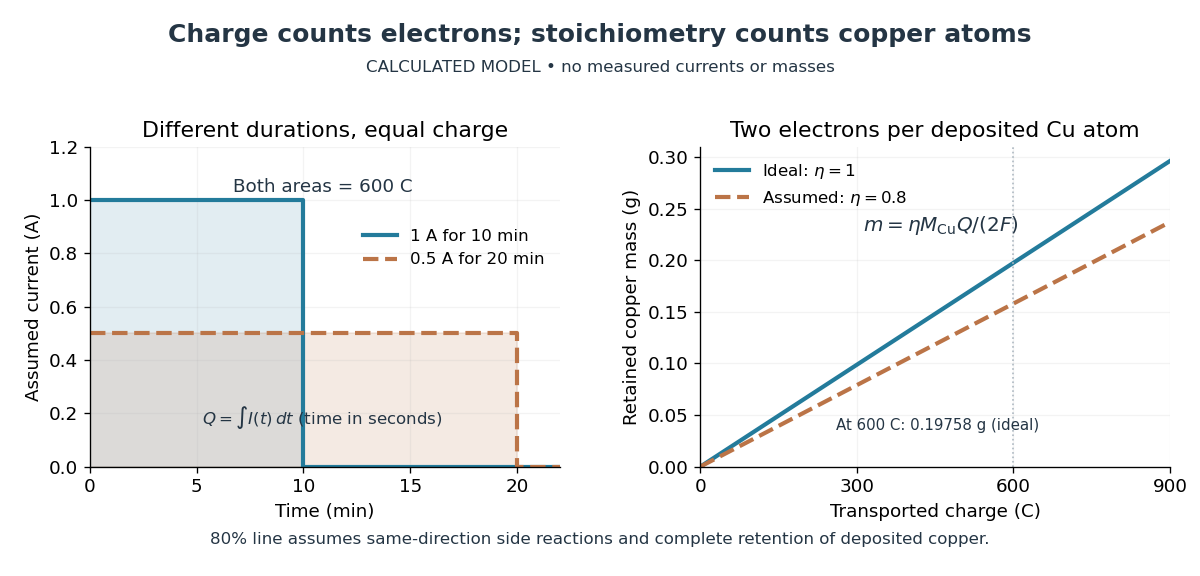
The balance reading is a test of the whole model. Competing reduction of water or other chemical species can divert electric current from copper deposition; transient electrode capacitance can also consume part of a short pulse without producing copper. A fragile deposit can detach even when its formation used the expected electric charge. Conversely, retained electrolyte or salts can increase an apparent mass gain. Comparing anode loss with cathode gain helps detect such problems but does not identify every cause. A slope below alone cannot distinguish competing chemical reactions from lost deposit. Current efficiency measures the fraction of transported electric charge assigned to a specified electrode reaction, rather than the fraction of electrical energy stored chemically.[ref]
The beautiful connection is that an electrical measurement counts chemical events: integrating electric current and reading a balance provide two ways of following the same electron stoichiometry. This makes electrolysis useful for controlling coating quantity and for testing a charge-to-amount of substance relation. It does not determine coating uniformity, adhesion or the required voltage, which depend on transport and electrode chemical kinetics as well.
Electrolytic purification by transferring the desired metal from an impure dissolving anode to a purer cathode. Impurities can stay dissolved, remain as solids or form precipitated anode slime. Potential control, transport and exclusion of solid contamination are as important as tabulated standard potentials.
Solid residue formed or collected during anodic dissolution in electrorefining. It can contain noble metals, precipitated salts and undissolved inclusions. Slime can retain valuable impurities, block transport or contaminate a deposit by entrainment.
Electrically driven conversion of water into hydrogen and oxygen. Reversible thermodynamics sets a minimum voltage, while activation, resistance and mass transport increase the operating requirement.
Deposition of a metal coating by electrochemical reduction of suitable dissolved species on a conducting workpiece. Current distribution and mass transport affect coating uniformity.
The fraction of passed charge assigned to the specified product: . Product yield and charge efficiency are distinct.
Faraday's laws of electrolysis state that the mass of material formed or consumed by a specified electrode reaction is proportional to the transported electric charge, and that equal electric charge produces masses proportional to for different reactions. Here is the product's mass per mole, and is the positive number of electrons transferred per product entity. For complete use of the electric charge in that reaction,The first relation uses the Faraday constant; the second uses half-reaction stoichiometry; the third converts amount of substance to mass. For equal transported electric charge in two ideal cells,The number belongs to the balanced half-reaction, rather than to the metal's name alone: copper deposited from needs . These modern forms of both laws are given in KIT's practical.[ref]
If other same-direction electrode reactions share the measured electric current, define an integrated current efficiency . Provided the product is neither subsequently consumed nor lost, the retained mass isHere follows from the specified same-direction partition of electric current. It is not a universal bound on every signed partial-current convention: IUPAC notes that simultaneous oxidation and reduction at one electrode can produce a current-efficiency ratio above one.[ref] When efficiency varies during a run, use the charge-weighted ratio above, rather than an unweighted average over time. If deposition removes material from a multicomponent chemical solution, specify which chemical species is being counted and balance its half-reaction before choosing .
Michael Faraday's accessible 1834 paper, Experimental Researches in Electricity, Seventh Series, §783 states proportionality between chemical action and the quantity of electricity passed. In §§789–791 he describes connecting a molten tin-chloride cell in series with a water-decomposition charge indicator, weighing the receiving electrode before and after, and comparing the deposited metal with the indicator's gas readout. The common series electric current makes these two readouts comparable. This was a quantitative test of chemical equivalents, rather than merely an observation that a deposit appeared. It is historical evidence, not a suggested classroom procedure; the modern electron-counting derivation above uses concepts unavailable to Faraday.[ref]
Experimental Researches in Electricity, Seventh Series by Michael Faraday. §783; §§789–791; pp. 101–103
An electrolytic cell uses an external source of electrical work to drive electrode chemical reactions. In the ordinary two-terminal driven mode, its positive anode supports oxidation and its negative cathode supports reduction. The source removes electrons from the anode and supplies electrons to the cathode; through the electrolyte, net conventional current goes from anode toward cathode. Terminal signs refer to the driven cell's terminals relative to each other. The source supplies electrical power to the cell. See 17.7 Electrolysis (§17.7: electrolysis and electroplating).
For example, transferring copper from a soluble copper anode onto a conducting object at the cathode has the ideal half-reactionsTheir sum transfers copper between surfaces. For identical bulk states, this transfer need not have a positive bulk Gibbs free energy change; finite electric current still needs applied drive to overcome losses. Thus "consumes electrical work" does not mean every electrolytic cell stores all that work as chemical Gibbs free energy. Electrolysis can instead redistribute material. The charge-to-amount relation remains when only these half-reactions carry the electric current; competing water reactions would change the deposited amount. The electroplating principle and charge accounting are described in 17.7 Electrolysis (§17.7: electroplating and quantitative aspects).
The University of Washington's teaching demonstration makes this material transfer visible with a copper electrode and a stainless-steel electrode in a glass cell containing . The external source connects its positive lead to copper and negative lead to steel; the reported observation is a copper coating on the steel. Reversing the source polarity removes the deposited copper again: the coated surface now supports oxidation and acts as the anode. This polarity reversal changes the drive, unlike swapping the measurement leads in the Daniell cell voltage and load experiment. Coating appearance alone does not measure charge efficiency or exclude competing chemical reactions. See University of Washington, Electroplating Copper on Stainless Steel: apparatus and reversible coating demonstration.
The copper cathode in this driven example is negative, while the copper cathode of a discharging Daniell cell is positive: both support exactly the same reduction half-reaction. Likewise, an anode need not lose material if its conducting surface is absent from its net half-reaction. Neither terminal sign nor a universal mass-change rule defines an anode or cathode.
A half-reaction is a balanced chemical equation for either the oxidation or the reduction part of a redox chemical reaction, explicitly including exchanged electrons. Match the electron counts before adding the two half-reactions; the net equation then contains no transferred electrons. A half-reaction is bookkeeping, not necessarily an elementary reaction. See Florida State University, lab background: separate electrode reactions and Daniell cell.
A salt bridge is an ionic connection between electrolyte compartments that limits bulk mixing while permitting electric charge transport. Its mobile ions compensate changes caused by the electrode half-reactions, keeping the bulk chemical solutions approximately electrically neutral during sustained electric current. It does not conduct electrons like the external wire, and its ions need not be consumed at either electrode. The ionic return path and compensating ion flows are explained in Purdue University, Electrochemical Reactions: salt bridge and charge balance.
In a discharging Daniell cell, anions moving toward the anode compartment and cations moving toward the cathode compartment both contribute to the internal conventional current from anode toward cathode. This charge-balance role is compatible with a negative anode: terminal signs do not imply that the whole anode chemical solution is negatively charged. The simple compensating-inventory example in Daniell cell does not fix all individual ion fluxes; diffusion and the cell's other mobile ions can contribute. A real bridge also introduces electrical resistance and may introduce a junction electric potential difference, so its presence does not guarantee an exact thermodynamic cell reading. See IUPAC Gold Book: salt bridge and liquid-junction potential.
An electrolyte is a conducting medium in which mobile ions carry electric current, according to IUPAC Gold Book: electrolyte. In introductory chemistry, a substance that yields ions when dissolved in water is also called an electrolyte. Both usages point to the same mechanism: an electric field gives mobile cations and anions directed drift velocities.
Mobility matters as much as the presence of electric charge. In a simple ideal model of solid sodium chloride, ions are confined to their sites and do not carry a sustained transport electric current. Molten sodium chloride has mobile ions; dissolved sodium chloride gives mobile and ions in water. Real solids can have some ionic transport through imperfections; the immobile-solid picture is an introductory limit, rather than a claim that all solids are perfect insulators.
A strong electrolyte yields essentially all ions from the dissolved substance, whereas a weak electrolyte yields only a fraction under the specified conditions. Dissolved sodium chloride is a strong electrolyte. Sucrose is a nonelectrolyte: it dissolves as neutral molecules, so dissolving something does not automatically create mobile ions. Water's own small population of hydronium and hydroxide remains possible. See 11.2 Electrolytes (§11.2: strong, weak, and nonelectrolytes) and Flowers et al., Chemistry 2e, §11.4, Table 11.3: sucrose and sodium chloride.
Acetic acid is a weak electrolyte and a weak acid. In water, some neutral acetic acid molecules transfer a proton to water, producing hydronium and the negatively charged partner:Both sides have net electric charge zero. At chemical equilibrium, neutral acetic acid coexists with these ions; the fraction converted depends on the conditions. Electrolyte strength describes this extent of ion production, while concentration describes how much substance is present per specified quantity of chemical solution. A dilute strong electrolyte can contain fewer ions per volume than a concentrated weak electrolyte. Neither the words strong and weak nor a conductivity comparison alone specifies concentration.
Now specify an electrolytic cell with a positive anode on the left, a negative cathode on the right, and an approximately uniform electric field pointing right in the bulk electrolyte. With a steady external source and neglecting diffusion and convection, positive cations drift right toward the negative cathode; negative anions drift left toward the positive anode. Yet both populations contribute a rightward conventional current! For number densities and drift velocities , the transport current density isThe product of electric charge and velocity determines conventional current: for the anion, both the charge and its rightward velocity component are negative, making its rightward contribution positive. This is the same sign rule used for electron conventional current. It follows directly from the existing charge carrier formula.
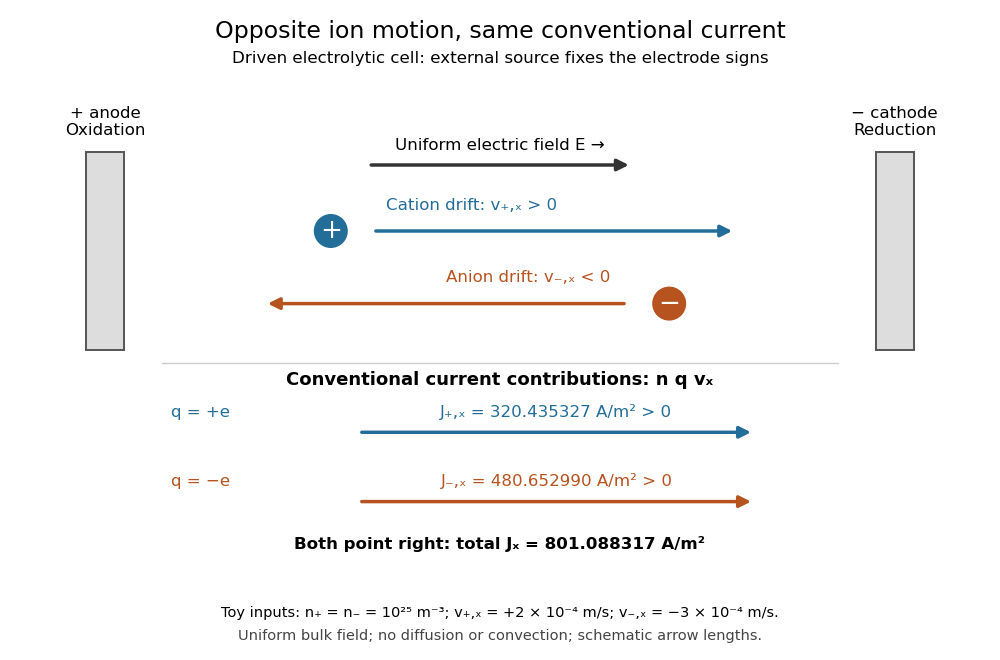
Opposite ion drift velocities contribute to the same conventional current in a specified electrolytic cell
. The positive anode is left and the negative cathode right. The upper arrows show ion motion; the lower arrows show the signs of for current density. A uniform bulk electric field is assumed; diffusion, convection, and electrode boundary layers are omitted. Arrow lengths are schematic. Details.For an independent numerical example, stipulate , , and . With the exact elementary charge , the contributions areEqual number densities of singly charged cations and anions give zero bulk charge density, while their motion gives nonzero current density. This is why a neutral electrolyte can conduct. These numbers are chosen toy inputs, not measurements of sodium chloride; maintaining sustained cell electric current also requires suitable electrode reactions. Blocking electrodes can instead lead to charge accumulation and decay of the electric current.
An electrolyte connects the microscopic motion of ions to observable electrical conductivity. A counterion-only model keeps just the mobile counterions needed to oppose a fixed electric charge; Poisson-Boltzmann equations use ideal Boltzmann distributions to model their equilibrium distributions, rather than the drift example above.
An interfacial decomposition layer that can suppress continued electrolyte reduction while allowing lithium-ion transport. Its formation consumes charge and may increase interfacial resistance.
A strong electrolyte yields essentially all ions from its dissolved substance in the specified solvent and conditions. Strength does not specify concentration.
For dissolved sodium chloride in dilute water, one dissolved formula unit supplies one sodium cation and one chloride anion. For hydrogen chloride in water, ions instead arise by proton transfer to the solvent, giving hydronium and chloride. Thus separating existing ions by dissociation of an ionic compound and producing ions from neutral molecules by ionization can both give a strong electrolyte.[ref]
The denominator in “essentially all” is the dissolved inventory. Solubility asks how much enters the chemical solution; electrolyte strength asks what happens to the part that enters. A sparingly soluble ionic compound can therefore have an essentially fully dissociated dissolved portion. Undissolved solid does not count as neutral dissolved chemical species, and low electrical conductivity alone does not establish a weak electrolyte.[ref]
11.2 Electrolytes. Chemistry 2e, §11.2, Ionic Electrolytes, paragraph on sparingly soluble ionic compounds
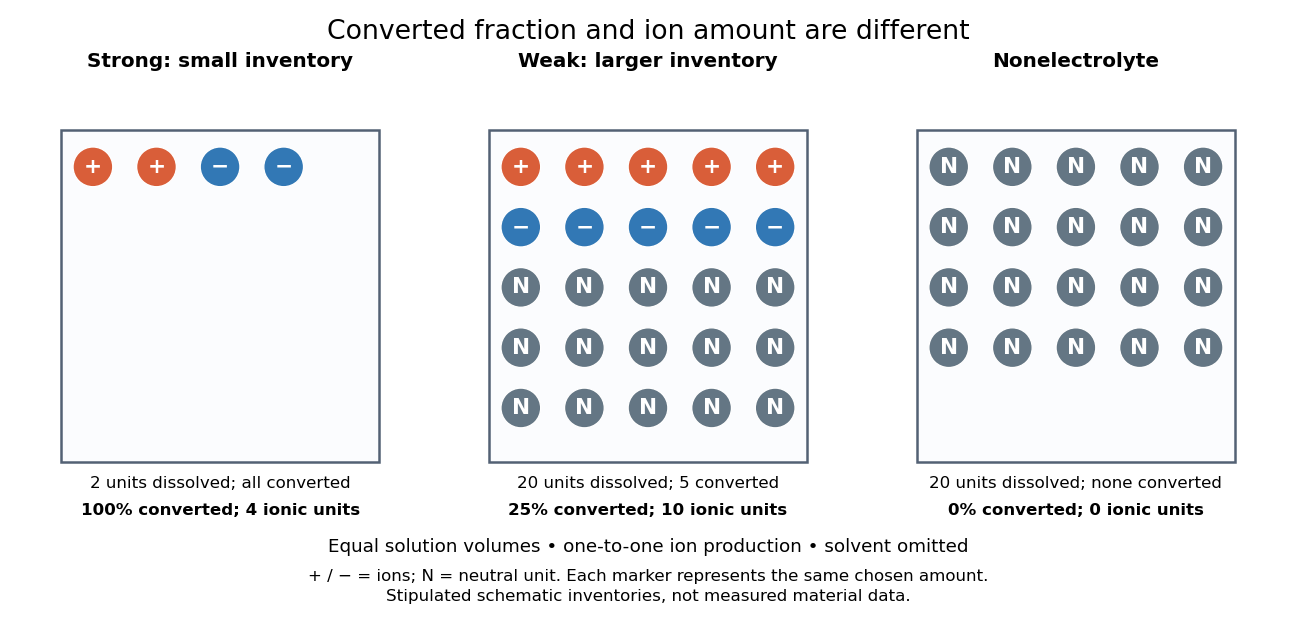
Electrolyte strength and dissolved amount of substance answer different questions
. Original schematic inventories in equal volume of a specified solvent. Each symbol represents the same chosen amount of substance, not one literal microscopic sample. A two-unit strong electrolyte inventory produces two cations and two anions; a twenty-unit weak electrolyte inventory with a stipulated one-quarter converted fraction produces five of each ion and fifteen neutral units. A twenty-unit nonelectrolyte inventory remains neutral. The solvent and its background ions are omitted. These are chosen inventories, not measured material data. Details.The diagram's weak electrolyte has the smaller converted fraction but more ions in the same volume: ten charged symbols versus four. Even at equal total ion concentrations, different ion drift velocities can give different electrical conductivities. Strength is useful for predicting dissolved chemical species in chemical equations; concentration and transport properties are additionally needed to predict electric current.
An inspected motivating experiment is Harvard Natural Sciences Lecture Demonstrations' Conductivity of Solutions by Harvard Natural Sciences Lecture Demonstrations, Setting it Up. Separate labeled beakers hold aqueous sodium chloride, sucrose, acetic acid and hydrochloric acid samples specified at , with about in beakers; distilled water supplies a blank. Metal electrodes enclosed in tubing connect to a lamp. The readout is lamp brightness; the page reports that an ionic chemical solution lights the lamp. A separate deionized-water rinse station limits carryover between samples.[ref]
Conductivity of Solutions by Harvard Natural Sciences Lecture Demonstrations. Setting it Up, sample list, enclosed electrodes, lamp and rinse station
For a controlled interpretation, keep electrode spacing and immersed area fixed, compare at the same temperature, and recheck the blank after rinsing. These are additional controls: the page supplies no numerical electrode geometry, temperature or calibration. Brightness supports the presence of mobile ions; it cannot alone measure the converted fraction because concentration, ion mobility and circuit response also matter. Its classification of insoluble compounds as weak should not replace the dissolved-inventory distinction above.[ref]
Conductivity of Solutions by Harvard Natural Sciences Lecture Demonstrations. How it Works and Setting it Up; qualitative readout and unspecified geometry and temperature
A weak electrolyte yields only a fraction of ions from its dissolved substance under the specified conditions, as illustrated by acetic acid in water.
For a neutral weak acid, unconverted molecules coexist with hydronium and the conjugate base at chemical equilibrium. The weak acid dissociation fraction describes the partition of the dissolved inventory; the acid dissociation constant describes the chemical equilibrium at fixed solvent, temperature and standard states. A single fraction is not a permanent label for every concentration: dilution can increase that fraction while the acid dissociation constant stays fixed. Calling a substance a weak electrolyte does not mean its chemical solution must be dilute.[ref]
14.3 Relative Strengths of Acids and Bases. Chemistry 2e, §14.3, Acid and Base Ionization Constants, percent-ionization discussion preceding Example 14.7
The following ideal weak electrolyte dilution law makes the distinction quantitative for a monoprotic acid. Other weak electrolytes, mixed chemical solutions and additional proton-transfer steps require their own chemical equilibrium and inventory balances.
Consider a neutral monoprotic acid dissolved in water, with no added salts or other acids. Assume dilute ideal thermodynamic activities, fixed temperature, water thermodynamic activity one, and negligible self-ionization of water. Write for its analytical concentration, with , and for its weak acid dissociation fraction. Conservation of acid units and electric charge givesHere is the conjugate base, and is conventional shorthand for hydrated hydrogen ions, represented by hydronium in this model. Substitution into the dimensionless acid dissociation constant givesSolving this quadratic equation and rejecting its negative root of a polynomial gives an exact result within the stated model:The second form avoids subtracting nearly equal numbers. Unlike the approximation , it retains depletion of neutral weak acid and always satisfies for positive . The broader weak acid mass and charge balances restore self-ionization of water when that omitted contribution matters.
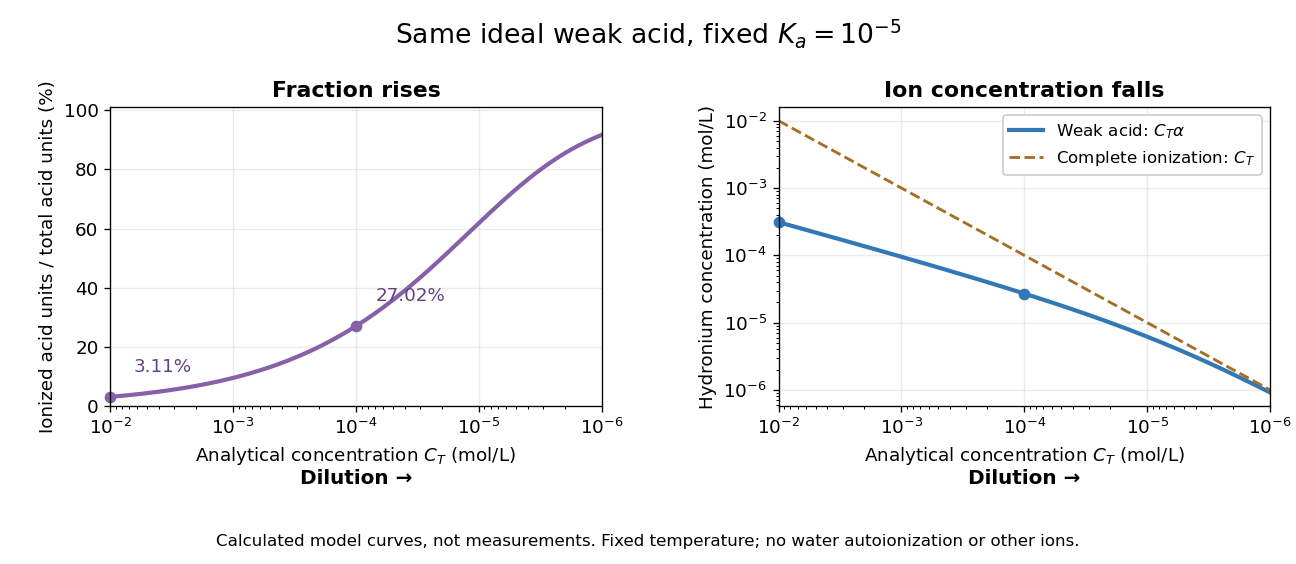
Dilution increases the ionized fraction while decreasing the absolute hydronium concentration in an ideal weak electrolyte model
. Original calculated curves for stipulated dimensionless acid dissociation constant at fixed temperature, not measurements of a named chemical acid. The shared horizontal analytical concentration axis decreases to the right. Separate panels show weak acid dissociation fraction and ; a dashed comparison shows a completely ionized monoprotic acid at the same . Both omit self-ionization of water, other ions and nonideal thermodynamic activities. Details.For an original worked example, stipulate without identifying a real substance. At , the weak acid dissociation fraction is approximately , or , and . A hundredfold dilution to raises the fraction to , or , but lowers to . A completely ionized strong acid at would have : less than the more concentrated weak acid in the first calculation, despite its greater converted fraction.
The directions of both changes follow without relying on the plot. Put . Rearranging the chemical equilibrium relation givesThus smaller forces smaller , which in turn makes larger. The derivative proves that total hydronium concentration and converted fraction move in opposite directions during dilution. In this model, adding solvent also makes additional acid units ionize at fixed total acid amount of substance, even though their ions are spread over more volume. That distinction explains why “more ionized” alone does not predict greater electrical conductivity.
Do not extend the no-background model to unlimited dilution: its prediction omits water's own ions. The weak acid mass and charge balances include that background. Added salts, other acids or bases, and nonideal activity coefficients also change the relation between analytical concentration, converted fraction and hydronium concentration.
A nonelectrolyte supplies neutral molecules rather than ions on dissolving in the specified solvent, as illustrated by sucrose in water.
For example, dissolving an idealized sucrose inventory gives dissolved sucrose molecules, rather than separate cations and anions. Dissolving the same amount of substance of a fully dissociated one-to-one strong electrolyte instead gives of each ion. Both can disappear visibly into the solvent; the resulting chemical species distinguish them.[ref]
A nonelectrolyte is not necessarily insoluble: sucrose provides a soluble counterexample. Nor does the label assert exactly zero measured electrical conductivity. Self-ionization of water, impurities or residual electrolyte from a probe can supply background ions. Comparing with a solvent blank and rinsing between samples, as in the strong electrolyte experiment, tests whether the dissolved substance itself produces appreciable additional mobile ions. This separates visible dissolution from ion production without treating lamp darkness as an absolute absence of electric charge.
Articles by others on the same topic

Electrochemistry is a branch of chemistry that deals with the interrelation of electrical and chemical phenomena. It focuses on the study of chemical processes that cause electrons to move, which in turn generates an electric current. This field encompasses a variety of processes, including: 1. **Electrochemical Reactions**: These are chemical reactions that involve the transfer of electrons, such as oxidation-reduction (redox) reactions.



