Dipole evidence for bond polarization
ID: dipole-evidence-for-bond-polarization

A permanent electric dipole moment gives evidence of separated positive and negative electric charge in an overall neutral molecule. This is a more direct probe of chemical polarity than an electronegativity table. For hydrogen chloride, NIST lists about debye for the lowest vibrational state and debye for the equilibrium value. They describe different averaging conventions, not two contradictory measurements. The NIST WebBook traces the vibrational value debye to molecular-beam electric-resonance measurements in 1970.[ref][ref]
How does molecular beam electric resonance reveal an electric dipole moment? A source and apertures form a beam of molecules in vacuum. A first nonuniform electric field, A, selects quantum states through their different Stark effects. In a central region, C, electrodes supply a nearly uniform electric field and applied radiation drives transitions at selected frequencies. A second nonuniform electric field, B, analyzes the outgoing quantum states; a detector measures the rate of arriving molecules. In a transmission-loss arrangement, resonant radiation transfers some molecules to a quantum state rejected by B, so the measured arrival rate dips. The observable is a change in detected molecules as the radiation frequency is scanned, rather than light absorption itself. This general apparatus description is documented in a later experimental thesis; it is not a reconstruction of the exact 1970 HCl instrument.[ref]
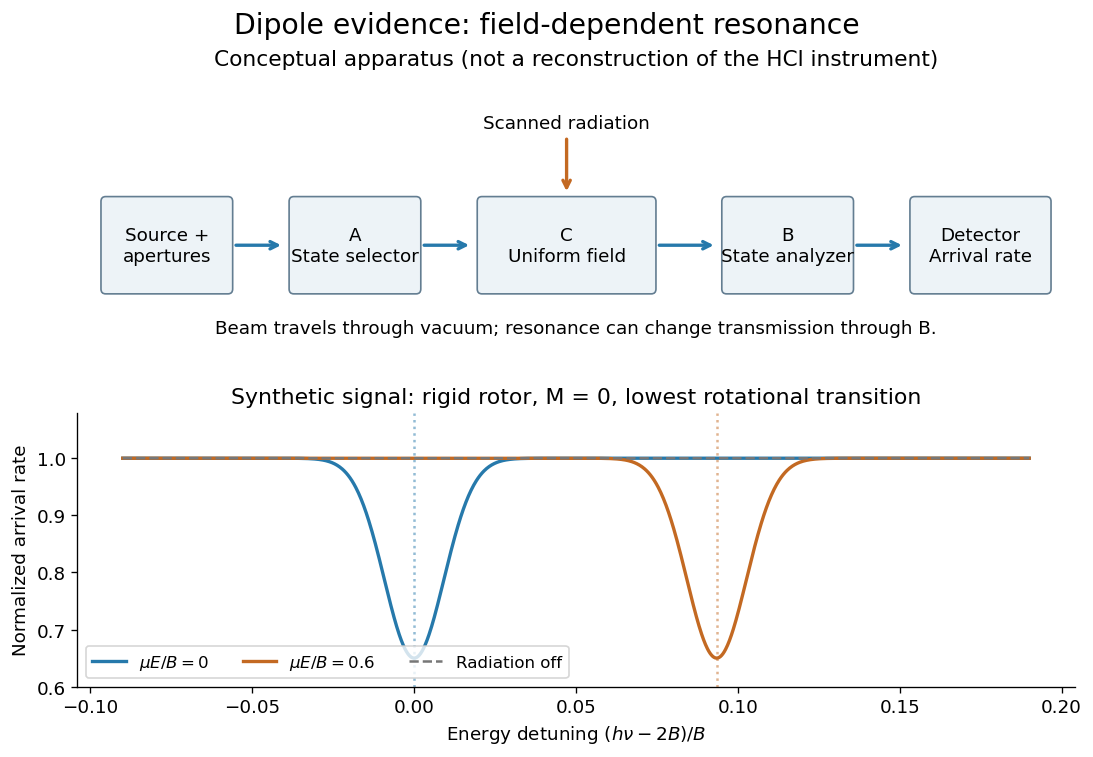
Molecular beam electric resonance: schematic state selection and a synthetic Stark effect signal from a rigid rotor model; neither apparatus dimensions nor signal curves are measured HCl data
. Details. 
The inference comes from how transition frequencies change with the known electric field. The interaction couples the electric dipole moment to the electric field; fitting the quantum mechanics of the relevant rotational states extracts its magnitude. A free rotating molecule need not show a first-order shift proportional to : the weak-field Stark effect can be quadratic. The diagram uses a simplified rigid rotor, with an energy constant, to illustrate this behavior. It omits the fine details of actual spectra.
Useful controls include scans with the radiation off to measure the baseline arrival rate, repeated scans at several calibrated electric fields, and agreement between independently assigned transitions. These are methodological checks, not claims about undocumented steps of the 1970 experiment. Field calibration and state assignment limit the inferred electric dipole moment. The published 1970 abstract confirms analysis of HCl and DCl beam-resonance spectra and combination with infrared spectroscopy intensities to obtain a distance-dependent electric dipole moment; its full apparatus and calibration record were unavailable here.[ref]
Dipole Moment and Hyperfine Parameters of H35Cl and D35Cl by E. W. Kaiser. pp. 1686–1703, authored abstract; full text unavailable
Even an accurately measured electric dipole moment is not an absolute partial atomic charge. Replacing a hydrogen chloride molecule by two point electric charges separated by bond length gives . Using debye and gives times the elementary electric charge. This is an effective two-point model, combining a vibrationally averaged electric dipole moment with an equilibrium bond length, not a unique partition of the actual electron density or a measured “18.1 percent ionic bond”.[ref]
For a molecule with several chemical bonds, molecular geometry can cancel opposing contributions to the total electric dipole moment. Carbon dioxide illustrates why an overall nonpolar molecule need not have unpolarized individual chemical bonds. An electronegativity comparison helps anticipate local bond polarization; the measured molecular electric dipole moment tests the entire electric charge distribution.
New to topics? Read the docs here!