
The focal ratio, or f-number, of a converging optical instrument focused at infinity is the dimensionless quantitywhere is effective focal length and is the on-axis entrance pupil diameter. The notation f/4 means , not in a particular unit. A focal length with gives f/4. Closing the aperture stop until gives f/8 while retaining the same focal length. The mechanical opening need not equal . [ref]
https://www.edmundoptics.com/knowledge-center/application-notes/imaging/lens-iris-aperture-setting/. Gregory Hollows and Nicholas James, Edmund Optics, System Throughput, f-number, and Numerical Aperture
.For a thin lens in air with a circular aperture stop at the thin lens, the converging bundle from a distant on-axis point has half-angle satisfyingThe last step uses the small-angle approximation. For a compound optical lens, the cone is set by the image-side optical pupil and its distance from the receiving plane; the simple triangle is not an exact high-angle rule. At finite object distance a thin lens instead gives , by its imaging equation and transverse magnification, so its working cone corresponds to . Nominal focal ratio therefore does not alone specify close-range image irradiance. [ref]
https://www.edmundoptics.com/knowledge-center/application-notes/imaging/lens-iris-aperture-setting/. Hollows and James, working f-number and image-space cone
.Two useful scalings follow under stated conditions. For a fixed uniform incident beam and unchanged transmission, collected radiant flux scales as . For an extended source with fixed radiance, the central image irradiance scales approximately as in the paraxial approximation: the solid angle of the cone scales as . For an ideal uniformly illuminated unobscured circular entrance pupil, the first dark ring of the point spread function has angular radius and focal plane radiusHere is wavelength. These are first-zero radii, not diameters or a universal rule for resolving arbitrary objects. A proof outline evaluates the circular aperture's Fraunhofer diffraction using its Fourier transform, then uses the first zero of the resulting Bessel function. [ref]
Two-Dimensional Fourier Optics. Richard Fitzpatrick, University of Texas at Austin, Two-Dimensional Fourier Optics, circular-aperture first minimum
.At , the example's f/4 and f/8 first-ring radii are and . Closing the aperture stop halves , quarters collected radiant flux and doubles this diffraction radius. It can also reduce optical aberrations by excluding outer light rays; actual sharpness reflects both effects. This explains why a smaller aperture need not produce a sharper image. [ref]
https://www.edmundoptics.com/knowledge-center/application-notes/imaging/limitations-on-resolution-and-contrast-the-airy-disk/. Gregory Hollows and Nicholas James, Edmund Optics, The Airy Disk and Diffraction Limit
.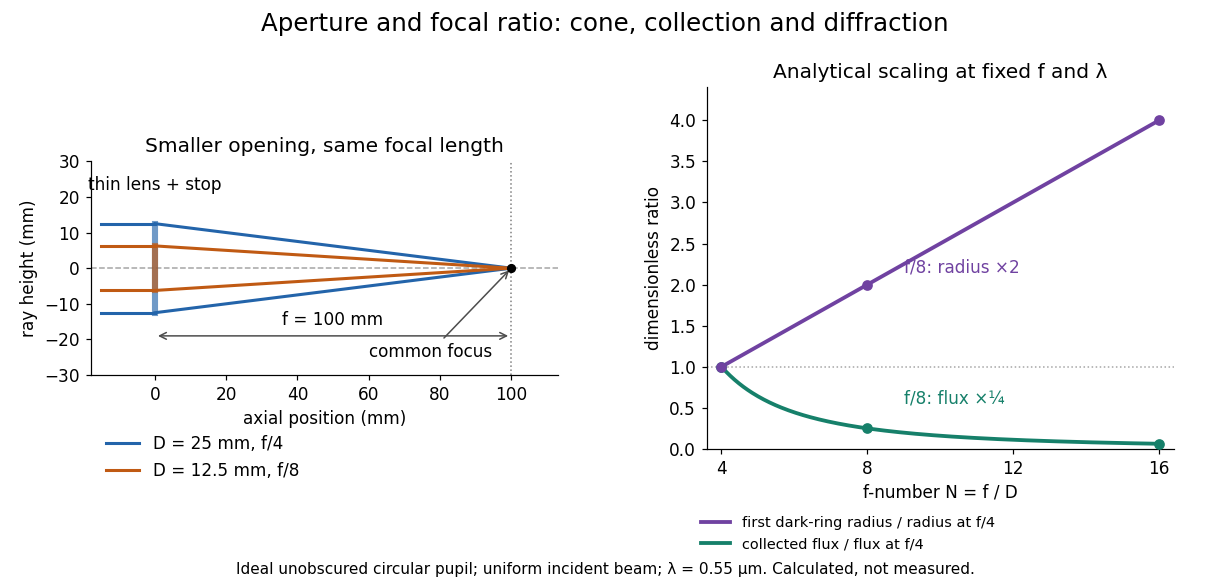
Aperture and focal ratio: a common optical focus, reduced collection and increased diffraction radius
. Original analytical illustration. Left: equal-scale thin lens geometry with and or . Right: collected radiant flux relative to f/4 is , and first-ring radius relative to f/4 is . The wavelength is ; the entrance pupil is circular, uniformly illuminated and unobscured. These are calculated quantities, not measurements. Details.
A proposed optical bench check puts a fixed collimator before a converging thin lens and a photodetector large enough to collect the entire image behind it. Compare two centred aperture stops of known diameters while fixing source output, detector gain and integration time. The integrated signal tests the collection law; a spatially resolved optical camera at the focal plane can separately measure the point spread function. Repeat a dark reading and the first aperture stop, and check that neither the incoming beam nor detector clips either bundle. A resolved pinhole source, imperfect collimation, optical aberrations and detector pixel size can dominate the apparent spot width; a single peak reading does not measure total collected radiant flux.
New to topics? Read the docs here!