DNA replication copies a double-stranded DNA molecule into two daughter double-stranded DNA molecules. In semiconservative replication, each daughter retains one parental strand and receives one newly synthesized complementary strand. DNA polymerases build the new strands from incoming nucleotides; they do not make RNA or proteins in this copying step. See Alberts et al., Molecular Biology of the Cell, 4th edition (2002): DNA replication mechanisms.
For a five-base pair example, separate from its partner . Base pairing specifies a new TACGG partner for the old ATGCC strand and a new ATGCC partner for the old TACGG strand. With error-free copying, both daughter DNA molecules have the original nucleotide sequence, but different physical strand histories. One initial duplex contains ten nucleotides; one complete round produces two duplexes containing twenty nucleotides, ten retained and ten newly incorporated.
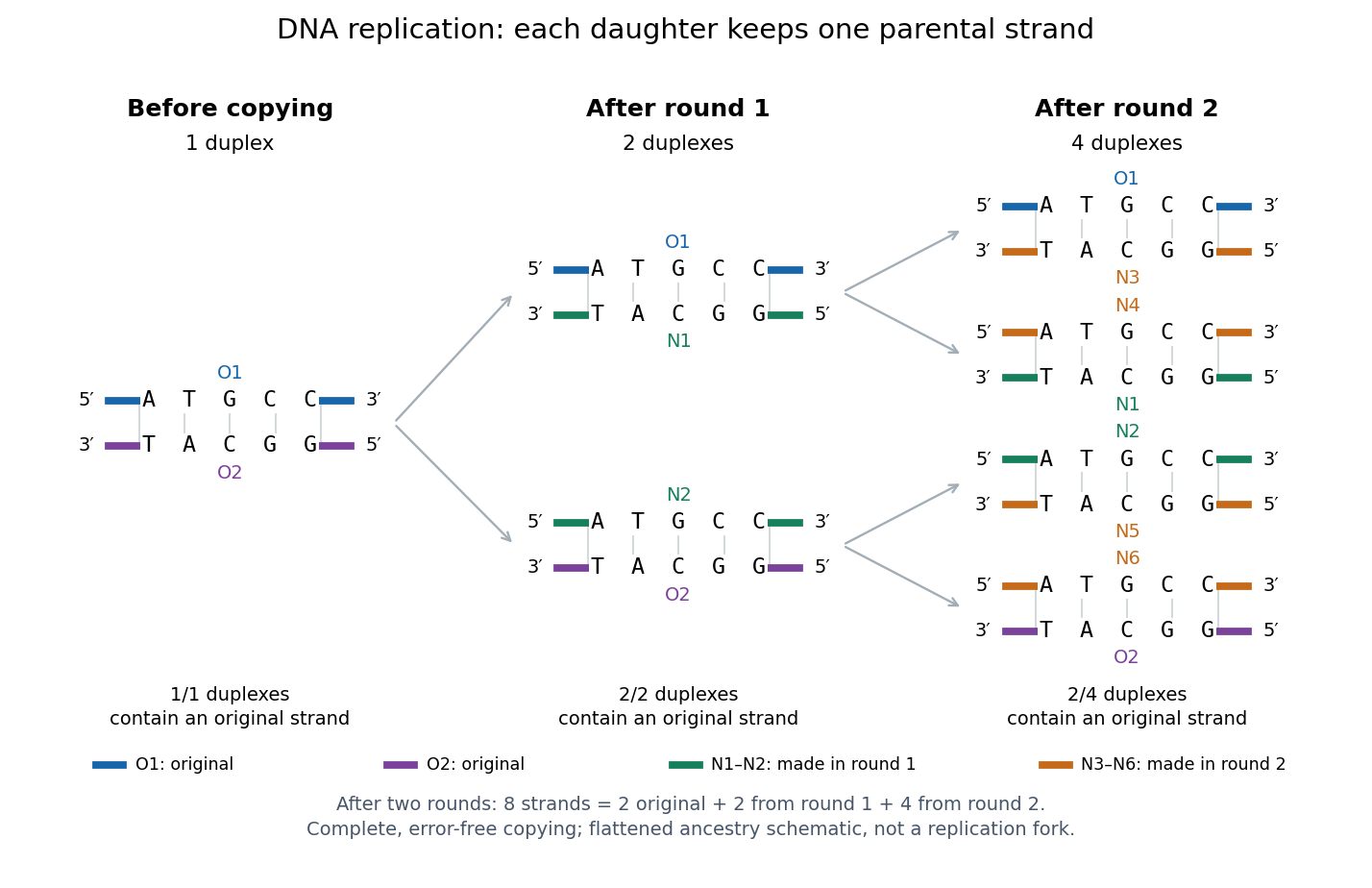
Semiconservative replication: follow two original DNA strands through two complete copying rounds
. Blue O1 and purple O2 are the original strands; green strands were made in round 1 and orange strands in round 2. Each arrow connects a parent duplex to its daughters. After round 2, two of four duplexes retain an original strand, and the other two retain a round-1 strand. All eight strands have the appropriate complementary nucleotide sequences; colors identify strand age, not different nucleobases. The flattened duplexes show ancestry and orientation, not a replication fork or molecular shape. Details.This is useful for inheritance: both daughter biological cells can receive a copy of the DNA record. The elegant feature is that base pairing lets each strand specify its missing partner. Direction matters too: a replicating DNA polymerase reads its template and extends the new strand at its end, so synthesis proceeds . These are opposite directions on antiparallel nucleic acid strands, not two alternative directions of synthesis. The enzyme needs a pre-existing paired strand end to extend; the diagram omits the machinery that starts and coordinates copying. See Alberts et al.: template-directed synthesis and the requirement for a primer.
The strand accounting predicts observable differences between copying mechanisms. In 1958, Meselson and Stahl grew Escherichia coli with the heavier nitrogen isotope , then supplied and measured extracted DNA by density-gradient centrifugation. After one generation their samples contained intermediate-density DNA; after two, intermediate-density and light DNA occurred in equal amounts. This supported semiconservative replication in the tested Escherichia coli culture. It was an isotope assay of sampled DNA, not simultaneous testing of every kind of DNA or direct colored-strand photography. See The replication of DNA in Escherichia coli by Matthew Meselson and Franklin W. Stahl.
Articles by others on the same topic

DNA replication is the biological process through which a cell makes an exact copy of its DNA. This process is essential for cell division and is crucial for inheritance, growth, and repair in living organisms. Here’s a brief overview of how DNA replication occurs: 1. **Unwinding**: The double helix structure of the DNA is unwound by enzymes called helicases. This creates two single strands of DNA, which serve as templates for replication.

