A ribosome is the molecular machinery for biological translation: it reads messenger RNA and joins amino acids into a polypeptide that can become a protein. Both prokaryotes and eukaryotes have ribosomes. A ribosome consists of ribosomal RNA and proteins organized into small and large subunits, with no enclosing membrane. Ribosomal RNA contributes to both structure and the active site that forms peptide bonds; a ribosome is therefore not merely a collection of proteins. See Clark, Douglas and Choi, Biology 2e, 4.3: ribosome composition and Nissen et al., The structural basis of ribosome activity in peptide bond synthesis, Science 289, 920–930 (2000).
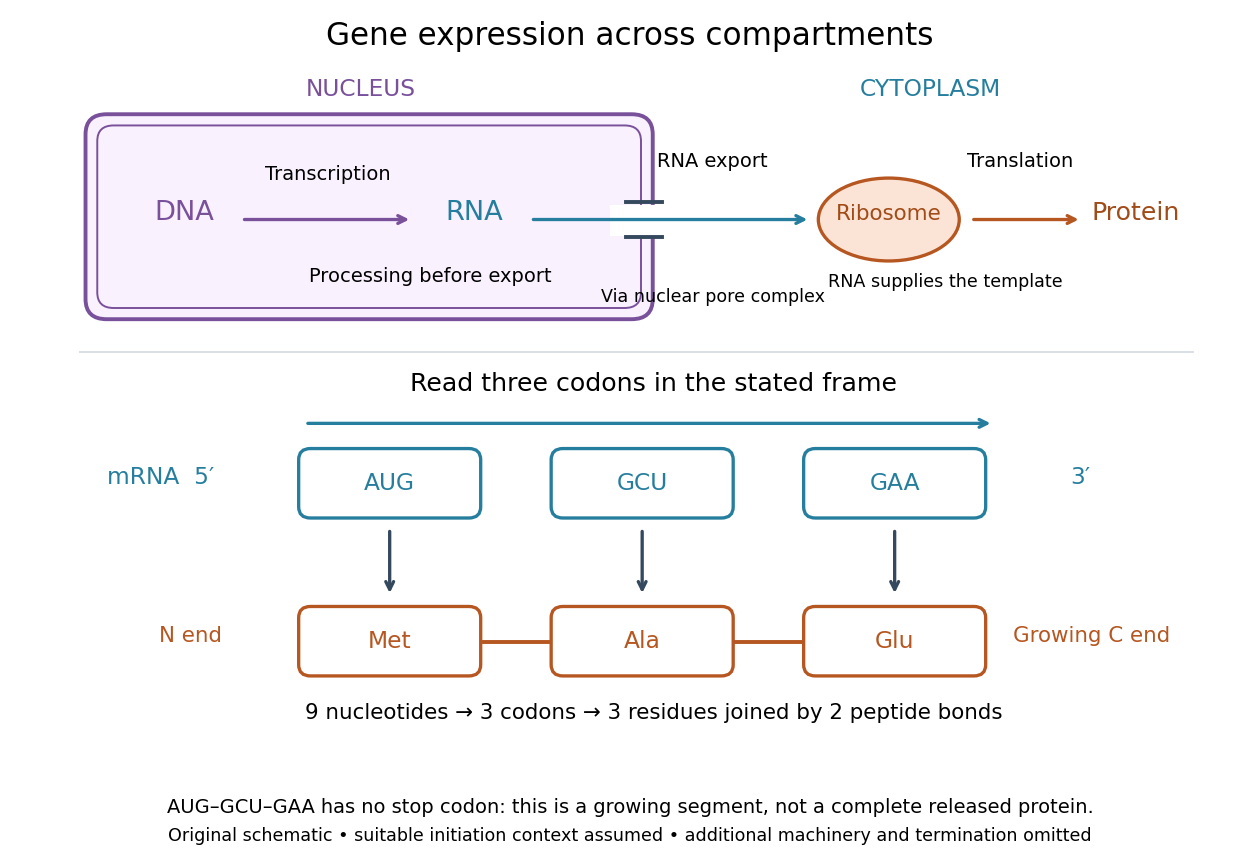
For a computed decoding example, choose the reading frame starting at the first displayed nucleotide of . Under the standard genetic code, AUG specifies methionine (Met), GCU specifies alanine (Ala), and GAA specifies a glutamic acid residue (Glu) in the growing polypeptide. Nine nucleotides divide into three codons, giving the ordered three-amino acid residue segment Met–Ala–Glu. The ribosome reads the messenger RNA , and the chain grows from its N-terminus toward its C-terminus. If synthesis begins at this AUG in an appropriate eukaryotic initiation context, these are the first three amino acid residues before any subsequent processing. See Clark, Douglas and Choi, Biology 2e, 15.1: standard codon assignments.
For this three-amino acid residue segment, joining the three delivered amino acids requires two peptide bonds, one between Met and Ala and another between Ala and Glu. There is no stop codon in the displayed nucleotide sequence, so this is a growing segment rather than a complete released protein. An isolated nine-nucleotide RNA is not claimed to supply all signals needed for initiation. This small calculation separates three jobs: the messenger RNA specifies order, transfer RNA delivers the amino acids, and the ribosome catalyzes their joining. Each new amino acid residue is added at the C-terminus. See Clark, Douglas and Choi, Biology 2e, 15.5: initiation and chain elongation.
The beauty of a ribosome is its reusable chemistry: the same machinery can assemble many different proteins by following different messenger RNA templates. The genetic code connects an alphabet of nucleotides to an alphabet of amino acids, while transfer RNA links recognition of the message to delivery of building material. Changing the message can therefore change the product without building a different ribosome for every protein.
In 1955 George E. Palade described small particles in the cytoplasm, both free and associated with membranes, in A small particulate component of the cytoplasm, Journal of Biophysical and Biochemical Cytology 1, 59–68. The paper documents the structural observations, rather than the full modern decoding mechanism. Complementary biochemical work by Hoagland, Stephenson, Scott, Hecht and Zamecnik described a soluble RNA intermediate in protein synthesis in 1958, helping establish the role now assigned to transfer RNA; see A soluble ribonucleic acid intermediate in protein synthesis, Journal of Biological Chemistry 231, 241–257. Together, structural observations and biochemical experiments connected visible cellular machinery with its working parts.