Isothermal ideal-gas work
ID: isothermal-ideal-gas-work

For a reversible thermodynamic process that changes the volume of a fixed amount of ideal gas at absolute temperature , the work done by the gas isHere is the amount of substance, the molar gas constant, the pressure, and the natural logarithm. The ideal gas law supplies ; the integral is the signed area under the pressure-volume curve. Isothermal expansion gives positive work; isothermal compression gives negative work. A convention counting work done on the gas instead has .[ref]
For a calculated example, let , and , . The pressure falls from approximately to , andTraversing the same isothermal process backward changes both transfer signs: . Neither direction changes internal energy of an ideal gas. These stipulated values illustrate the energy balance; they are not experimental measurements.
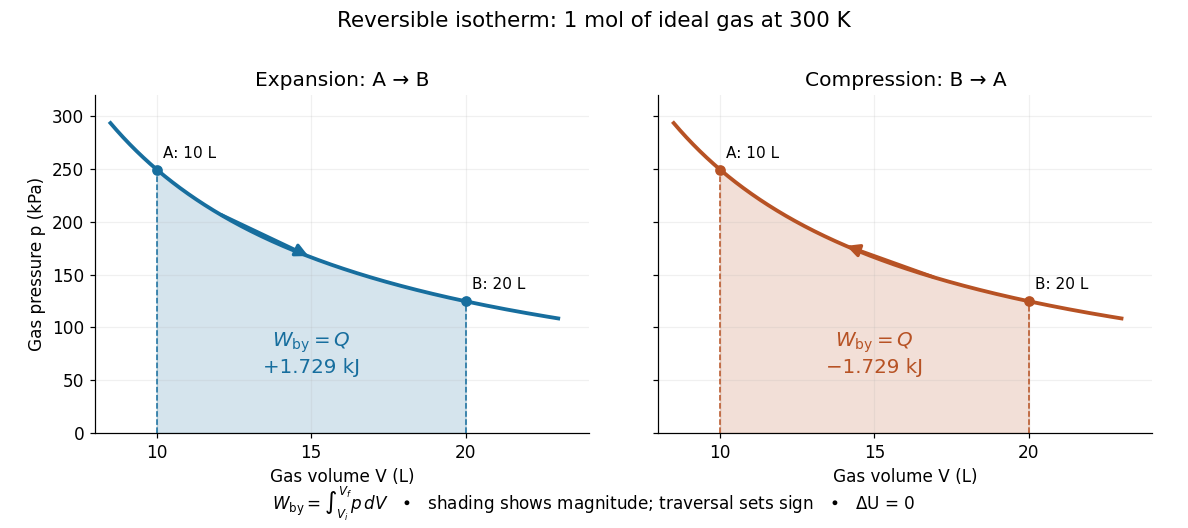

The shaded geometric area is positive in both panels; the direction of the integral supplies the sign of work. Knowing only the two equilibrium endpoints does not justify shading this curve for an irreversible process. For an idealized piston moving against a specified external resisting pressure, boundary work is . Substitution of the equilibrium gas pressure requires the appropriate reversible limit. In free expansion into vacuum, and this boundary work is zero.
New to topics? Read the docs here!