
In the ideal sinusoidal Josephson junction, the pair electric current and quantum phase obeyHere is the magnitude of the electron electric charge, uses the Planck constant, and is the junction's superconducting critical current under the specified conditions. Define the signs as follows: positive conventional electric current flows from terminal 2 to terminal 1, and is the voltage of terminal 2 relative to terminal 1. The Gauge-invariant Josephson phase below fixes the matching orientation of . The DC Josephson effect and AC Josephson effect follow from these relations. [ref]
Possible new effects in superconductive tunnelling by Brian D. Josephson. Josephson (1962), p. 252, predictions (i) and (ii): zero-voltage supercurrent and frequency 2eV/h
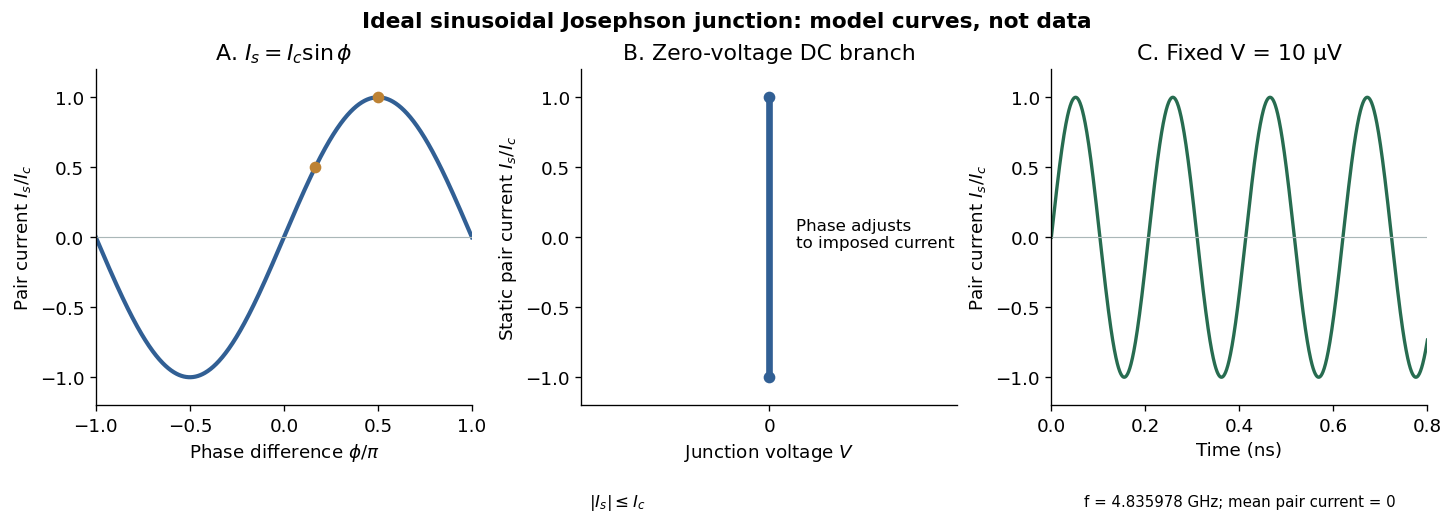

The Josephson effect is a quantum mechanical phenomenon observed in superconductors, where a supercurrent flows between two superconductors separated by a thin layer of insulator or a nonsuperconducting material, often referred to as a Josephson junction. This effect was first predicted by the physicist Brian D. Josephson in 1962 and has since become fundamental to various applications in superconducting electronics.


Discrete quantum effect observed in superconductors with a small insulating layer, a device known as a Josephson junction.
To understand the behaviour effect, it is important to look at the Josephson equations consider the following Josephson effect regimes separately:
Bibliography:
- www.youtube.com/watch?v=cnZ6exn2CkE "Superconductivity: Professor Brian Josephson". Several random excerpts from Cambridge people talking about the Josephson effect
New to topics? Read the docs here!