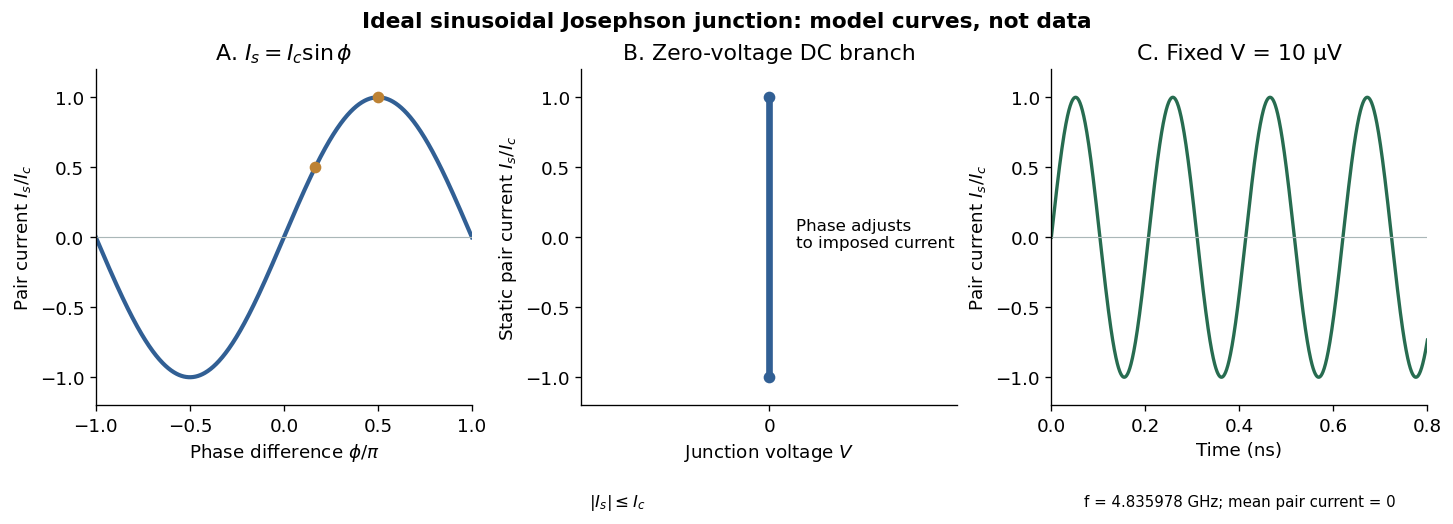
In the ideal sinusoidal Josephson junction, the pair electric current and quantum phase obeyHere is the magnitude of the Electron electric charge, uses the Planck constant, and is the junction's superconducting critical current under the specified conditions. Define the signs as follows: positive conventional electric current flows from terminal 2 to terminal 1, and is the voltage of terminal 2 relative to terminal 1. The Gauge-invariant Josephson phase below fixes the matching orientation of . The DC Josephson effect and AC Josephson effect follow from these relations. [ref]
Possible new effects in superconductive tunnelling by Brian D. Josephson. Josephson (1962), p. 252, predictions (i) and (ii): zero-voltage supercurrent and frequency 2eV/h
A SQUID uses Josephson junctions in a loop made from a superconductor to detect changes in magnetic flux.
Write the superconducting order parameters as , using a field of pair electric charge . For a specified path across the superconducting weak link, defineHere is the magnetic vector potential. To check electromagnetic gauge invariance, use a scalar function and transformThe change of is , exactly cancelled by the change of the line integral. Thus is unchanged although each local quantum phase changes. This is the same charge/sign bookkeeping discussed in gauge-coupling sign in Ginzburg-Landau superconductivity. Different physical paths can enclose magnetic flux, so fixing the path matters.
For stationary reservoirs with equal internal pair chemical potentials and a time-independent vector potential, the local Schrödinger equation gives after dropping the common internal term. With electric potentials and , subtraction gives . For a general circuit, denotes the corresponding measured electrochemical voltage and the electromagnetic contribution must be treated consistently. A bare difference of phases without the vector potential term is insufficient in an arbitrary gauge.
The ideal Josephson junction has a phase-dependent energyDifferentiating and using the voltage–phase relation yieldsThus the ideal pair element stores and returns energy. At it carries a static electric current without electrical power loss. Under a nonzero periodic drive its instantaneous power need not vanish, but its energy returns after a full phase cycle. Real junctions also have a capacitance, quasiparticle transport and an external circuit; their total losses cannot be inferred from this conservative pair term alone.
At zero electric potential difference, permits a nonzero constant quantum phase and hence a steady pair electric current. Under an imposed electric current with , a static solution satisfies . The low-energy branch has . For example, a stipulated gives modulo ; it does not require a voltage drop. In the ideal current-biased energy , the positive second derivative on that branch explains its local stability.
The superconducting critical current is a maximum available static pair electric current, not the inevitable electric current under a voltage bias. At the initial state and circuit select a phase and a current. Above this sinusoidal model has no static phase solution, but its two relations alone do not predict the complete resistive current-voltage characteristic, switching dynamics or hysteresis. Those require the circuit and dissipative channels.
For constant nonzero voltage , direct integration givesA constant electric potential difference therefore produces an oscillating pair electric current. The average of this ideal sinusoid over a complete cycle is zero; a measured nonzero steady electric current can include single-electron superconducting tunneling. Josephson's lecture explicitly separates the ordinary quasiparticle term from the phase-dependent term. [ref]
The Discovery of Tunnelling Supercurrents by Brian D. Josephson. Josephson, Nobel lecture, discussion of I₀(V), the phase-dependent term and Fig. 2
Articles by others on the same topic

The Josephson effect is a quantum mechanical phenomenon observed in superconductors, where a supercurrent flows between two superconductors separated by a thin layer of insulator or a nonsuperconducting material, often referred to as a Josephson junction. This effect was first predicted by the physicist Brian D. Josephson in 1962 and has since become fundamental to various applications in superconducting electronics.


Discrete quantum effect observed in superconductors with a small insulating layer, a device known as a Josephson junction.
To understand the behaviour effect, it is important to look at the Josephson equations consider the following Josephson effect regimes separately:
Bibliography:
- www.youtube.com/watch?v=cnZ6exn2CkE "Superconductivity: Professor Brian Josephson". Several random excerpts from Cambridge people talking about the Josephson effect