For constant nonzero voltage , direct integration givesA constant electric potential difference therefore produces an oscillating pair electric current. The average of this ideal sinusoid over a complete cycle is zero; a measured nonzero steady electric current can include single-electron superconducting tunneling. Josephson's lecture explicitly separates the ordinary quasiparticle term from the phase-dependent term. [ref]
The Discovery of Tunnelling Supercurrents by Brian D. Josephson. Josephson, Nobel lecture, discussion of I₀(V), the phase-dependent term and Fig. 2
Articles by others on the same topic

It is called "AC effect" because when we apply a DC voltage, it produces an alternating current on the device.
By looking at the Josephson equations, we see that a positive constant, then just increases linearly without bound.
Wikipedia mentions that this frequency is , so it is very very high, so we are not able to view individual points of the sine curve separately with our instruments.
Also it is likely not going to be very useful for many practical applications in this mode.
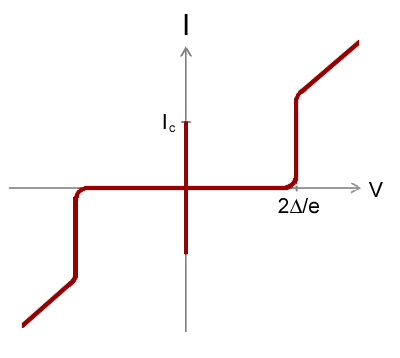
An I-V curve can also be seen at: Figure "Electron microscope image of a Josephson junction its I-V curve".
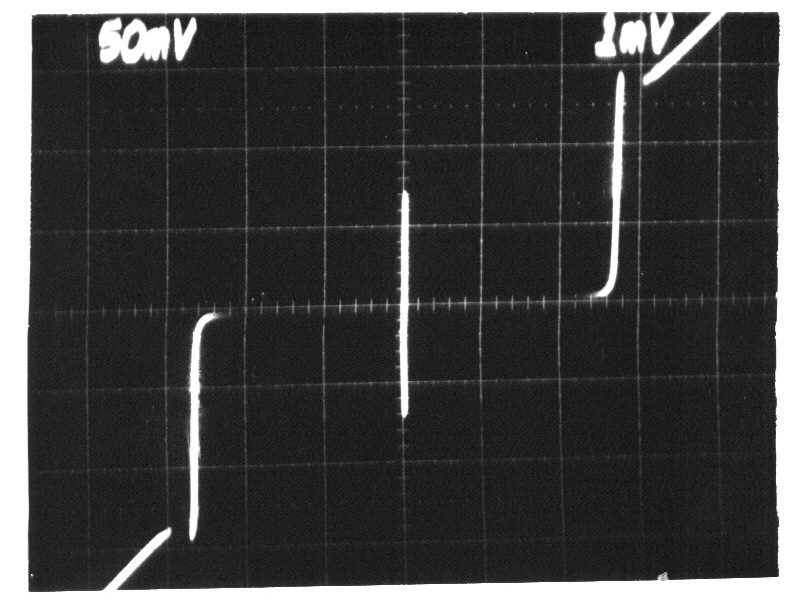
I-V curve of the AC Josephson effect
. Source. 
Voltage is horizontal, current vertical. The vertical bar in the middle is the effect of interest: the current is going up and down very quickly between , the Josephson current of the device. Because it is too quick for the oscilloscope, we just see a solid vertical bar.
Superconducting Transition of Josephson junction by Christina Wicker (2016)
Source. Amazing video that presumably shows the screen of a digital oscilloscope doing a voltage sweep as temperature is reduced and superconductivity is reached.