Oil drop charge readout and calibration
ID: oil-drop-charge-readout-and-calibration

Robert Andrews Millikan's 1911 protocol alternated electrically driven ascent with timed descent after short-circuiting the plates; a changed ascent speed signalled ion capture.[ref]
His 1913 refinements checked voltage before and after runs, calibrated optical distance and the clock, compared independent air-dynamic viscosity measurements, and varied pressure to test slip.[ref]
On the Elementary Electrical Charge and the Avogadro Constant by Robert Andrews Millikan. pp. 112–118
His 1924 lecture describes suppressing convection, switching the electric field, neutralizing drops, and reproducing smallest observed electrical speed increments.[ref]The Electron and the Light-Quant from the Experimental Point of View by Robert Andrews Millikan. Nobel Lectures, Physics 1922–1941; pp. 56–60
Harvey Fletcher's posthumous account recalls building the first oil apparatus and measuring with Robert Andrews Millikan; priority for suggesting oil remains uncertain.[ref]
To interpret the readout, keep one drop and one electric field polarity. Let be its signed upward terminal velocity in charge state , and let be its field-off falling speed. Use the linear drag coefficient already defined in elementary charge, with any required gas slip correction to Stokes drag included. Provided the drop's radius, surrounding air and electric field remain fixed, its electrical speed increment isThese relations apply while the electric force points upward in every state. A drop may still descend, with , when that force is too weak to support it. A held drop has and therefore , rather than zero electrical response. A neutral drop has : its signed terminal velocity agrees with field-off descent. Thus neither raw upward speed nor the ability to hold a drop is itself a count of Electrons.
The ratios cancel a fixed , even if its value is poorly known. This is why relative charge quantization and absolute measurement calibration are different questions. A changed field-off warns that evaporation, air motion or another change has spoiled comparison of charge states. A stable is useful evidence but cannot exclude every compensating change. Repeat field-off checks around a proposed jump, allow the terminal velocity under linear drag to settle after switching, and propagate measurement uncertainty in both the field-on and field-off readings. Reusing a single estimate of gives the different a shared covariance.
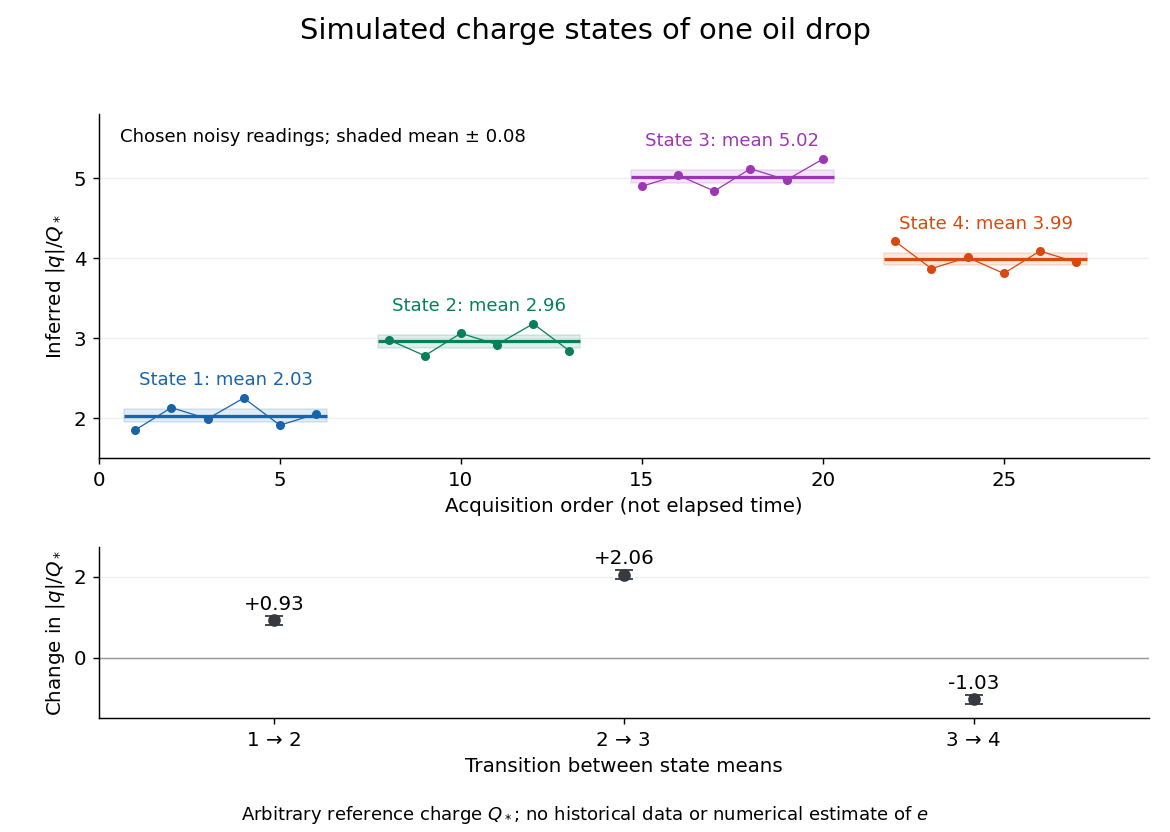
Simulated repeated electric charge states and resolved charge changes of one drop
. Original chosen noisy readings in an arbitrary reference electric charge , with four state means and their stipulated standard uncertainties. These are a simulation, not measurements by Robert Andrews Millikan or Harvey Fletcher. Acquisition order is not elapsed time; connecting lines only group observations made in the same state. Details.
New to topics? Read the docs here!