Consider a point mass of fixed mass released from rest in a stationary medium. Choose downward as positive, assume constant gravitational acceleration , neglect buoyancy, and impose linear drag with constant linear friction coefficient . Here is the signed downward velocity component; it equals speed during this descent. Newton's second law becomesThe terminal velocity balances the two forces, and the time constant controls how quickly that balance is approached:For the illustrative parameters , and , the time constant is and the terminal velocity is downward. At , the downward velocity is and the downward acceleration is . This is a toy linear drag model, not a claim that every falling object has this resistance law.
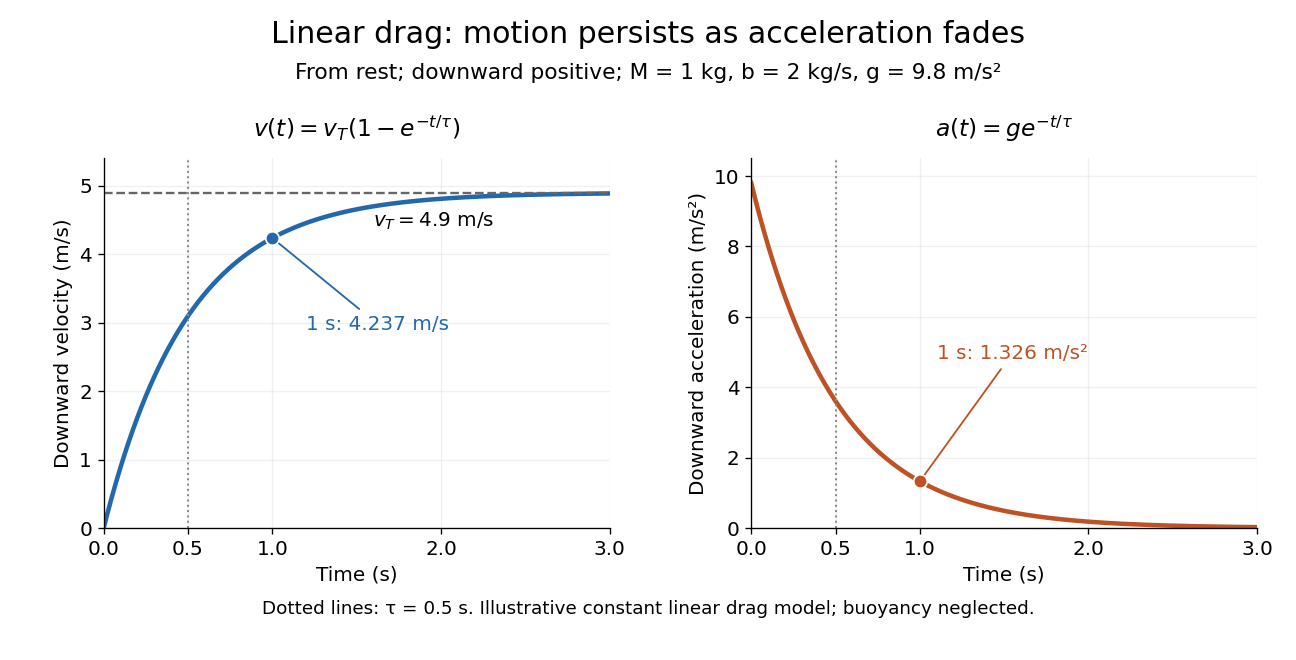
Exponential approach to terminal velocity and decay of acceleration in an illustrative linear drag model
. Details. 
For a proof outline, subtract the equilibrium value: obeys . The exponential decay solution and the initial condition give ; one derivative gives the acceleration. Every time constant multiplies the remaining gap by . The exact limit is reached only as . This makes the model useful for estimating a settling duration without mistaking vanishing acceleration for vanishing velocity.
Newton already analyzed vertical motion under uniform gravity and resistance proportional to velocity in Book II, Section I, Proposition III of the Principia. His geometric construction includes a greatest downward velocity, illustrating that a limiting rate can emerge from balancing a driving force and resistance. [ref]
https://en.wikisource.org/wiki/The_Mathematical_Principles_of_Natural_Philosophy_(1729)/Book_2/Section_1. Newton, Principia, Book II, Proposition III; Motte's 1729 translation
Articles by others on the same topic
There are currently no matching articles.