Optical trap position readout
ID: optical-trap-position-readout

A detector measures a signal, not a force. One proposed arrangement collects transmitted and scattered light onto a quadrant photodiode, using a normalized difference of opposite segments as a position-sensitive signal. A camera can supply an independent image and bead-height check. Near a chosen operating point, a voltage channel may obey , but its linear range and sensitivity must be measured at that bead size, focus and collection geometry. An arbitrary scattered-light intensity is not automatically proportional to displacement.
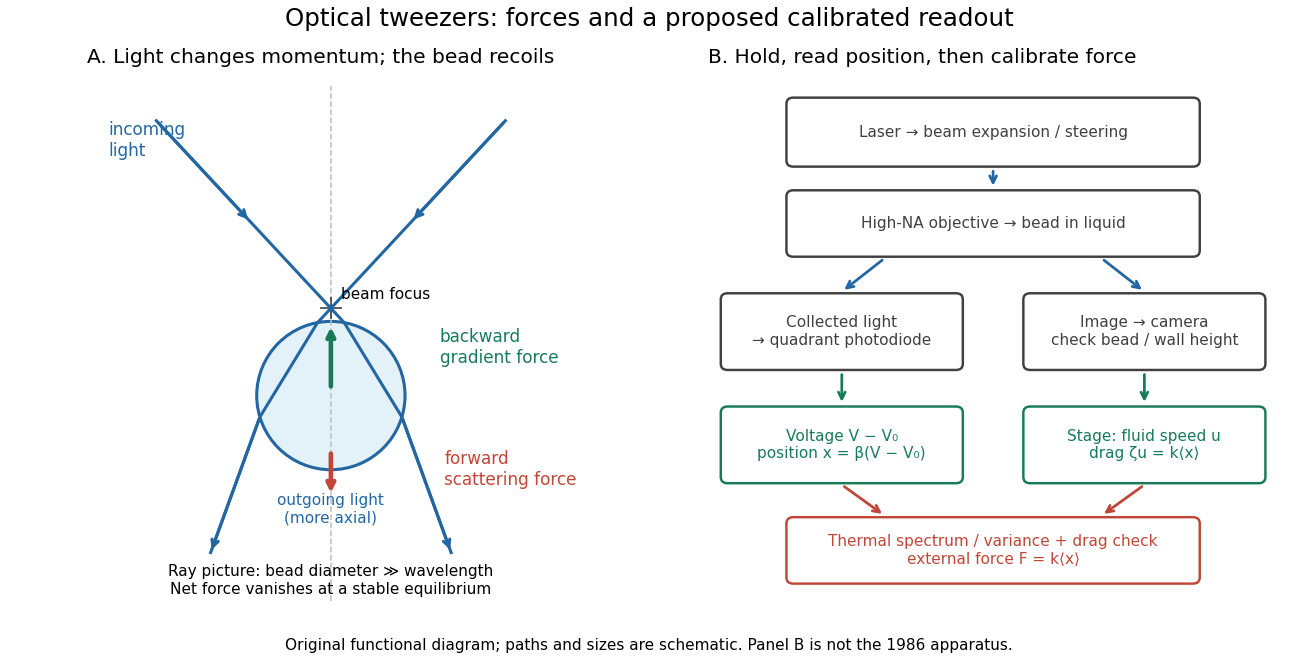

A useful proposed control sequence is to record detector offsets with illumination blocked, calibrate image scale against known stage travel, and test the detector response with independently known bead-relative motion. Moving a free trapped bead's chamber is not by itself a known bead displacement: fluid drag and trap stiffness determine the shift. Use a separate immobilized bead or an independently imaged trajectory for the position response, then check whether the response transfers to the actual trapped bead. Repeat the calibration after changing trapping power or optics.
Measure the acquisition frequency response and choose a sample rate that resolves , with sufficient signal bandwidth and control of aliasing. Compare thermal calibration of an optical trap with optical trap drag calibration, sweep small positive and negative flow speeds, inspect for multiple beads, and repeat at several wall distances. Check temperature and drift before interpreting a power-dependent stiffness: a changed fluid viscosity can change even at unchanged . These are proposed diagnostics of the model, not procedures attributed to the 1970 or 1986 papers.
New to topics? Read the docs here!