
Osmosis is net movement of water across a boundary whose permeability differs for water and relevant solutes. The direction depends on the chemical potential of water, including both dissolved material and pressure. A cell wall can let water reach the cell membrane, yet oppose expansion through turgor pressure. Zero net movement does not mean individual water molecules have stopped crossing.
Imagine pure water on side A and a chemical solution on side B of a semipermeable membrane. At equal temperature and pressure, dissolved particles lower the chemical potential of water in B, and net water transfer initially favors A to B. Retaining the solutes lets water redistribute without simply mixing everything. Increasing B's pressure opposes entry; enough pressure gives thermodynamic equilibrium with unequal solute concentrations. This is why “water moves toward more solute” requires a pressure condition.[ref]
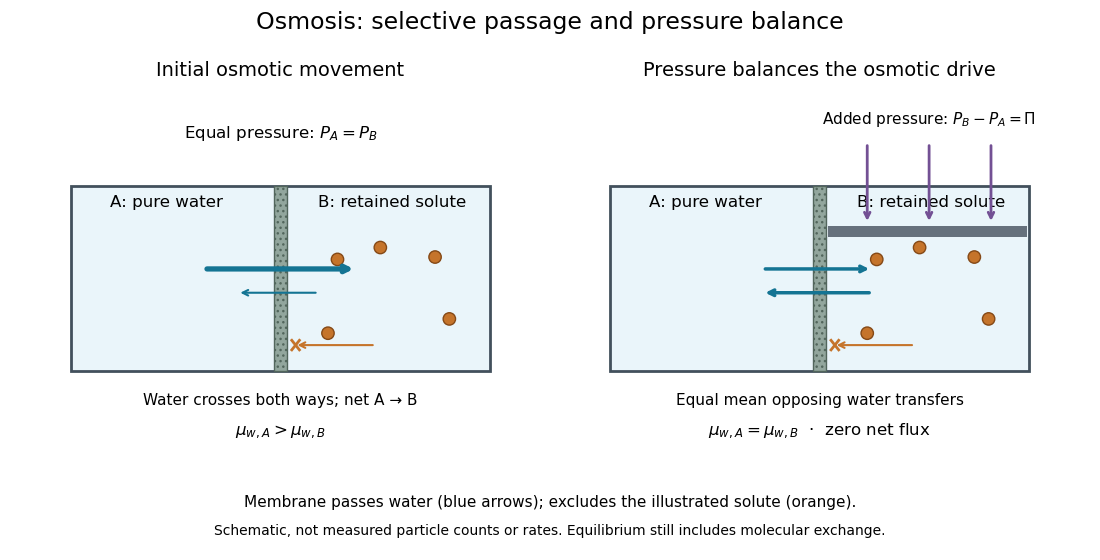

At thermodynamic equilibrium, the chemical potentials of exchangeable water are equal. Individual water molecules still move and cross in both directions, with equal mean opposing transfer rates and zero net flux. A stationary liquid level alone does not prove this: a blocked route can also give no visible transfer. Selective permeability provides a route; water potential supplies the direction, and neither alone determines the speed. The cell wall, turgor pressure and plasmolysis articles show why a living boundary's mechanical support and its selective permeability must be distinguished.
New to topics? Read the docs here!