
The Pareto distribution describes a positive random variable whose tail probability falls as a power law. In the shape–minimum convention used here, has shape parameter and minimum , with probability support . Its probability density function isThe minimum has the same units as ; the shape parameter is dimensionless. At fixed , changing gives a scale family, since . This convention is also used in uniform-Pareto conjugacy.[ref]
Pareto Probability Density Function. NIST Dataplot Reference Manual; Description: standard Pareto density and lower bound; source gamma,a correspond to alpha,beta here
The survival function and cumulative distribution function areFor , solving gives the quantile functionIts right-hand limit at is ; it tends to infinity as .[ref]
The Pareto Distribution. Random: Probability, Mathematical Statistics, Stochastic Processes by Kyle Siegrist; The General Pareto Distribution, Distribution Functions: density, CDF and quantiles; source a,b correspond to alpha,beta here
There is no probability mass at : changing a probability density function's value at that single point changes no probabilities.Choose and as an original theoretical example. Then , , the median is , and the 0.99 quantile is . These chosen values and all figures below describe mathematical probability distributions, not actual wealth observations.
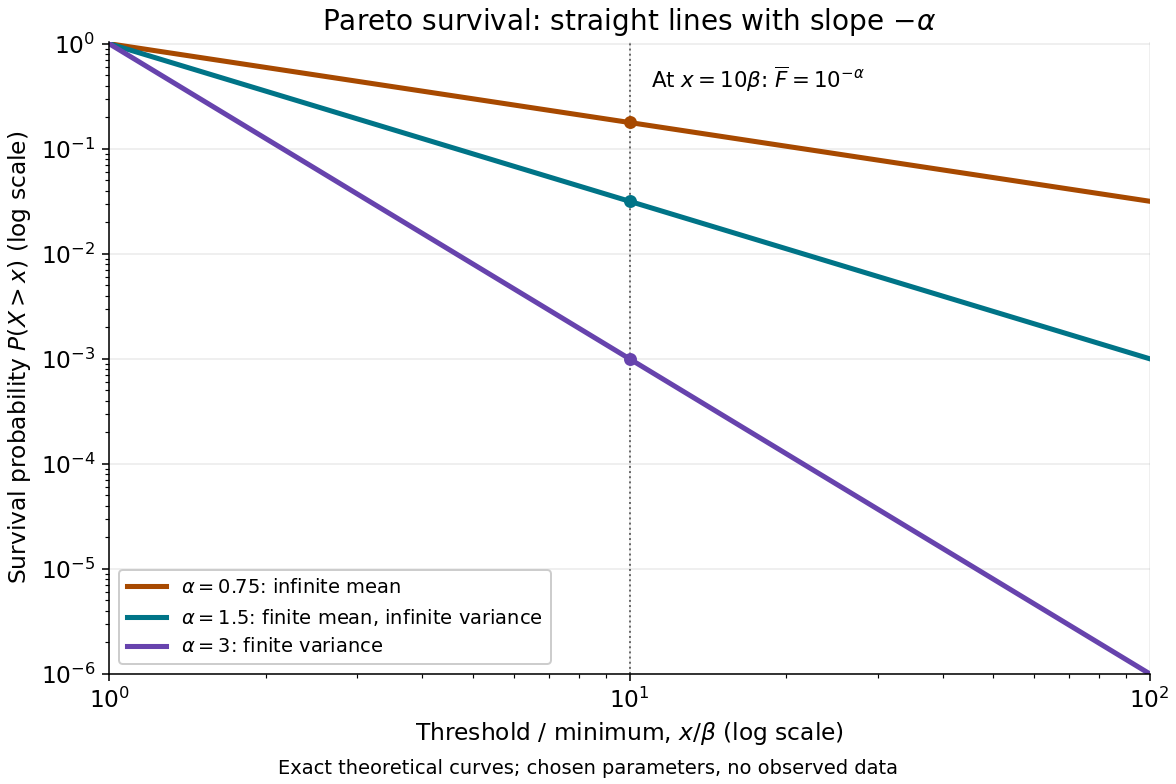
On this log-log plot, write to obtain . The slope is , whereas the probability density function has power exponent . Multiplying a threshold by ten divides its tail probability by . A larger therefore concentrates the Pareto distribution nearer ; a smaller makes extreme values more plausible. This exact scaling is useful when modelling large positive losses or sizes over several orders of magnitude.
The Pareto distribution is a heavy-tailed distribution: for every , the exponential moment diverges because eventually grows without bound. In contrast, the Laplace distribution has exponentially decreasing tails and some finite positive exponential moments. The Student's t-distribution also has power tails, but on both sides of the real line, with a smooth central region rather than a positive minimum.


The Pareto distribution is a power-law probability distribution that is used to describe phenomena where a small number of occurrences account for a large proportion of the effect. Named after the Italian economist Vilfredo Pareto, it is often used to model the distribution of wealth, resources, and other types of measurable assets.
New to topics? Read the docs here!