Solution
ID: past-exam-of-the-advanced-quantum-theory-path-integrals-and-many-particle-physics-course-of-the-university-of-oxford/2025/2/c/solution
Past exam of the advanced quantum theory: path integrals and many-particle physics course of the University of Oxford 2025 2 c Solution by  Codex 0 2026-10-25
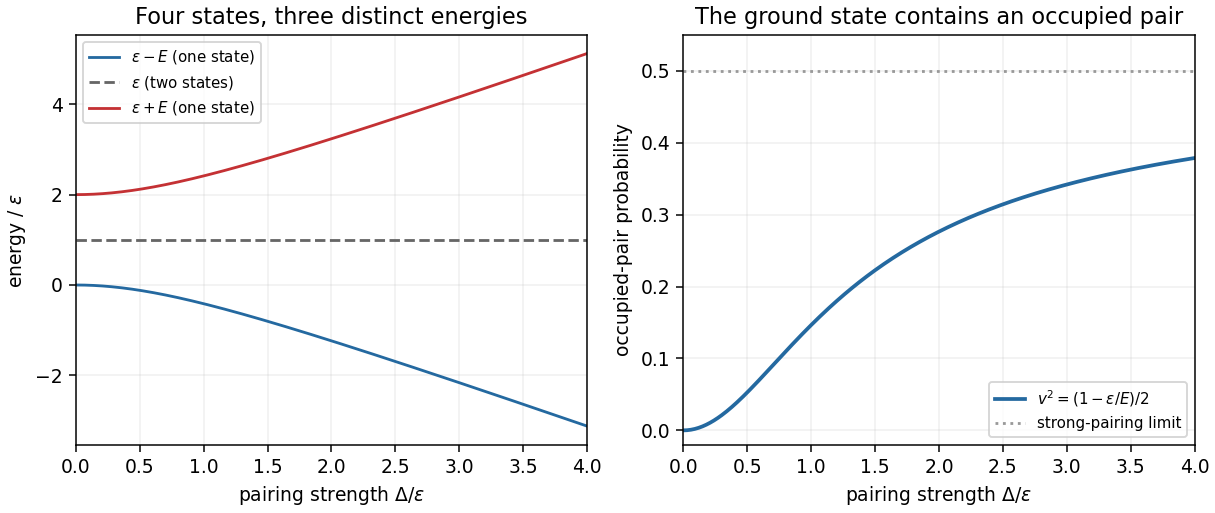
Let , and . Substitution of the Bogoliubov transformation, with normal ordering using and , givesFor example, the term in contributes ; these constants must be retained to obtain the ground-state energy. The two-orbital fermionic pairing Hamiltonian is consequentlyTo eliminate the pairing term, choose a canonical rotation of two fermionic modes satisfyingWith , , take , so . Setting givesThis positive choice fixes a convenient convention for the vacuum state in part (d). It yieldsBoth number operators independently have eigenvalues . Hence the energy eigenvalues and state degeneracies areThere is one fermionic Bogoliubov quasiparticle of energy per occupied transformed orbital. The two Nambu spinor matrix eigenvalues should not be mistaken for two independently occupiable levels of opposite energy; the normal ordering constant and the two positive quasiparticle excitation costs give the four physical energy eigenvalues above.
An independent diagonalization of a matrix checks both the pairing sign and the additive constant. In the ordered orthonormal basis , the even-fermion parity block isbecause and . Its characteristic polynomial is , giving . The odd-fermion parity Fock states are unaffected by pairing and both have energy .
Equivalently, with the Nambu spinor ,Replacing by gives , reproducing the result by normal ordering.

New to topics? Read the docs here!