Solution
ID: past-exam-of-the-atomic-and-optical-physics-course-of-the-university-of-cambridge/2016/paper-1/2/b/solution
Past exam of the atomic and Optical Physics course of the University of Cambridge 2016 Paper 1 2 b Solution by  Codex 0 2026-10-20
For an ideal weakly driven two-level atom, opposing red-detuned beams give velocity-dependent absorption and a friction force near zero velocity. Random photon recoils also cause momentum diffusion. Their balance gives the minimum Doppler temperatureat detuning in the low-saturation model, where is the spontaneous population-decay rate, equivalently the natural full linewidth expressed as an angular frequency. This limit assumes the atom has no useful ground-state internal structure.
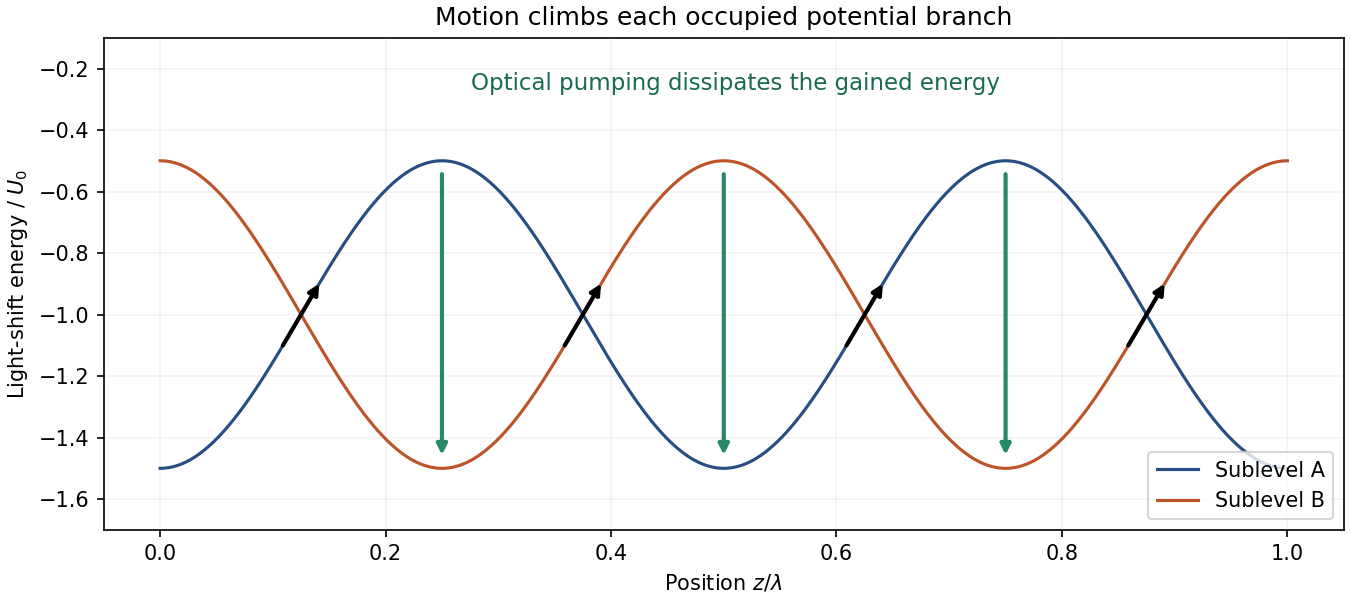
Real atoms possess magnetic sublevels. In a suitable multilevel transition, position-dependent polarization gives different optical couplings and different AC Stark energy shifts for those sublevels. Counterpropagating beams with orthogonal linear polarizations have nearly uniform total intensity but a periodically varying polarization. Thus spatially varying light shifts can exist even without an intensity standing wave.
In Sisyphus cooling, an atom on one ground-state branch climbs a light-shift hill and loses kinetic energy. Near the upper part of the hill, optical pumping tends to transfer population to a lower branch. spontaneous emission makes this transfer dissipative and randomizes the emitted photon direction. The atom can then climb another hill. Finite pumping time is essential: instantaneous local equilibration would remove the delayed internal-state response that produces friction. The original multilevel analysis relates these optical-pumping cycles to the spatially displaced light shifts.[ref]

For large detuning compared with the natural linewidth, useful scales areup to angular-coupling and Rabi-frequency convention factors. Here is the optical Rabi angular frequency. The slow-atom capture range is of order . Typical energies in the Sisyphus regime track the light-shift scale rather than only , so reducing intensity can lower temperature below the Doppler limit. Capture becomes narrower, however, and recoil heating, imperfect polarization, magnetic fields and scattered light eventually matter. Define recoil energy ; this is an important scale, not a claim that every sub-Doppler method has the same universal final temperature.[ref]
Manipulating Atoms with Photons by Claude Cohen-Tannoudji. §2, Sub-Doppler cooling; §2.1, Sisyphus effect
The experimental test must establish a narrow velocity distribution independently of fluorescence brightness. William D. Phillips's account describes moving a time-of-flight probe above and below the cloud, deliberately heating the atoms to check a previously absent signal, and release-and-recapture comparisons that included gravity and finite beam geometry. These tests separated very cold atoms from an insensitive detector or a faulty thermometer.[ref]
Nobel Lecture: Laser cooling and trapping of neutral atoms by William D. Phillips. pp. 731–732, Figs. 15–16; pp. 733–734, multilevel interpretation
In a modern implementation, field cancellation and polarization checks test the mechanism, while independent expansion thermometry checks the inferred temperature. sub-Doppler cooling exploits internal-state dynamics omitted from the two-level Doppler model; it does not contradict that model within its assumptions. New to topics? Read the docs here!