Optical pumping redistributes populations among internal quantum states by selective photon absorption followed by spontaneous emission. It can prepare atoms for measurement and participate in sub-Doppler cooling.
The practical aim is to make otherwise almost equally populated magnetic sublevels behave differently. Repeated absorption and emission can store a population imbalance in the long-lived ground state; a change in photon absorption or fluorescence then reveals a perturbation of that prepared distribution. This combines preparation and measurement: a weak radio wave can reorganize the populations, while abundant optical photons supply the readout.
An imbalance among ground state magnetic sublevels need not be a population inversion between optical energy levels. Optical pumping also supplies excitation in some lasers, where an appropriate population inversion matters for gain. The preparation problem here concerns the distribution within the ground state. A two-level system with only one lower quantum state cannot describe this redistribution.
Circular polarization selects the sign of the absorbed photon's angular momentum along the beam. Choose that direction as and define by the absorption rule , where is the magnetic quantum number. Spontaneous emission can return an atom to a different magnetic sublevel, so absorption followed by emission is a population-transfer cycle. A sublevel that the chosen beam cannot excite is dark to that beam. Darkness is relative to the selected transition and electromagnetic polarization, rather than a claim that the atom cannot interact with any light.
A static magnetic field along defines a stable axis and gives Zeeman splitting. A transverse oscillating magnetic field can redistribute magnetic sublevel populations when its frequency matches an allowed splitting. With the appropriate optical transition, that redistribution restores photon absorption: transmitted intensity decreases, or collected fluorescence increases. These are alternative readouts whose detailed sensitivity depends on the transition, viewing direction and electromagnetic polarization.
Alfred Kastler's 1966 lecture recalls his 1950 proposal and distinguishes the early atomic beam work from later sealed-vapour experiments. Its Fig. 5 shows subsequent sodium radio wave resonances, including multiple-photon transitions.[ref]
Optical methods for studying Hertzian resonances by Alfred Kastler. 1966 lecture, pp. 188–189, 193–194, Fig. 5; inspected authored transcription
The 1952 demonstration by Jean Brossel, Alfred Kastler and Jacques Winter used a sodium atomic beam, lamp light with circular polarization and fluorescence readout. Jean Brossel was a central experimental contributor; Alfred Kastler received the 1966 Nobel Prize in Physics alone.[ref]
Jean Brossel by Laboratoire Kastler Brossel. Direction du laboratoire, 1952 sodium-beam demonstration and Brossel's experimental role
[ref]The lecture also describes a experiment: a pumping beam with circular polarization prepares the vapour, while a perpendicular probe converts transverse magnetic dipole moment Larmor precession into modulated absorption at a photodetector. Interrupting pump and RF together exposes decaying free Larmor precession. Its envelope measures transverse relaxation under that model; it is distinct from the sodium atomic beam fluorescence signal.[ref]
Optical methods for studying Hertzian resonances by Alfred Kastler. pp. 196–199, Figs. 9–12: crossed-beam detection and interruption experiment
MIT's later rubidium experiment pumps natural / with a discharge lamp filtered to D1 (, near ). A polarizer and quarter-wave plate precede a heated rubidium/neon cell. Helmholtz coils set a weak static magnetic field. Separate transverse RF mixing increases absorption, measured by photodiode transmission.[ref]
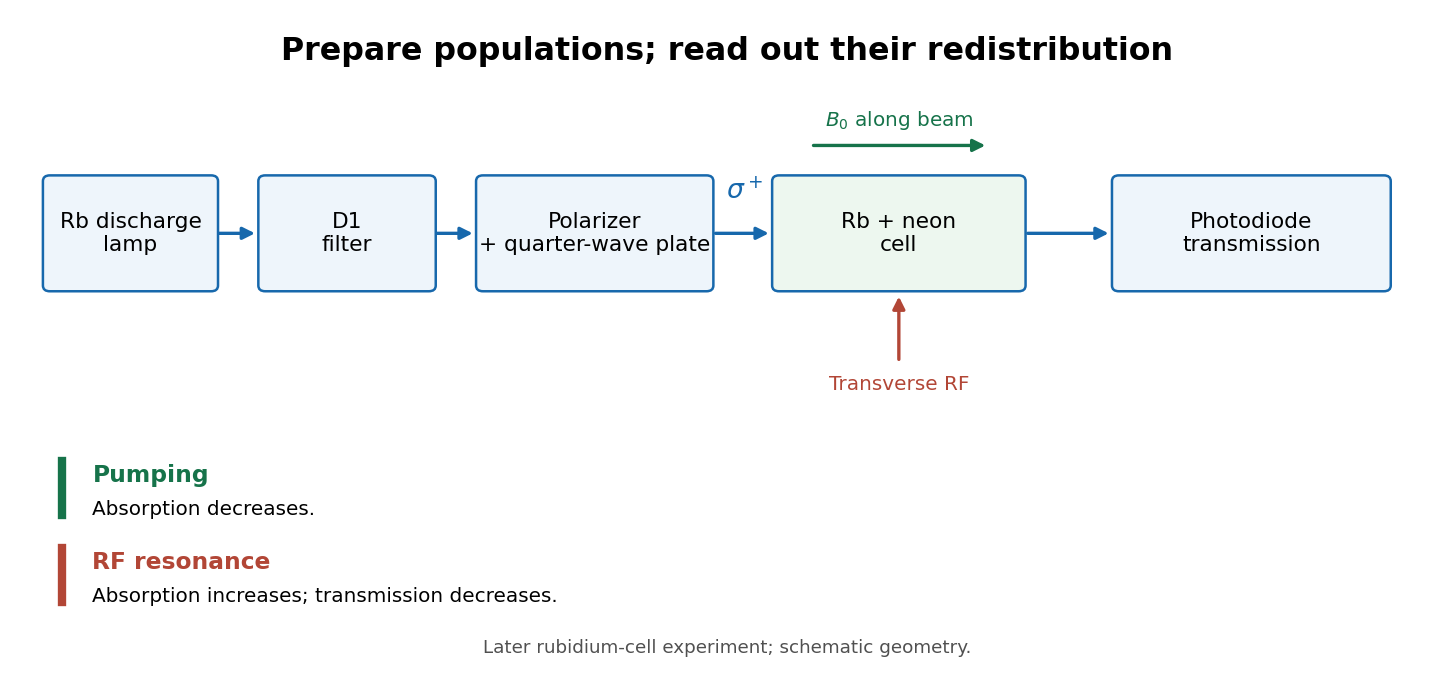
Vapour-cell preparation and optical transmission readout
. Original functional schematic of the later rubidium-cell apparatus. Geometry is schematic; lamp and interrogation drives are separate. Details.Compare resonant and detuned RF with the optical beam fixed, then change the calibrated static magnetic field: a true magnetic sublevel resonance should move with its Zeeman splitting. Lamp drift, stray magnetic fields, imperfect circular polarization, optical attenuation and RF power broadening can change the observed signal. Consequently, a transmission dip alone does not determine every sublevel population. These are measurement-design considerations, not additional reported historical observations.
Consider an original hypothetical atom with a lower angular momentum multiplet , , and one opposite-parity excited level . Stipulate that all spontaneous emission returns to these three lower quantum states, with no other decay channel. This is an isolated four-state model, not the actual sodium or rubidium D-line structure. In particular, the physical rubidium cell above contains multiple hyperfine structure levels.
The electric-dipole selection rule permits here; absorption with excites only . Decay from has three equal integrated branching probabilities : rotational symmetry gives equal squared Clebsch-Gordan coefficients. The emitted photons carry the three permitted angular momentum projections; equal integrated branching does not imply equal intensity in every observation direction. Thus and are both dark. The chosen beam cannot prepare a unique pure state.
Let be the absorption rate of an atom in , and let be the excited-state spontaneous emission rate, both in inverse seconds. Assume , negligible stimulated emission, and no maintained quantum coherence between sublevels. Eliminating the short-lived excited population gives normalized lower populations to this approximation. At each scattering event the atom leaves with probability ; the remaining simply returns it there.
Model depolarizing collisions and other population relaxation by resets to the unpolarized distribution at rate . The rate equations areThis relaxation prescription assumes that Zeeman splitting is small compared with thermal energy, so the unpolarized distribution approximates thermal equilibrium. It is not an energy-independent relaxation law at arbitrarily low temperature.
Every transfer has a nonnegative rate: optical transfers and each have rate , and relaxation transfers between each distinct pair have rate . These define a continuous-time Markov chain. The three derivatives sum to zero, and at the corresponding derivative cannot be negative. Hence the model conserves population and preserves nonnegative populations. Optical cycles that return to contribute to scattering even though they cause no net population transfer.
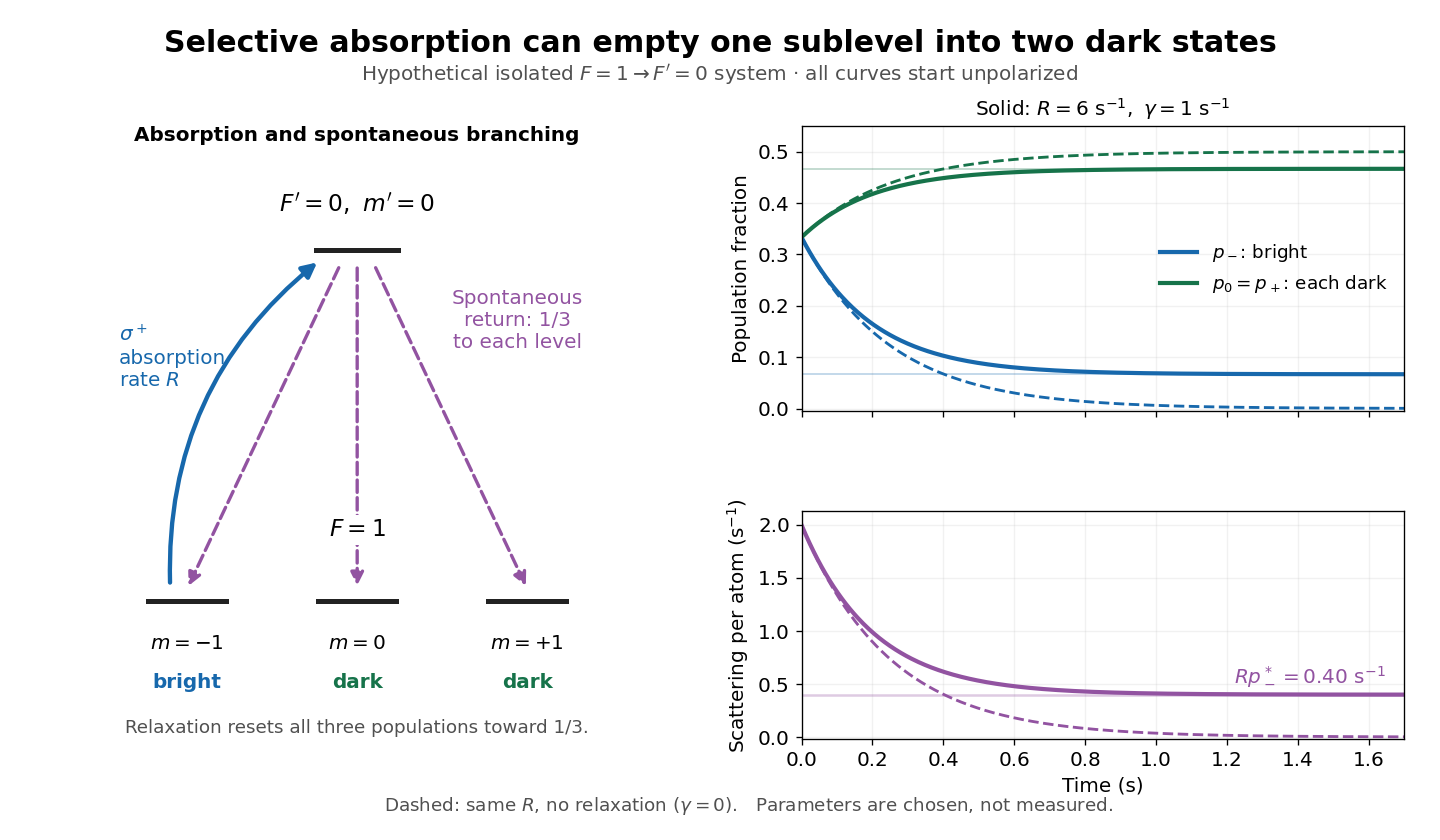
Three-sublevel pumping, spontaneous branching and dark-state dynamics
. Original hypothetical model. Solid blue shows selective absorption; dashed purple arrows show equal spontaneous branching. Two lower states are dark to the selected beam. Curves start unpolarized and compare pure pumping with chosen . Rates and curves are stipulated examples, not historical data or a model of the full rubidium spectrum. Details.For , setting the rate equations to zero gives the unique stationary distribution of this continuous-time Markov chain:The nonzero mean magnetic quantum number represents atomic orientation. Increasing empties the bright state, but leaves two dark populations. For , relaxation alone gives . When and , every distribution with is stationary; the initial difference between the two dark populations survives. The equal dark populations below follow from the specified unpolarized initial condition.
Starting from , the solution for or isFor pure pumping, take in this formula. Its redistribution time is , longer than the mean scattering interval of a bright atom, because one third of scattering events return it to the same sublevel. For arbitrary initial populations the additional mode satisfies .
For an original numerical example choose and , with much larger than either. ThenAt , , while . If the light is then switched off, relaxation returns all three populations toward with time constant . Faster optical preparation and slower dark recovery measure different combinations of rates.
In an optically thin uniform sample of atoms, with equal collection efficiency for each decay branch, the detected fluorescence count rate is approximately . The same scattering removes pump photons, giving when depletion is small. For the chosen example the steady scattering rate is per atom, compared with the initial . Pumping lowers this signal fivefold, while increasing transmission. If rapid mixing restores nearly uniform populations, scattering rises again. Reabsorption, strong attenuation, unequal collection efficiencies or coherent RF dynamics require a more detailed model; the reset rate does not stand for an exact RF Hamiltonian.
Articles by others on the same topic



Optical pumping is a process used in physics and engineering to manipulate the energy states of atoms or molecules using light. It involves the absorption of photons, usually from a laser or other light source, to excite electrons in an atom from a lower energy state to a higher energy state. This process can selectively populate certain energy levels, leading to a non-equilibrium distribution of atomic or molecular states.