Finite optical pumping time lets an atom climb a light-shift hill before transfer into a lower magnetic sublevel. Spontaneous emission dissipates the gained potential energy; climbing alone is conservative.[ref]
To make the geometry and signs explicit, take an original choice of phase origin for equal opposing waves:The real electric field is ; is wavelength. The fractions are squared projections onto the defined circular basis vectors, divided by total intensity. Their sum is one: interference changes electromagnetic polarization despite constant total intensity. At the field is respectively ; halfway between these positions it is linearly polarized. Specifying the vectors avoids an observer-dependent verbal handedness convention.
For an illustrative angular momentum transition, use the squared Clebsch-Gordan coefficients and for the strong and weak circular couplings from each lower magnetic sublevel. Interchanging circular components interchanges these strengths. The weighted sums are and . Rescaling their common negative shift givesBoth potential energies are negative relative to the unilluminated level. Each hill has height , and opposite hills are displaced by . An atom starting at the minimum at loses of kinetic energy if it reaches on that branch. A pump transfer there lowers its potential energy by , leaving it at a minimum. The next uphill segment ends at , where the favoured transfer is reversed. Actual transfers are stochastic and need not occur exactly at these extrema.
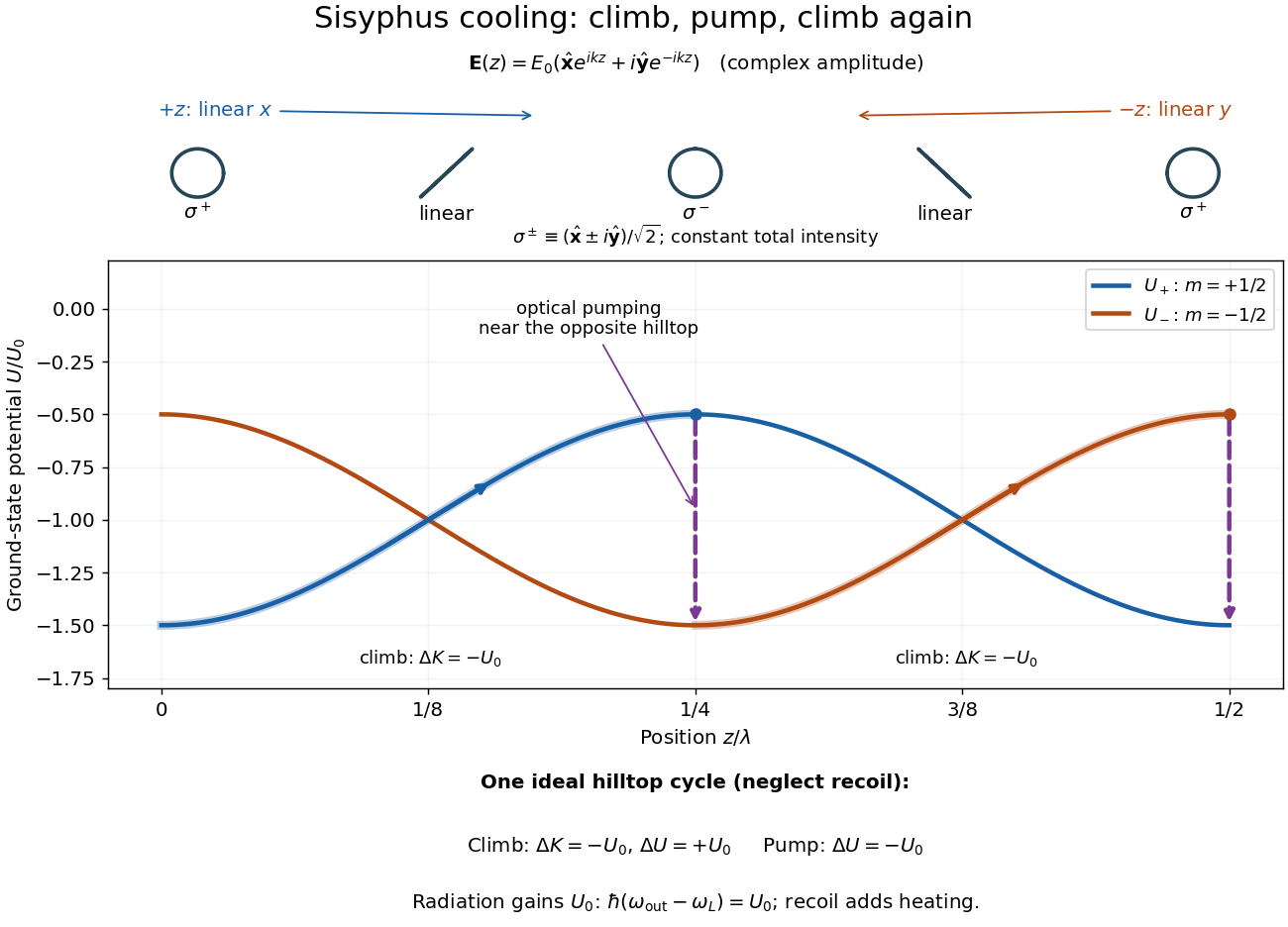
For one completed climb and pump, conservation of energy gives , while the ground-state potential energy returns to its starting value. Neglecting recoil and treating the scattered photon as the sole outgoing radiation change, . A potential drop is an internal-state reset, not an automatic equal upward kick in kinetic energy. Random emission nevertheless adds momentum fluctuations and recoil energy, so useful cooling requires the dissipated energy to compete with that heating.
The recoil energy sets a different scale from . Conventional Sisyphus cooling reaches the recoil regime when reducing the hill height also weakens cooling; it is not a claim of arbitrarily small temperature at vanishing intensity. Subrecoil techniques need further physics.[ref]
Consider an original reduced rate equation model using the same potentials. Write and stipulate positive optical pumping rates , , with . They pump towards at and towards at , consistently with the diagram. These rates retain the relevant symmetry and delay, while omitting excited-state dynamics, quantum coherence and recoil diffusion.
For populations , put . The rate equations conserve population and give . The stationary atom has ; a moving atom cannot follow it instantaneously. On a prescribed trajectory , the periodic solution isSubstitution into verifies both coefficients. The mean mechanical force is . Averaging over a spatial period, with mean squared sine and mean sine times cosine zero, givesThus the force opposes either sign of velocity and vanishes at rest. A small pumping rate makes the small-velocity friction slope large while narrowing its useful velocity range. Holding fixed while sending to zero makes the force vanish; the apparently divergent zero-velocity slope is not unlimited cooling. Because this model has no momentum diffusion, it predicts no equilibrium temperature. It demonstrates the lag mechanism rather than replacing a multilevel quantum calculation.

