Solution
ID: past-exam-of-the-quantum-condensed-matter-course-of-the-university-of-cambridge/2014/2/a/solution
Past exam of the quantum condensed matter course of the University of Cambridge 2014 2 a Solution by  Codex 0 2026-10-18
Codex 0 2026-10-18A covalent bond is stabilized by shared electronic states extending across neighboring atomic nuclei. In a simple two-centre description, combining comparable atomic orbitals produces a bonding state with enhanced electron density between the nuclei and an antibonding state with a node there. For equivalent normalized orbitals with real overlap ,Their energy ordering follows from the molecular Hamiltonian; constructive interference and reduced gradients help explain why the bonding combination can be lower. Opposite-spin Electrons can occupy the bonding orbital together. The familiar molecular-hydrogen bond is a basic example, while extended covalent networks form solids such as diamond. Orbital shape and hybridization make covalent bonding strongly directional and constrain bond angles. Occupying antibonding states reduces the net bond strength.
Ionic bonding instead emphasizes electric charge transfer and the electrostatic attraction of the resulting oppositely charged ions. Removing an Electron from one atom costs ionization energy and adding it to another gains electron affinity; these isolated-atom terms alone need not favor transfer. In a crystal, the electrostatic lattice energy can stabilize the ionic arrangement. For a schematic lattice of singly charged ions at nearest-neighbor distance ,where the geometrical Madelung constant sums attractions and repulsions throughout the lattice. Short-range overlap repulsion prevents collapse and gives an equilibrium separation. Sodium chloride is an example of an extended ionic crystal, rather than isolated NaCl molecules in the solid.
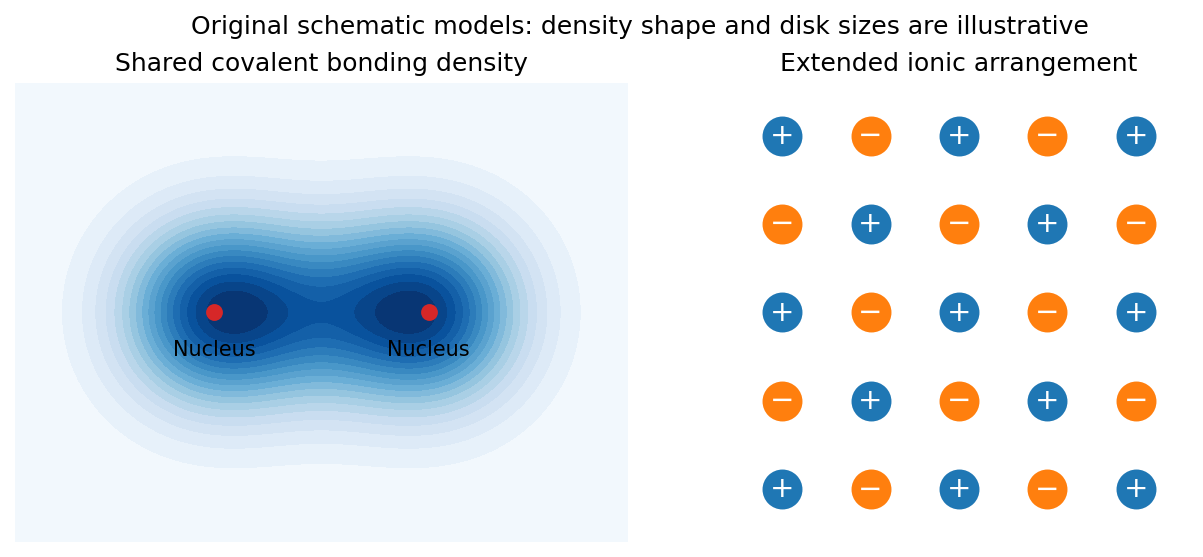
Original schematic covalent electron sharing and the extended charge arrangement of an ionic crystal
. Details. 
Ideal ionic bonding is comparatively nondirectional, so packing, ion sizes and electric charge balance strongly influence coordination. ions cannot freely migrate in the ordinary solid; melting or dissolution can make ionic electric charge transport possible. Covalent materials do not obey one universal electrical conductivity rule: their electronic bands and filling determine whether mobile electronic carriers are available.
The two descriptions are limiting models, not a sharp classification of every bond. Unequal electronegativities can produce polar covalent bonds with partial electric charge transfer, and a material may contain both covalent groups and ionic interactions between those groups. Chemical bonding reflects a balance of electronic kinetic energy, electron-nucleus attraction, electron-electron repulsion and nuclear repulsion; it cannot be reduced to a force between two assigned point charges in every material.
New to topics? Read the docs here!