Solution
ID: past-exam-of-the-quantum-condensed-matter-course-of-the-university-of-cambridge/2014/4/solution
Past exam of the quantum condensed matter course of the University of Cambridge 2014 4 Solution by  Codex 0 2026-10-18
Codex 0 2026-10-18Nondegenerate carrier product. Assume three-dimensional parabolic energy bands near their extrema, spin degeneracy two, and no additional uncounted valley multiplicity. Near the conduction edge, a Boltzmann approximation to the Fermi-Dirac distribution givesAngular integration and the Gaussian radial integral yieldFor valence electron holes, the empty-state probability is . Measuring electron hole kinetic energy downwards from similarly givesThe factors two count spin once in each band. Multiplying cancels the chemical potential and proves the semiconductor mass-action law:In an intrinsic neutral semiconductor, . In a doped equilibrium semiconductor the same product holds under the stated nondegenerate assumptions, even when . Extra valleys or several valence branches must be included in the effective density-of-states factors rather than counted inconsistently.
Equilibrium junction. Put the p region on the left and the n region on the right. Before contact their majority carriers are electron holes and Electrons, respectively. Diffusion initially sends Electrons from n to p and electron holes from p to n. This leaves negative ionized acceptors on the p side and positive ionized donors on the n side, creating a depletion region and an electric field directed from n to p. At equilibrium this field balances diffusion, so the net electric current vanishes.
For a homojunction the gap remains constant while the conduction band and valence band edges bend downwards from p to n by . The equilibrium chemical potential is flat. Since , the electrostatic potential rises from p to n. The carrier profiles satisfyWith fully ionized nondegenerate dopants, the neutral p side has , , while the neutral n side has , . Thus the Electron concentration rises across the junction and the electron hole concentration falls, with both small relative to the far-side majority densities in much of the depleted region. The ideal depletion approximation neglects these mobile populations when calculating the fixed space electric charge, but the actual equilibrium profiles are smooth.
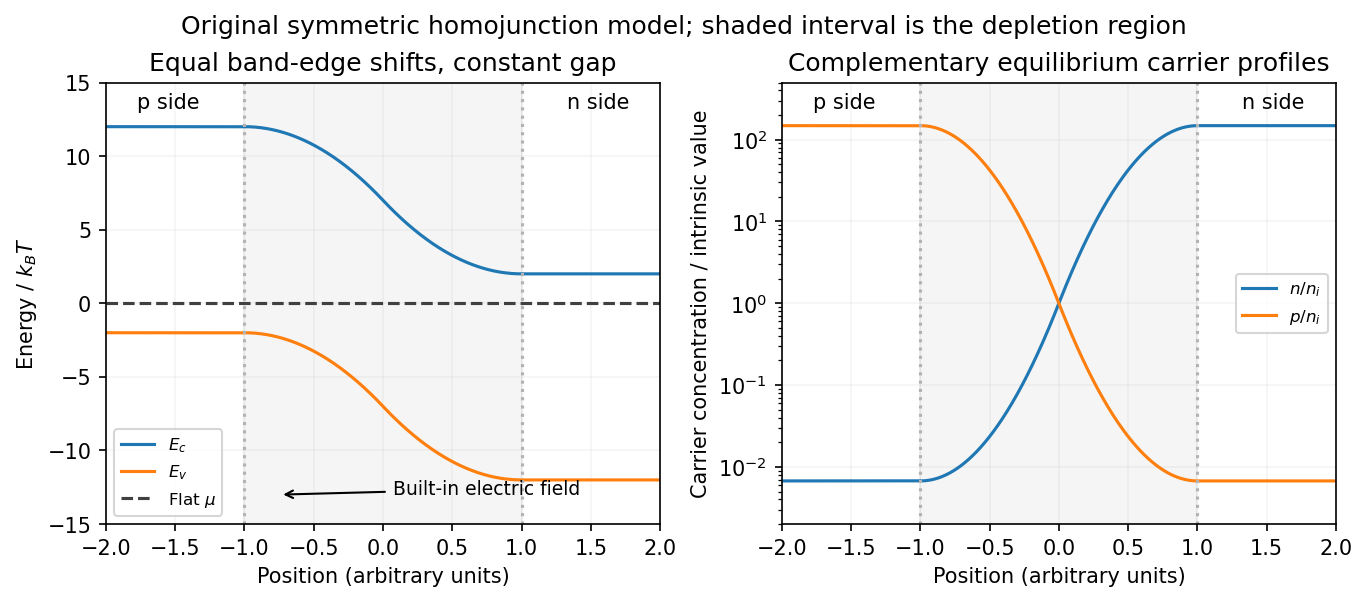
Equilibrium band bending, a flat chemical potential and complementary electron/hole profiles across a homojunction
. Details. 
The built-in potential follows from these Boltzmann factors:There is no applied terminal bias; the internal electrostatic potential variation does not contradict a constant electrochemical potential.
Opposing carrier fluxes under reverse bias. Use for the magnitude of reverse bias and for reverse electric current, as in the PDF. The junction barrier increases by . The Shockley diode equation in that orientation can be writtenThe reverse-directed contribution is supplied by minority Electrons on the p side and minority electron holes on the n side. They reach the depletion edge by diffusion and are swept across by the built-in field. The opposing contribution is associated with majority carriers thermally crossing the barrier in the forward direction; reverse bias suppresses it by the Boltzmann factor. At zero bias detailed balance makes the two equal, while at large enough reverse bias the opposing flux becomes negligible.
In the ideal neutral-region diffusion model,Here are minority-carrier diffusion coefficients, their diffusion lengths, and is junction area. The two terms inside this positive prefactor are the Electron and electron hole contributions; both flow in the same reverse-current direction. This separates the two carrier-species contributions from the two opposing fluxes in the Shockley diode equation. Calling the saturation term a drift current refers to its passage across the depleted region, and does not eliminate the minority-carrier diffusion needed to supply it.
Reading the measured curves. At , the ideal equation gives , initially proportional to reverse electric potential difference. At , it approaches a plateau . The thermal electric potential differences at the three temperatures are about –, consistent with a rise at small reverse biases and near saturation at larger ones. Higher temperature produces a much larger plateau because thermal electron-hole excitation raises exponentially.
The lower-temperature curve has a noticeable residual electric potential difference dependence rather than a perfectly flat plateau. Depletion-region generation, surface leakage or other departures from the ideal diffusion model can contribute. The sharp upturn at the largest reverse electric potential differences is reverse breakdown, outside the unextended Shockley diode equation; the plot alone does not identify a unique microscopic breakdown mechanism. The original horizontal axis duplicates the final decade label, so a precise breakdown electric potential difference cannot be read reliably. Neither issue prevents estimating the gap from the intermediate-bias saturation region.
Band-gap estimate. Use plateau electric currents at a common intermediate reverse bias, away from both the small-bias rise and the breakdown upturn. Approximate readings are , –, and . Kelvin temperatures are required in the activation law.
For fixed effective masses, . If the remaining transport prefactor is approximately constant, extracting a semiconductor band gap from diode saturation current therefore usesUsing the widest temperature separation and the rounded readings givesNeglecting all algebraic prefactors and fitting instead gives about . These differ by roughly , a material correction on the graph's precision scale. Thus an honest graph-based conclusion isThe nonflat low-temperature plateau, rough electric current readings, unprovided temperature dependence of , and possible gap variation prevent a more precise extraction. If depletion-region generation dominated rather than the specified mechanism, its activation slope could involve a different energy scale; the displayed estimate explicitly uses the diffusion-dominated saturation model requested here.
New to topics? Read the docs here!