Solution
ID: past-exam-of-the-thermal-and-statistical-physics-course-of-the-university-of-cambridge/2018/section-b/b4/solution
Past exam of the thermal and statistical physics course of the University of Cambridge 2018 Section B B4 Solution by  Codex 0 2026-10-18
Codex 0 2026-10-18Order parameter and the free-energy landscape. In Landau theory, take a scalar magnetization component at fixed volume and composition. It is an order parameter: its nonzero spontaneous value distinguishes an ordered phase with ferromagnetism from the symmetric high-temperature phase. One first constructs a constrained order-parameter free energy at specified magnetization by summing over microscopic states compatible with it. An external magnetic field is an independent control, so it can also appear in that constrained function. For a total magnetic moment the conjugate term is ; if is a magnetization density, the total-energy term is , or in free-energy density. Minimizing over then yields the equilibrium thermodynamic potential as a function of the imposed field.
Thus treating both and as arguments of a Landau function does not treat them as independent natural variables of the already-minimized equilibrium free energy. The first is the fluctuating or constrained order parameter, and the second its conjugate field.
At zero field, reversal symmetry requires , excluding odd powers. Near a continuous transition, assume the homogeneous constrained free energy is analytic for small , that the quadratic coefficient crosses zero linearly, and that the quartic coefficient is positive. ThenThe temperature is where the zero-field quadratic coefficient vanishes and spontaneous ordering begins in this approximation. Higher powers are negligible sufficiently close to it; spatial fluctuations are neglected in this mean-field treatment.
Stationarity gives . Above , the only minimum is at zero. Below it, zero becomes a maximum and two minima appear:The two signs describe spontaneous symmetry breaking: they are the average magnetizations in the symmetry-broken pure phases. A strictly finite system at exactly zero field samples the two wells symmetrically and has ensemble average . A spontaneous pure-phase value is defined by selecting a phase, for example taking the thermodynamic limit before removing a small field. This qualification distinguishes a minimum's location from the average over a symmetric two-well distribution.
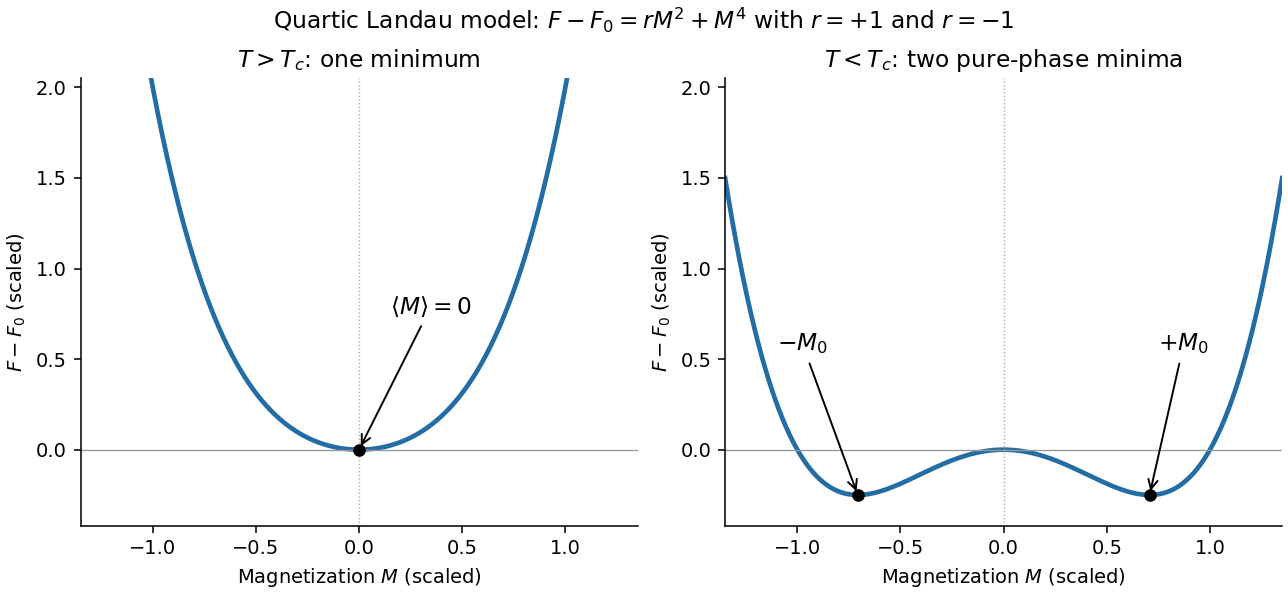
Quartic Landau free energy above and below the transition, showing the disordered and symmetry-broken minima
. Details. 
Minimum free energy and the heat-capacity jump. At a nonzero minimum, . Substituting this value givesHencewhile above the transition. Take the temperature derivatives only after minimizing, so the equilibrium order parameter is allowed to change with temperature. With ,ThereforeThis is the heat-capacity jump in quartic Landau theory. The entropy is continuous at , so there is no latent heat. If denotes free-energy density rather than total free energy, these expressions denote heat capacity per unit volume with the same normalization.
Stabilizing a tricritical expansion. At a tricritical point, the quartic coefficient is tuned to zero at the same point where the quadratic coefficient changes sign. Reversal symmetry still excludes odd powers. The next available stabilizing term is thereforeA negative or vanishing leading sextic coefficient would not stabilize this truncation for large ; a higher positive term would then be needed and the present tricritical form would be insufficient. The ordinary quartic theory has a continuous transition for , while a stabilized theory with can have a first-order transition. Their meeting at zero field is what makes the simultaneous tuning tricritical.
The tricritical minimum. At zero field and , stationarity givesThe nonzero solutions are minima: their curvature is . Put . Since at stationarity,ThusThe order parameter now vanishes as rather than the quartic theory's square root.
Heat-capacity singularity. Define , so the ordered-side singular free energy is . Its derivatives areConsequentlyThis is the tricritical heat-capacity amplitude in a sextic Landau expansion. It is positive on the ordered side and diverges as , rather than remaining a finite jump. This value of the heat-capacity critical exponent is the mean-field result along the path keeping the quartic term zero; a detuning to ultimately restores ordinary quartic behavior. Fluctuation corrections to the mean-field theory are not included in the stipulated polynomial minimization.
New to topics? Read the docs here!