Power iteration failure cases
ID: power-iteration-failure-cases

A tied largest modulus can prevent even direction convergence. With and ,The two directions form a cycle; neither is an eigenvector. There is no dominant-modulus spectral gap. A tied modulus is not a universal failure: an initial eigenvector remains on its line, and preserves every direction. Subspace iteration addresses a separated cluster by targeting a dominant invariant subspace instead of one eigenvector.
An orthogonal start can fail despite a strict spectral gap. For and , the dominant component is zero, so and every iterate equals . The Rayleigh quotient is exactly and the eigenpair residual is zero, although the dominant eigenvalue is . Exact arithmetic never creates a missing component.[ref]
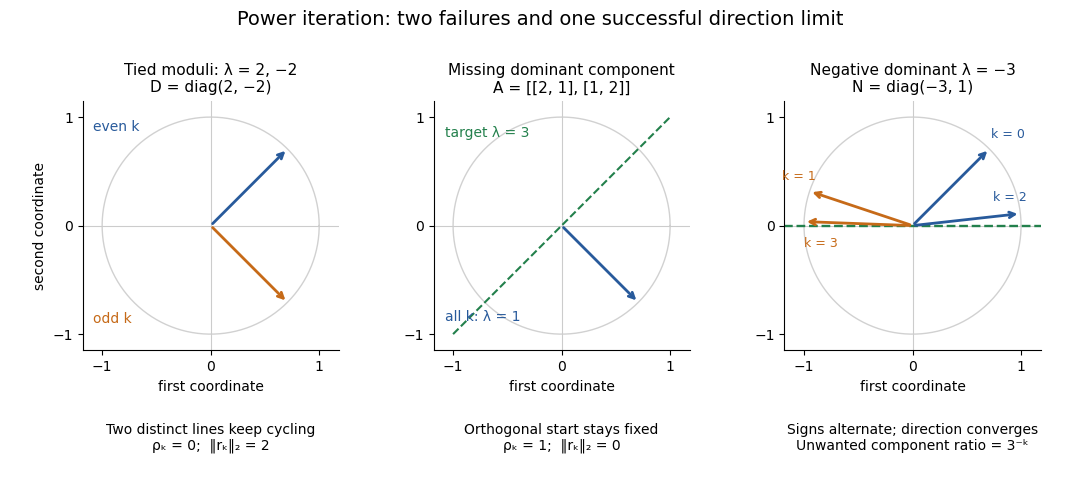

The third panel contrasts these failures with , , for whichHere the horizontal eigenvector direction converges with a strict spectral gap, while the normalized vectors alternate signs. This is the successful direction convergence described under sign and phase in power iteration.
For a nonorthogonal eigenbasis, even the word “orthogonal” must be used carefully. The diagonalizable matrix has right eigenvectors , , and dominant left eigenvector . For , the dominant coefficient is . The starting vector is nonorthogonal to but stays at the smaller eigenvalue ; is orthogonal to but has and converges to the dominant direction. The left eigenvector test, not the right-eigenvector inner product, controls the outcome.
A random vector drawn from a continuous probability distribution with a probability density function on the full real or complex vector space has with probability one. This avoids the exact missing-component hyperplane, but does not guarantee a large component or fast convergence. Floating-point arithmetic may seed a missing component, yet a structurally preserved zero can remain zero, so accidental perturbations are not a convergence guarantee.
New to topics? Read the docs here!