Primary standard inventory
ID: primary-standard-inventory

Let be the transferred sample mass, the known mass fraction of the intended chemical compound, and its molar mass. In a model with complete dissolution and chemically inactive impurities,The purity fraction is dimensionless: would mean , not . These equations assume that the impurity contributes no titrant demand; an impurity that also reacts needs its own inventory equation. The value of must refer to the same preparation state as , for example the specified dry material. A mass fraction assigned before unaccounted uptake of water cannot simply be used after it.
For an original worked example, stipulate pure potassium hydrogen phthalate, abbreviated KHP, so , a selected mass , and rounded molar mass . The NIST Chemistry WebBook lists formula and molecular weight , consistent with the rounded molar mass used here.[ref]
potassium hydrogen phthalate. NIST Chemistry WebBook, SRD 69, potassium hydrogen phthalate, CAS 877-24-7; Formula and Molecular weight fields
The selected mass, purity assumption and volumes in this example are chosen inputs, not measured results or a claim about a real batch's purity.The acid-bearing anion of potassium hydrogen phthalate loses one proton to hydroxide. The net chemical equation isThus sodium hydroxide has one-to-one stoichiometry with potassium hydrogen phthalate in this neutralization, givingChoose a delivered endpoint titre of and matched titration blank of . ThenThe extra displayed digits show the arithmetic of the stipulated model; they do not establish experimental accuracy. A compact rounded result is .
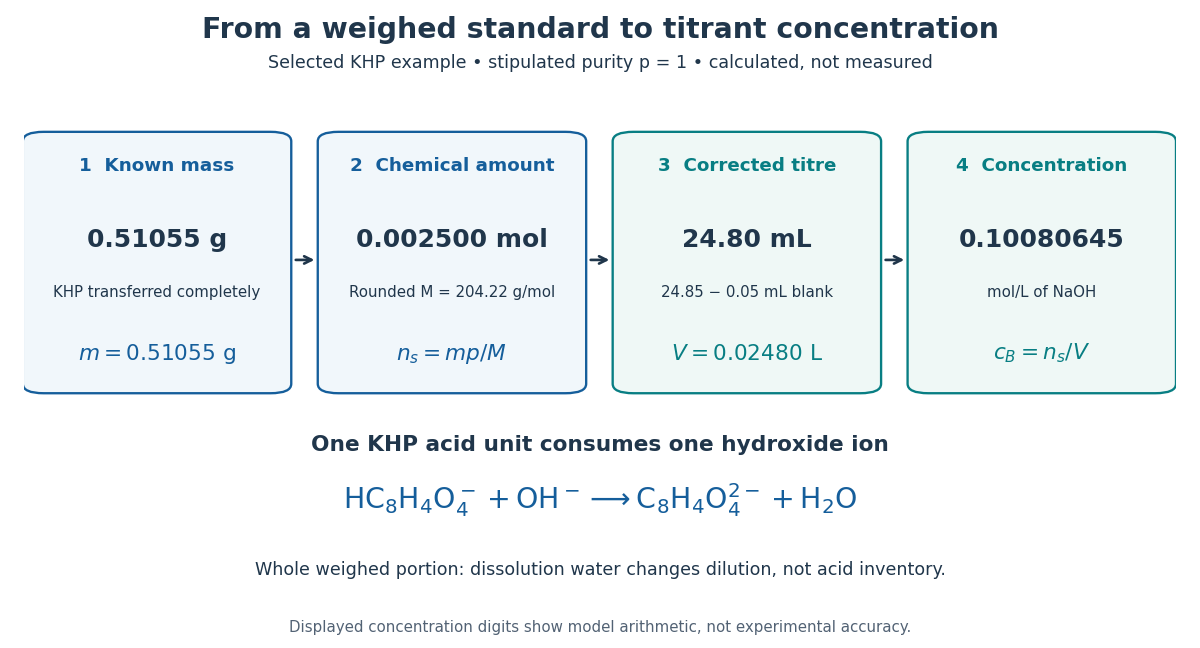
A primary standard connects known mass to amount of substance, corrected titre, and titrant concentration
. Original calculated inventory diagram for selected potassium hydrogen phthalate, stipulated , rounded molar mass , and one-to-one sodium hydroxide neutralization. The endpoint and matched titration blank are chosen examples, not observations. Details.
When the entire weighed portion is titrated, added water changes concentration and the pH path but preserves the initial acid inventory. The dissolution volume therefore does not appear in . If instead a volumetric flask prepares a stock and a volumetric pipette selects an aliquot, the selected inventory is for homogeneous stock, with delivered aliquot volume and final stock volume . The same bookkeeping explains why complete transfer matters even when the amount of dissolution water is approximate.
New to topics? Read the docs here!