SEC molar mass calibration
ID: sec-molar-mass-calibration

SEC molar mass calibration measures standards under the same column, solvent, and temperature conditions as the unknown. Over a suitable fractionation interval, a common empirical approximation iswhere specifies the molar mass unit and has inverse-volume units. Interpolation is conditional on the standards' size–molar mass relationship. SEC measures access associated with hydrodynamic size, so a branched polymer, an extended chain, and a compact protein need not share that relationship.
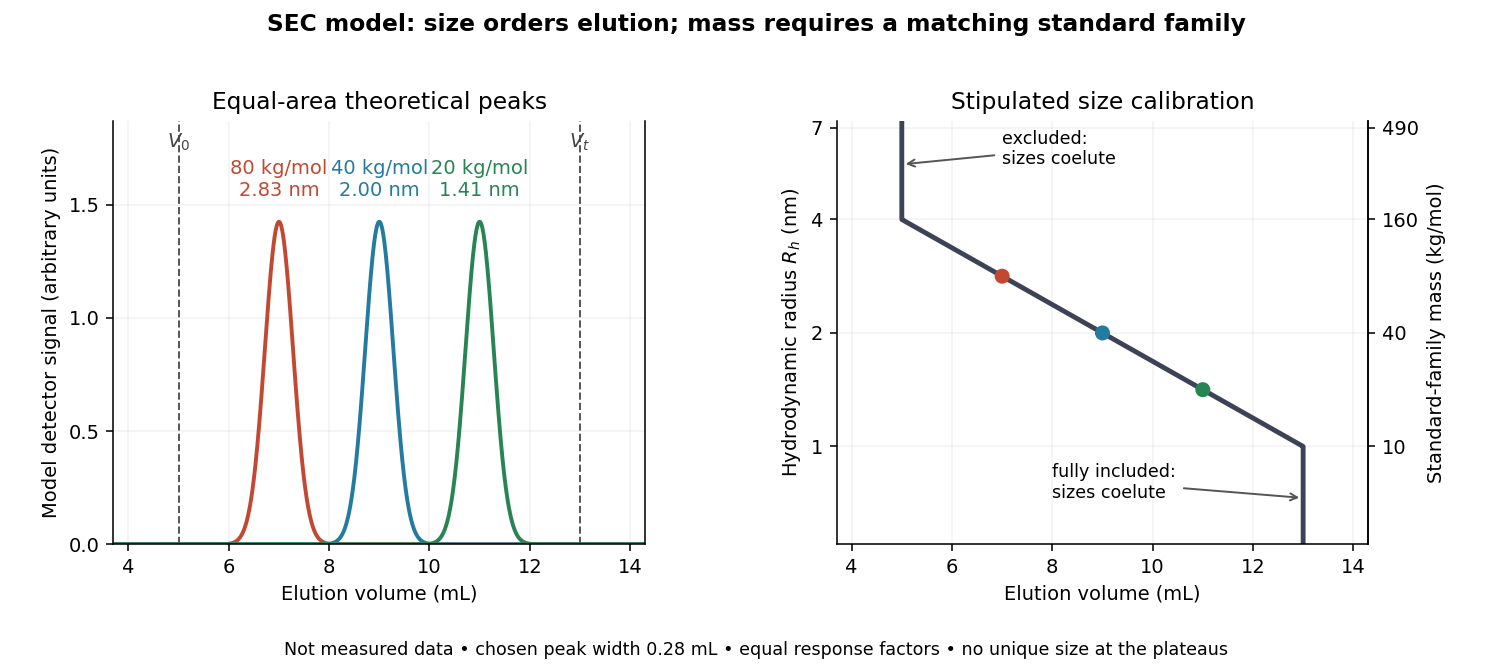

In this model the , , and standards have hydrodynamic radii , , and and elute at , , and . An unknown at would be assigned by this calibration. But a species that expands from to elutes at and is assigned without gaining any mass. The numbers demonstrate ambiguity, rather than predict a real unfolding transition.
Changes in conformational isomerism, protein folding, protein denaturation, and protein aggregation can therefore shift peaks. Association usually increases size; compaction can reduce size at unchanged molar mass. Adsorption creates a different ambiguity: delayed elution need not indicate a smaller species. A different solvent can change both polymer coil dimensions and interactions with the packing. The SEC protein conformation experiment tests these alternatives with additional detectors.
New to topics? Read the docs here!