Solubility product and material balance
ID: solubility-product-and-material-balance

A solubility product constrains a product of thermodynamic activities; the available inventories determine which combinations of concentrations are possible. Their intersection determines the molar solubility. Consider an original, abstract AB solid, with the preceding one-to-one dissolution chemical equation. Stipulate , and at fixed temperature and pressure. Thus is dimensionless. These are chosen model parameters, not data for an identified material.
Initially, a completely dissociated soluble XB salt supplies B anions at molar concentration and X cations at the same molar concentration; A is absent. All three ions have unit electric charge magnitude. X remains a spectator ion, and only AB can form a solid. Assume constant volume, no additional chemical reactions, and negligible contributions from self-ionization of water. Dissolving AB raises both reacting-ion concentrations by the same :Charge neutrality is satisfied: . Adding B alone without its accompanying cation would omit the initial electric charge balance.
In the plane of the two reacting-ion concentrations, this inventory constraint is the line . Saturation supplies the hyperbola for . Their positive intersection solves a quadratic equation:The quadratic formula supplies two roots of a polynomial; only the positive one is a physical concentration. Uniqueness also follows because strictly increases for , starting at zero and growing without bound. The second expression, obtained by multiplying by the conjugate, avoids subtraction of nearly equal numbers at large .
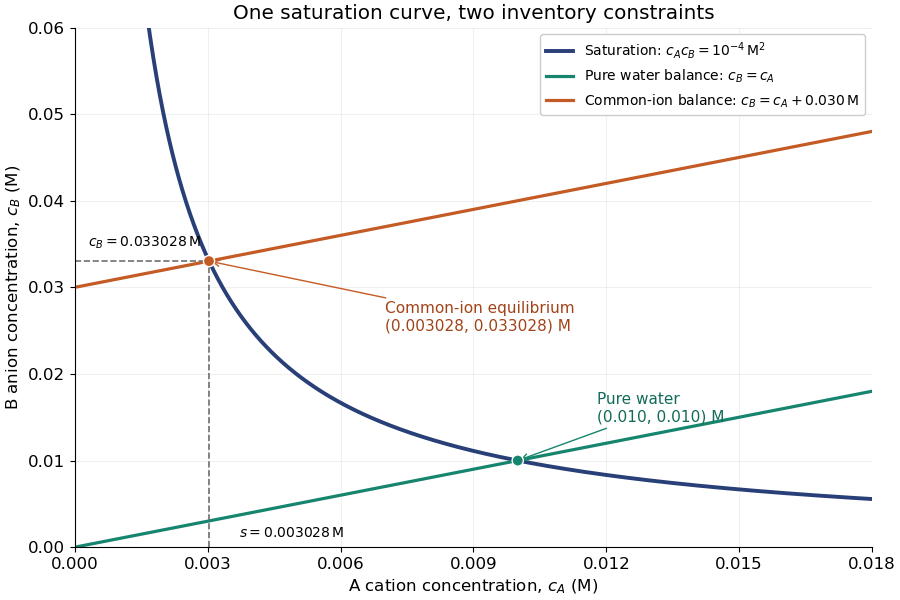
Solubility product and material balance and the conditional solubility product select the dissolved concentrations
. Original stipulated AB model with and unit activity coefficients. Intersections of the saturation hyperbola with inventory lines give the pure-water and common-ion chemical equilibrium compositions. The dashed projections read the intersection; these curves are calculated constraints, not measured data or a time evolution. Details.
For pure water, gives . For ,Their product is , although neither concentration equals the pure-water value. This is the useful geometrical distinction: an inventory line and an equilibrium constant specify different constraints.
Check the solid inventory before imposing saturation. If the initially added AB has amount of substance in volume , the saturated branch requires for excess solid to remain. For example, choose and . In pure water, dissolves and the same amount of substance remains as solid. At , approximately dissolves, leaving as solid. In this model, an insufficient supply instead givesIf , all AB dissolves and the ion product is below the solubility product. At , the last solid disappears exactly at saturation.
New to topics? Read the docs here!