The solubility product is the equilibrium constant for dissolution of a specified solid into its dissolved ions. For a pure bulk AB solid at the chosen temperature, pressure and standard states,The pure bulk solid's thermodynamic activity is one in this convention. Coexisting solid and chemical solution at chemical equilibrium give this equality. If all available solid dissolves, the final chemical solution may instead be undersaturated; do not impose equality merely because a salt was initially added.[ref]
15.1 Precipitation and Dissolution. Chemistry 2e, §15.1, The Solubility Product: saturated solution with excess solid and dissolution equilibrium
Using the thermodynamic activity definition , with activity coefficients and reference molar concentration , gives the independent conversionThus is dimensionless, while the conditional concentration form has units for this one-to-one model. Treating as constant requires a justified fixed or approximately fixed activity coefficient product. Changing ionic strength can change that product even at fixed temperature; changing temperature can change the equilibrium constant itself. Specify the solid thermodynamic phase too: different crystal polymorphs need not have the same solubility product.
The ion product evaluates the same dissolved-ion thermodynamic activity product as the solubility product, but at the current composition rather than necessarily at chemical equilibrium. For AB, ; its concentration counterpart is . Compare with only under compatible activity coefficient assumptions.[ref]
15.1 Precipitation and Dissolution. Chemistry 2e, §15.1, Predicting Precipitation: comparison of reaction quotient and solubility product
For other stoichiometries, use the dissolution coefficients as powers: gives . A solubility product is not itself the molar concentration dissolved; even in the ideal AB model in pure water, that concentration is .
Relative to the specified solid, favors dissolution if that solid is available; favors precipitation; equality marks saturation. These comparisons identify a driving direction favored by thermodynamics, not a reaction rate.[ref]
15.1 Precipitation and Dissolution. Chemistry 2e, §15.1, Predicting Precipitation: unsaturated, saturated and supersaturated cases
A proof outline comes from the reaction Gibbs free energy for dissolution:Here is the molar gas constant and the absolute temperature. If , the logarithm is positive, making the reverse transfer into solid favorable. At equality the bulk driving difference vanishes. Equality can also occur at the boundary where the last solid disappears, but it is not a universal constraint on every solid-free chemical solution.
A supersaturated solution has an ion product above the relevant solubility product. It can persist through metastability: nucleation must first create a sufficiently large new solid region. Added surfaces, impurities and mixing history can affect that barrier. Therefore a clear sample during a finite observation does not prove undersaturation, and visible cloudiness does not measure the ion product.
Consider an original toy AB salt model with stipulated at fixed temperature and fixed activity coefficient product. This is a conditional concentration constant, not measured data for calcium carbonate or any identified material. A stock contains A cations and X anions; another contains Y cations and B anions. All four ions have unit electric charge magnitude. Only AB can form a solid; X and Y remain spectator ions. Assume full dissociation, no other chemical reactions, and a mixed volume equal to the sum of the initial volumes.
Mix two stocks, each of volume ,, each at molar concentration of its indicated salt. Before any precipitation, the mixed volume is , soMultiplying the two stock concentrations would overestimate the mixed ion product by a factor of four. The saturation threshold is .
If , mixing gives : no AB precipitate is favored. If , mixing gives . Suppose nucleation occurs and bulk AB solid remains at chemical equilibrium. Equal starting inventories and one-to-one stoichiometry require equal remaining concentrations, henceFor two portions in the second case, each reacting ion starts with ; the final chemical solution retains of each, and of AB enters the solid. The respective X and Y inventories stay at . Exactly half of each reacting inventory precipitates in this toy model.
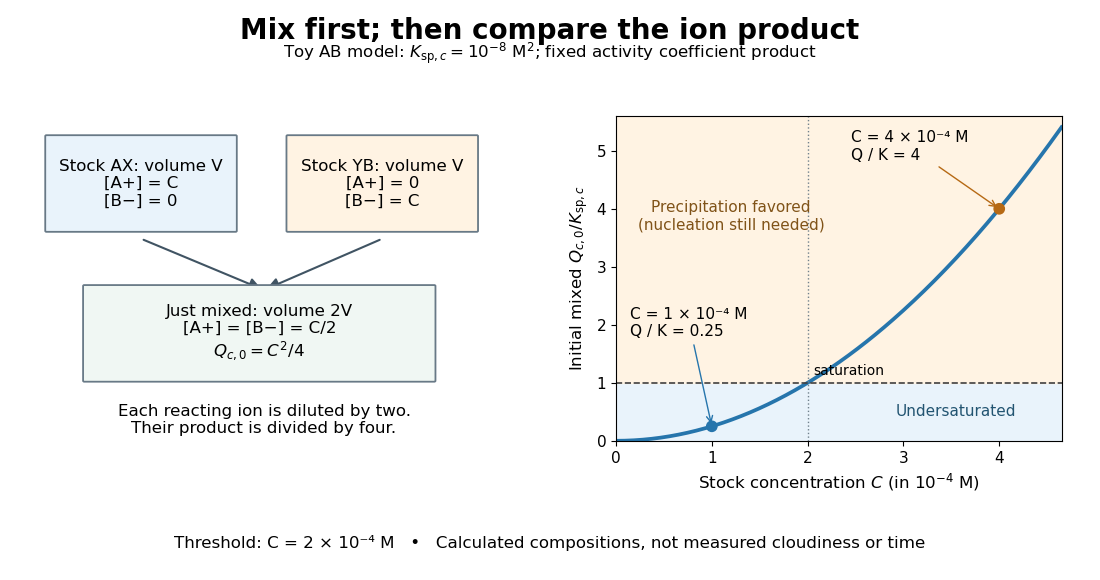

The chemical equilibrium calculation adds a phase constraint to the inventory balance. Write and . In the equilibrated bulk model,When , the last condition requires saturation; when , the inventory can leave an undersaturated chemical solution. Together these give . This excludes a persistent supersaturated solution by its explicit chemical equilibrium assumption; it does not model a nucleation delay.
Articles by others on the same topic
There are currently no matching articles.