Thermodynamic free energy
ID: thermodynamic-free-energy

A free energy is a thermodynamic potential that compares possible states under specified environmental constraints. For a closed system of fixed composition, treated as a simple compressible system with only pressure-volume work, stable thermodynamic equilibrium minimizes Helmholtz free energy at fixed temperature and volume, or Gibbs free energy at fixed temperature and pressure. The choice follows the experiment: a rigid sealed vessel and a sealed cylinder with a freely moving loaded piston impose different constraints. Both may exchange heat with a thermal reservoir. See W. C. Carter, MIT thermodynamics notes, sections 2-1.14 and 2-1.19.
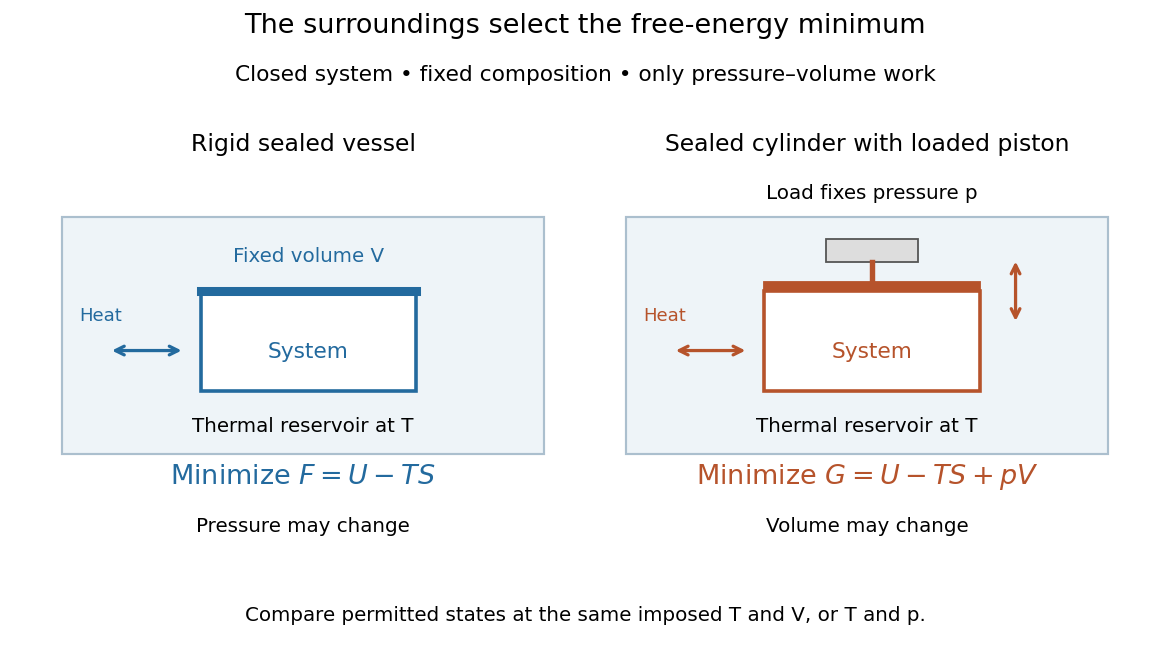
Choose Helmholtz free energy for fixed temperature and volume, or Gibbs free energy for fixed temperature and pressure
. Original schematic of two closed vessels in contact with a thermal reservoir. Composition is fixed, and only pressure-volume work is allowed. The right piston permits the volume to change. Details.The useful insight is that internal energy alone cannot rank these alternatives: exchanging heat also changes the surroundings' entropy. Subtracting packages that accounting into a property of the chosen system. Adding additionally accounts for displacing the surroundings at fixed pressure. A free energy is a state function; supplied heat describes a transfer during a process. Under the stated constraints, supplied heat is at fixed volume or at fixed pressure, whereas neither nor generally equals .
A lower free energy identifies a thermodynamic preference, without specifying a timescale. A barrier can trap a system in a local minimum, producing metastability although a lower global minimum exists. The enzyme example illustrates the corresponding distinction for chemical reactions: changing the route can change the reaction rate while preserving the endpoint Gibbs free energy difference and chemical equilibrium.


Thermodynamic free energy is a concept in thermodynamics that quantifies the amount of work that can be extracted from a system at constant temperature and pressure. It provides a useful measure to determine the spontaneity of processes and the equilibrium state of systems. There are two commonly used forms of free energy: 1. **Gibbs Free Energy (G)**: This is used for systems at constant temperature (T) and pressure (P).
New to topics? Read the docs here!