
Differential gravitational acceleration, multiplied by the affected mass, across a spatially extended body. In the linear approximation the acceleration difference is , where is the tidal tensor. Stellar tidal forces limit the domain of a circumplanetary orbit; sufficiently strong ones can produce tidal disruption.
To isolate a tidal force, subtract the gravitational acceleration shared by the body as a whole. Let a reference test particle follow , and let another have position . In a translating accelerated reference frame with parallel, nonrotating axes,for a source point mass, when . Here is its standard gravitational parameter and the last term uses Big O notation. This Taylor expansion removes the common inward pull and keeps the spatial variation. The near side has an excess pull toward the source; the far side has a deficit of inward pull, which is an outward relative acceleration. Both sides can stretch apart while both still accelerate toward the source.[ref]
Chapter 7: The Theory of Gravitation. §7–4, discussion of stronger near-side and weaker far-side attraction
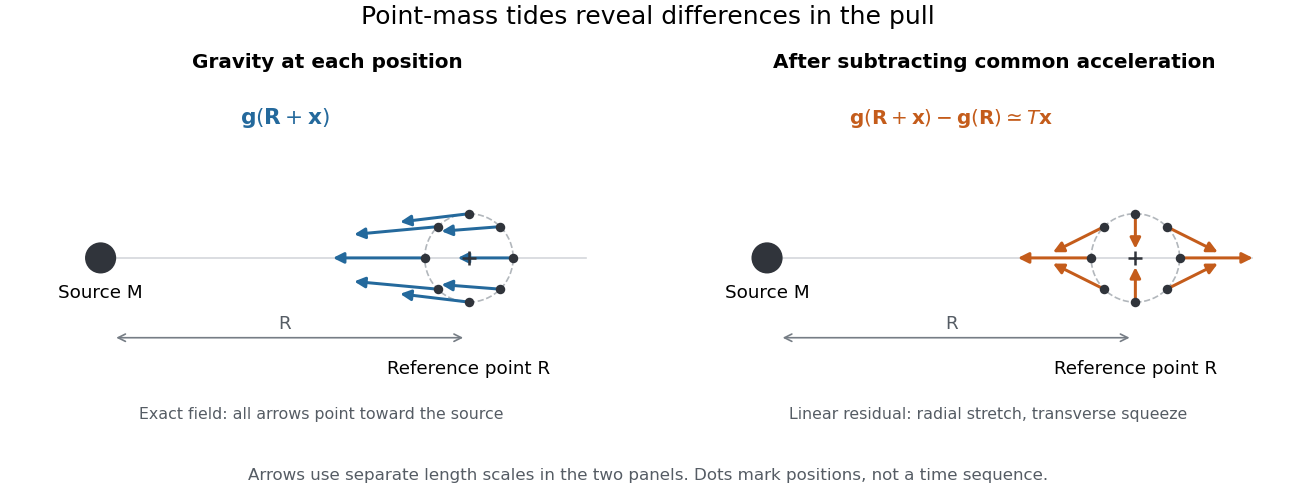
Subtracting common gravitational acceleration reveals radial stretching and transverse squeezing
. Blue arrows show the exact Newtonian gravitational field at several positions near a reference point. Orange arrows show its linear residual, calculated with the tidal tensor. Arrow lengths use separate scales in the two panels; this is a comparison of direction and spatial variation, not two equal-magnitude fields. Details.For a material element of mass , the residual external force in this translating accelerated reference frame is . Actual deformation also depends on elasticity, pressure and self-gravity. A rigid body approximation suppresses deformation but can still have internal forces that resist the tidal force. The point-mass tidal stretching and squeezing pattern describes freely falling, noninteracting test particles, rather than promising the same shape for every solid, star or ocean. A rotating reference frame introduces centrifugal acceleration and Coriolis acceleration, which must be included separately.


Tidal force refers to the gravitational effect that one celestial body exerts on another due to the differential gravitational pull exerted on different parts of the object being influenced. This force arises from the fact that the gravitational attraction of a massive body, like the Moon or the Sun, varies with distance.
New to topics? Read the docs here!